Back to the on-screen lesson ·
Torques between the parts of a system pass angular momentum from one part to another, while kinetic energy can be dissipated or supplied.
Paper packet. Every task here also exists on screen, where it is checked automatically; answers written on paper are not assessed by Nydus. When you are back at a device, enter your answers there.
By the end of this lesson you will be able to track angular momentum and energy between the parts of a system, for clutches, walkers, doors and spacecraft.
You can apply conservation of angular momentum to a whole system, and compute rotational kinetic energy. This lesson looks inside the system, following angular momentum and energy as they pass between its parts.
| Term | What it means |
|---|---|
| Clutch | A device that presses two turning parts together so they turn as one. |
| Internal torque | A torque one part of a system exerts on another. |
| Angular momentum transfer | Passing angular momentum from one part to another. |
| Dissipation | Turning kinetic energy into heat, as in a slipping clutch. |
| Reaction wheel | A wheel a spacecraft spins to turn its body the opposite way. |
| Rotational collision | An impact that changes objects' rotation, such as putty striking a door. |
When parts of a system twist each other, the torques are equal and opposite. One part gains exactly the angular momentum the other loses:
$$\Delta L_A = -\Delta L_B.$$
Keep separate accounts for each part and for the total.
Another way: picture
Picture standing on a turntable holding a spinning bicycle wheel above your head. Flip the wheel upside down and you start to turn. Your hands twisted the wheel, and the wheel twisted you back, handing you angular momentum. The total, you plus the wheel, never changed.
Another way: steps
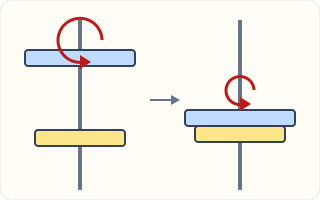
The figure shows two disks on one shaft. The upper disk spins; the lower one is still. When the clutch presses them together, friction between them twists the lower disk forward and the upper disk backward, until they turn together.
The torques are equal and opposite, so the angular momentum the upper disk loses is exactly what the lower disk gains. The pair turns more slowly than the upper disk did alone, because the same angular momentum now spins more inertia.
While the clutch plates slip against each other, kinetic friction turns kinetic energy into heat. The fraction lost is $I_B/(I_A + I_B)$, the still disk's share of the total inertia. Equal disks lose half the energy.
This is the rotational version of a sticking collision: momentum is shared, energy is not conserved. Car clutches get hot for exactly this reason, especially when a driver lets the clutch slip while starting on a hill.
A person standing on a still turntable starts walking along its rim. Their feet push backward on the turntable, and it pushes them forward. The turntable turns backward while the person moves forward, and the total angular momentum stays zero.
Here kinetic energy is not lost but created: both the person and the turntable start moving. The energy comes from the person's muscles, chemical energy converted to motion.
A classic demonstration: a student sits on a rotating stool holding a spinning bicycle wheel with its axle vertical. Flipping the wheel upside down reverses its angular momentum. To keep the total fixed, the student and stool must start turning with twice the wheel's original angular momentum.
The torque comes from the student's hands twisting the axle; the wheel twists back. Nothing outside the student-stool-wheel system is involved.
When putty strikes a door and sticks, its angular momentum about the hinge, $mvL$, becomes the angular momentum of door plus putty. The hinge's force passes through the axis, so it exerts no torque, and angular momentum is conserved about the hinge.
Linear momentum, however, is not conserved, because the hinge pushes on the door during the impact. Choosing the hinge as the axis is what makes the problem solvable.
Checking an answer. Each part's change must be equal and opposite to the others'. A clutch must lose energy; a walker must add it. The total angular momentum must match before and after.
Internal torques come in pairs by Newton's third law: the torque of part A on part B equals and opposes the torque of B on A. So the changes in their angular momenta cancel, and the total cannot change.
Energy has no such rule. Internal forces can do net work, either positive, as muscles do, or negative, as friction does, so kinetic energy can rise or fall while angular momentum stays fixed.
Spacecraft use reaction wheels to turn without fuel. Spinning a wheel one way passes angular momentum to it; the spacecraft's body gains equal angular momentum the other way and turns slowly.
Stopping the wheel returns the angular momentum and stops the body's rotation. The Hubble Space Telescope points this way, holding targets steady for hours. Over time, small outside torques build up in the wheels, which magnetic torquers or thrusters must remove.
In a manual transmission car, the clutch connects the spinning engine to the still wheels. Letting it out smoothly lets the plates slip while angular momentum flows from engine to wheels, with some energy lost as heat.
Automatic transmissions use a fluid coupling instead, which also dissipates energy while passing torque. Designers balance smoothness against the energy lost and the heat produced.
When you stop a spinning merry-go-round by planting your feet and grabbing a rail, angular momentum seems to vanish. It has passed into Earth through your feet. With Earth inside the system, the total is conserved.
Because Earth's rotational inertia is enormous, the change in its spin is immeasurably small. The same happens every time a car accelerates or a helicopter lands: Earth absorbs the angular momentum without any detectable change.
A helicopter's engine applies torque to the rotor, passing angular momentum to it. The rotor pushes back on the engine and body with an equal torque, which would spin the body the other way.
The tail rotor pushes against the air to provide an outside torque, so the body stays pointed. Twin-rotor designs cancel the two rotors' angular momenta against each other, and need no tail rotor.
When one gear drives another, the teeth push with equal and opposite forces. The gears exchange angular momentum through their contact, but each is also held by an axle, which applies outside forces.
For gears on a fixed frame, the frame itself exchanges angular momentum with them. That is why a powerful electric drill twists in your hand as its motor speeds up: your hand supplies the reaction torque.
Good bookkeeping tracks angular momentum and energy separately. For angular momentum, write each part's value before and after and check the totals match. For energy, compute each part's kinetic energy and note any difference.
A table with columns for each part, and rows for before and after, makes both accounts clear, and quickly shows whether energy was lost to heat or supplied by muscles or motors.
The energy a clutch turns into heat can be large. A car engine's flywheel and clutch at a few thousand rpm store thousands of joules, and repeatedly slipping the clutch while creeping in traffic can overheat it.
The fraction lost depends only on the ratio of the inertias, not on the speed. A light disk clutched onto a heavy one wastes most of the energy; a heavy disk clutched onto a light one wastes little.
Transfers are easiest to follow with a clear sign convention. Choose one sense of turning as positive, often the direction the first part spins, and give every angular momentum a sign. A part that turns the opposite way then carries a negative value.
With signs in place, a transfer shows up as one part's value falling while another's rises by the same amount. When a person on a still turntable starts walking, the person's positive angular momentum is exactly matched by the turntable's negative one, and the sum stays at zero throughout.
Angular momentum moves between parts of machines all the time. A washing machine's drum and its motor trade it as the spin cycle starts and stops, and the machine's frame and the floor absorb what is left over, which is why an unbalanced load can make the whole appliance shake and walk across the room.
NASA's space telescopes must point at faint targets and hold steady for hours. Firing thrusters would use fuel and shake the instruments, so they turn with reaction wheels instead: heavy wheels inside the spacecraft that motors spin up or slow down.
Spinning a wheel one way passes angular momentum to it, and the body turns the other way, slowly and smoothly. Stopping the wheel stops the turn. The total angular momentum of spacecraft plus wheels never changes, so the maneuver needs only electric power from the solar panels. When small outside torques from sunlight or Earth's magnetic field build up, the wheels spin faster to absorb them, and magnetic torquers periodically dump the excess.
Drivers of manual-transmission cars and trucks work a clutch every time they shift. With the clutch pedal down, the engine spins freely. Letting the pedal up presses a friction disk against the engine's flywheel, passing angular momentum from the engine to the drive shaft.
While the plates slip, kinetic energy becomes heat, exactly as in the two-disk clutch. Smooth drivers keep the slipping brief. Riding the clutch on a steep hill or in stop-and-go traffic keeps the plates slipping, heating and wearing them. Mechanics can tell from a glazed, overheated clutch disk how much energy it has been asked to dissipate.
When a clutch slows the spinning disk, it is tempting to say its angular momentum was lost to friction. It was not lost; it passed to the other disk, which now turns. Only kinetic energy was lost, as heat.
A related error is to think a person on a still turntable cannot start moving without pushing on something outside. They push on the turntable, which turns the other way, and the total angular momentum stays zero.
A disk with $I = 3.0$ kg·m² spins at $40$ rad/s; a disk with $I = 1.0$ kg·m² is still. Find the total angular momentum.
$L = 3.0 \times 40 = 120\ \text{kg·m}^2\text{/s}$
First disk only.
Find the shared angular velocity.
$\omega = \dfrac{120}{4.0} = 30\ \text{rad/s}$
Total over total inertia.
Find the first disk's change in angular momentum.
$\Delta L_A = 3.0 \times 30 - 120 = -30$
It loses some.
Find the second disk's change.
$\Delta L_B = 1.0 \times 30 - 0 = +30$
It gains the same.
Find the energy lost.
$\tfrac{1}{2} \times 3.0 \times 40^2 - \tfrac{1}{2} \times 4.0 \times 30^2 = 600\ \text{J}$
A quarter of $2400$ J.
A $60$ kg person stands on the rim of a still turntable with $I = 360$ kg·m², $2.0$ m from the axle. State the total.
$L = 0$
At rest.
The person walks at $1.5$ m/s relative to the ground. Find their angular momentum.
$L_p = 60 \times 1.5 \times 2.0 = 180\ \text{kg·m}^2\text{/s}$
$mvR$.
Find the turntable's angular momentum.
$L_t = -180\ \text{kg·m}^2\text{/s}$
Equal and opposite.
Find the turntable's spin.
$\omega = \dfrac{180}{360} = 0.5\ \text{rad/s}$
Opposite to the walker.
Find the total kinetic energy.
$\tfrac{1}{2} \times 60 \times 1.5^2 + \tfrac{1}{2} \times 360 \times 0.5^2 = 112.5\ \text{J}$
From the muscles.
Describe what happens when the person stops.
$\text{the turntable stops too}$
Total returns to zero.
A $0.40$ kg lump of putty at $15$ m/s hits the edge of a $20$ kg door $1.2$ m wide and sticks. Find its angular momentum about the hinge.
$L = 0.40 \times 15 \times 1.2 = 7.2\ \text{kg·m}^2\text{/s}$
$mvL$.
Find the door's rotational inertia.
$I_d = \tfrac{1}{3} \times 20 \times 1.2^2 = 9.6\ \text{kg·m}^2$
Rod about one end.
Find the putty's inertia at the edge.
$I_p = 0.40 \times 1.2^2 = 0.576\ \text{kg·m}^2$
Point mass.
Find the total inertia.
$I = 9.6 + 0.576 = 10.176\ \text{kg·m}^2$
Door plus putty.
Find the angular velocity.
$\omega = \dfrac{7.2}{10.176} = 0.708\ \text{rad/s}$
Angular momentum conserved.
Find the putty's kinetic energy before.
$K_i = \tfrac{1}{2} \times 0.40 \times 15^2 = 45\ \text{J}$
Before impact.
Find the kinetic energy after.
$K_f = \tfrac{1}{2} \times 10.176 \times 0.708^2 = 2.55\ \text{J}$
Most is lost.
Find the total angular momentum.
$L = 4.0 \times 10 = 40\ \text{kg·m}^2\text{/s}$
First disk only.
Divide by the total inertia.
$\omega = \dfrac{40}{5.0}$
Both disks.
Evaluate the angular velocity.
A disk with rotational inertia $1.5$ kg·m² spins at $40$ rad/s on a frictionless shaft. A clutch presses it onto a still disk with rotational inertia $0.5$ kg·m² on the same shaft, and they turn together. What is their shared angular velocity, in rad/s?
Complete the worked solution: a $0.6$ kg lump of putty moving at $8$ m/s strikes the free edge of a still $30$ kg door, $1.2$ m wide, at right angles and sticks. Treating the door as a rod about its hinge, find the putty's angular momentum about the hinge in kg·m²/s, the total rotational inertia afterward in kg·m², and the door's angular velocity in rad/s.
Find the putty's angular momentum.
$L = mvL_{\text{door}} =$ a
Momentum times lever arm.
Find the total rotational inertia.
$I = \tfrac{1}{3}ML^2 + mL^2 =$ i
Door plus putty at the edge.
Find the door's angular velocity.
$\omega = \dfrac{L}{I} =$ w
Angular momentum conserved.
Note what is not conserved.
$\text{kinetic energy}$
The putty sticks.
In each event the total angular momentum of the stated system is unchanged. Match each to what happens to the energy or angular momentum.
| kinetic energy becomes heat in the plates | the muscles' work raises the kinetic energy | both walker and turntable gain kinetic energy from the muscles | the angular momentum passes into Earth | |
|---|---|---|---|---|
| a clutch locking two disks together | ||||
| a skater pulling in the arms | ||||
| a person starting to walk around a still turntable | ||||
| a person standing on the ground stopping a merry-go-round |
A disk with rotational inertia $3$ kg·m² spinning at $18$ rad/s is clutched onto a still disk with rotational inertia $6$ kg·m². Fill in the total angular momentum in kg·m²/s, the shared angular velocity in rad/s, and the kinetic energy turned into heat in J.
| value | |
|---|---|
| total angular momentum (kg·m²/s) | |
| shared angular velocity (rad/s) | |
| energy turned to heat (J) |
A disk with rotational inertia $3$ kg·m², spinning at angular velocity $w$ in rad/s, is clutched onto a still disk with rotational inertia $1$ kg·m². Write the kinetic energy turned into heat, in J, as a function of $w$.
Answer:
A $40$ kg person stands on the rim of a still turntable with rotational inertia $200$ kg·m², $1.5$ m from its frictionless axle, then walks along the rim at $1.5$ m/s relative to the ground. How fast does the turntable turn, in rad/s?
Answer: rad/s
To point its instruments, a navigation satellite with rotational inertia $2000$ kg·m² spins up a reaction wheel with rotational inertia $0.05$ kg·m² from rest to $1500$ rpm. Starting at rest, how fast does the spacecraft's body turn, in degrees per minute?
Answer: °/min
Lesson test: one question per skill, one attempt each, no hints. Your answers are checked when you submit.
A disk with rotational inertia $3$ kg·m², spinning at angular velocity $w$ in rad/s, is clutched onto a still disk with rotational inertia $1$ kg·m². Write the kinetic energy turned into heat, in J, as a function of $w$.
Answer:
You can keep angular momentum and energy accounts for parts of a system. Explain to someone where the angular momentum goes when a clutch slows a spinning disk.
27. Your turn: a disk with $I = 4.0$ kg·m² at $10$ rad/s is clutched onto a still disk with $I = 1.0$ kg·m². What is their shared angular velocity?, step 3
$\omega = 8.0\ \text{rad/s}$
Shared.