Back to the on-screen lesson ·
Torque is force times the perpendicular lever arm; it measures how strongly a force turns an object about an axis.
Paper packet. Every task here also exists on screen, where it is checked automatically; answers written on paper are not assessed by Nydus. When you are back at a device, enter your answers there.
By the end of this lesson you will be able to compute the torque of a force at any angle, find lever arms, and add torques with signs.
You can resolve forces into components and use the sine and cosine of an angle. You know that a net force changes an object's straight-line motion. This lesson introduces torque, which measures how strongly a force turns an object about an axis.
| Term | What it means |
|---|---|
| Torque | The turning effect of a force about an axis, $\tau = rF\sin\theta$. |
| Axis of rotation | The line an object turns about, such as a hinge or axle. |
| Lever arm | The perpendicular distance from the axis to the force's line of action. |
| Line of action | The line along which a force acts, extended in both directions. |
| Newton-meter | The unit of torque, N·m. |
| Pivot | The point about which torques are measured. |
The turning effect of a force about an axis is its torque:
$$\tau = rF\sin\theta = F\ell,$$
where $r$ is the distance from the axis to where the force acts, $\theta$ is the angle between $r$ and the force, and $\ell = r\sin\theta$ is the lever arm.
Another way: picture
Picture opening a heavy door. Push on the handle, far from the hinges, and it swings easily. Push near the hinges and you strain. Push on the edge straight toward the hinges and nothing happens at all, however hard you push, because your force points through the axis.
Another way: steps
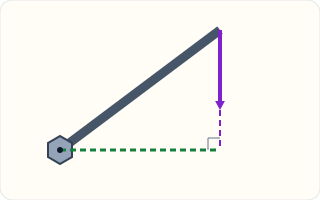
The figure shows a wrench whose handle slopes upward, with a push straight down at its end. The dashed purple line extends the push's line of action, and the green line runs from the bolt's center to meet it at a right angle.
That green line is the lever arm, only eight tenths of the handle's length. The torque is the push times the lever arm, not the push times the handle. Tilting the handle toward the push's direction shrinks the lever arm and the torque.
The same torque can be found two ways. Either multiply the whole force by the lever arm, $F \times r\sin\theta$, or multiply the distance by the part of the force perpendicular to the handle, $r \times F\sin\theta$. Both give $rF\sin\theta$.
Choose whichever is easier to see in the diagram. When the force is vertical and the handle tilted, the lever arm is a horizontal distance. When the handle is horizontal and the force tilted, the perpendicular component is simpler.
Torque has a direction: it tends to turn an object either counterclockwise or clockwise about the axis. By convention, counterclockwise torques are positive and clockwise torques negative, viewed from a chosen side.
When several forces act, the net torque is the sum of their torques with signs. Two children on a seesaw produce opposite torques; if they are equal in size, the net torque is zero and the seesaw does not start to turn.
A force whose line of action passes through the axis has zero lever arm and so produces no torque. Pushing on a door's edge straight toward the hinges does nothing; neither does the hinge's own force on the door.
This is useful when analyzing balance: by choosing the axis where an unknown force acts, that force drops out of the torque equation entirely. The rotational equilibrium lesson relies on this trick.
Torque is measured in newton-meters, N·m. In the United States, mechanics often use pound-feet, about $1.36$ N·m each. A car's lug nuts are tightened to about $100$ to $200$ N·m.
Torque and work both have units of newtons times meters, but they are different quantities. Work uses the distance moved along the force; torque uses the distance perpendicular to it. Torque is never written in joules.
Checking an answer. The torque can never exceed force times the full distance. A force through the axis gives zero. Doubling the distance from the axis doubles the torque for a perpendicular force.
Torque measures how effectively a force changes rotation, just as force measures how it changes straight-line motion. Only the perpendicular part of a force can swing a point around the axis; the part along the radius just pushes or pulls on the axle.
The torque formula $rF\sin\theta$ is the size of the cross product of the position and force vectors. Its direction, along the axis, follows the right-hand rule, which a later course develops.
A lever multiplies force by using torque. A small force on a long arm balances a large force on a short arm, because the torques are equal. A crowbar, a pair of pliers and a wheelbarrow all work this way.
The trade-off is distance: the long end moves farther than the short end. The work in equals the work out, but the force is multiplied by the ratio of the arms. Archimedes claimed that with a long enough lever he could move the Earth.
A car engine's power reaches the wheels as torque on the axles. Engines are rated by maximum torque as well as horsepower. Electric motors produce their full torque from a standstill, which is why electric cars accelerate so quickly from a stop.
Gears trade torque for speed. In first gear, the transmission multiplies the engine's torque for strong acceleration at low speed; in higher gears, it gives less torque but faster wheel rotation for highway cruising.
A cyclist pushes down on the pedals, but the torque on the crank depends on the crank's angle. With the crank horizontal, the lever arm is the full crank length and the torque is greatest. With it vertical, the push passes through the axle and gives no torque, the dead spot.
Clip-in pedals let riders pull up and push forward too, keeping torque on the crank through more of each turn. Power meters on racing bikes measure the torque hundreds of times per second.
Your muscles work through torques about your joints. The biceps attaches only a few centimeters from the elbow, while a weight in the hand is about thirty centimeters away, so the biceps must pull with many times the weight to hold it.
That is why lifting with a straight back and the load close to the body is safer: a short lever arm for the load means a smaller torque about the lower back, and less strain on its muscles and discs.
Bolts on engines, wheels and aircraft must be tightened to a precise torque: too loose and they vibrate free; too tight and they stretch or strip. A torque wrench clicks or bends to show when the set torque is reached.
Because torque is force times lever arm, a torque wrench's reading depends on gripping its handle where it is designed to be held. Pushing farther out would give a larger torque than the dial shows.
Everyday torques are easy to estimate. Opening a door with $10$ N at $0.8$ m takes $8$ N·m. Turning a stiff jar lid with about $30$ N on a $4$ cm radius takes about $1.2$ N·m. A child on a seesaw produces several hundred newton-meters.
Such estimates catch errors. A lug nut specification of $150$ N·m, reached with a bar $0.4$ m long, needs a push of about $375$ N, a firm shove but no more than a person's weight.
Torque is always measured about a particular axis, and the same force has different torques about different axes. A push on a door has a large torque about the hinges and none about a point on its own line of action.
For an object that is actually turning about a fixed hinge or axle, use that axis. For an object that is not turning, any axis may be chosen, and a clever choice, through the point where an unknown force acts, removes that force from the equation.
Every car's owner's manual lists a lug nut torque, typically $100$ to $200$ N·m, about $75$ to $150$ pound-feet. Too little and the wheel can work loose; too much and the studs stretch or the brake rotors warp. Tire shops across the country use calibrated torque wrenches for the final tightening.
At the roadside, a driver with the short lug wrench from the trunk may struggle to loosen a nut, because its lever arm is short. A longer breaker bar reduces the force needed in proportion to its length. Pushing at right angles to the bar gives the full lever arm; pushing at a slant wastes effort. Standing on the end of a horizontal bar lets body weight supply the force, a trick roadside assistance crews use every day.
The Americans with Disabilities Act limits the force needed to open interior doors in public buildings to about $22$ N, five pounds, measured at the handle. Designers meet this by placing handles far from the hinges and using door closers with adjustable torque.
Push plates and lever handles near the free edge give the largest lever arm, so a person using a wheelchair can open the door with a small push. Automatic doors avoid the problem entirely, but most doors rely on torque: a heavy fire door with a strong closer might need $30$ N·m, which at $0.8$ m from the hinges is about $37$ N, while pushed near the hinges it would need several times as much.
It is natural to multiply a force by the length of the wrench or door it acts on. That is right only when the force is perpendicular to the handle. For a slanted force, the lever arm is the perpendicular distance from the axis to the force's line, which is shorter.
A related error is to think a bigger force always turns an object more. A huge force aimed straight at the hinges gives no torque at all, while a small force far out at right angles turns the door easily.
A $40$ N push acts at right angles to a door, $0.90$ m from the hinges. Find the torque.
$\tau = 40 \times 0.90 = 36\ \text{N·m}$
Perpendicular push.
The same push acts $0.30$ m from the hinges. Find the torque.
$\tau = 40 \times 0.30 = 12\ \text{N·m}$
A third of the lever arm.
Find the force needed there for $36$ N·m.
$F = \dfrac{36}{0.30} = 120\ \text{N}$
Three times the push.
The push at $0.90$ m is at $30°$ to the door. Find the torque.
$\tau = 0.90 \times 40 \times \sin 30° = 18\ \text{N·m}$
Only the perpendicular part.
Find the torque of a push toward the hinges.
$\tau = 0$
Through the axis.
A $30$ kg child sits $1.5$ m left of a seesaw's pivot. Find the weight.
$W = 30 \times 9.8 = 294\ \text{N}$
Pointing down.
Find the torque about the pivot.
$\tau_1 = 294 \times 1.5 = 441\ \text{N·m}$
Counterclockwise, positive.
A $45$ kg child sits $1.2$ m right. Find the torque.
$\tau_2 = -45 \times 9.8 \times 1.2 = -529.2\ \text{N·m}$
Clockwise, negative.
Find the net torque.
$\tau = 441 - 529.2 = -88.2\ \text{N·m}$
Net clockwise.
Describe which way it turns.
$\text{the right side goes down}$
Clockwise.
Find where the heavier child should sit to balance.
$x = \dfrac{441}{45 \times 9.8} = 1.0\ \text{m}$
Zero net torque.
A $0.25$ m wrench handle points right; a $200$ N push acts downward at its end, with the handle at $37°$ above the horizontal. Find the angle between handle and push.
$\theta = 90° + 37° = 127°$
Handle up, push down.
Find the sine of that angle.
$\sin 127° = \sin 53° = 0.80$
Supplementary angles.
Find the lever arm.
$\ell = 0.25 \times 0.80 = 0.20\ \text{m}$
Horizontal distance.
Find the torque.
$\tau = 200 \times 0.20 = 40\ \text{N·m}$
Force times lever arm.
Check with the perpendicular component.
$0.25 \times 200 \times 0.80 = 40\ \text{N·m}$
The same.
Find the torque with the handle horizontal.
$\tau = 200 \times 0.25 = 50\ \text{N·m}$
The largest possible.
Find the push needed for $50$ N·m at the tilt.
$F = \dfrac{50}{0.20} = 250\ \text{N}$
Tilting costs force.
Write the torque formula.
$\tau = F\ell$
Perpendicular force.
Substitute the values.
$\tau = 50 \times 0.30$
Newtons times meters.
Evaluate the torque.
A mechanic pushes with $90$ N on the end of a wrench handle $0.35$ m long, at an angle of $70°$ to the handle. What torque does the push exert on the bolt, in N·m?
Complete the worked solution: a cyclist pushes straight down with $600$ N on a pedal whose crank is $0.17$ m long. The crank points at an angle from the vertical whose sine is $0.9$. Find the lever arm in m, the torque in N·m, and the torque in N·m when the crank is horizontal.
Find the lever arm.
$\ell = L\sin\theta =$ a
Perpendicular to the push.
Find the torque.
$\tau = F\ell =$ t
Force times lever arm.
Find the torque with the crank horizontal.
$\tau_{\max} = FL =$ m
The full crank is the lever arm.
Explain the dead spot.
$\text{crank vertical: } \tau = 0$
The push passes through the axle.
Match each term to its meaning.
| force times lever arm | the perpendicular distance from the pivot to the force's line | produces zero torque | positive by the usual sign convention | |
|---|---|---|---|---|
| torque | ||||
| lever arm | ||||
| a force aimed through the pivot | ||||
| a counterclockwise torque |
A person pushes a door at right angles to it with $40$ N, $0.6$ m from the hinges. Fill in the torque in N·m, the torque in N·m if the same push is applied halfway to the hinges, and the force in N needed halfway to match the first torque.
| value | |
|---|---|
| torque (N·m) | |
| torque halfway (N·m) | |
| force needed halfway (N) |
On a seesaw, a $40$ kg child sits $1.8$ m to the left of the pivot, and a $50$ kg child sits a distance $x$, in meters, to the right. With counterclockwise positive and $g = 9.8$ m/s², write the net torque about the pivot, in N·m, as a function of $x$.
Answer:
A bolt must be tightened to $100$ N·m with a wrench $0.4$ m long. In a cramped engine bay, the mechanic can only push at $60°$ to the handle. What push is needed, in N?
Answer: N
The owner's manual for a Jeep Wrangler specifies tightening each lug nut to $176$ N·m. Using a $18$ inch, $0.457$ m, breaker bar and pushing at right angles to its end, what force is needed, in N?
Answer: N
Lesson test: one question per skill, one attempt each, no hints. Your answers are checked when you submit.
On a seesaw, a $30$ kg child sits $2$ m to the left of the pivot, and a $40$ kg child sits a distance $x$, in meters, to the right. With counterclockwise positive and $g = 9.8$ m/s², write the net torque about the pivot, in N·m, as a function of $x$.
Answer:
You can compute torques. Explain to someone why pushing a door near its hinges is harder than pushing at the handle.
25. Your turn: a $50$ N force acts at right angles to a wrench $0.30$ m from the bolt. What is the torque?, step 3
$\tau = 15\ \text{N·m}$
Newton-meters.