Back to the on-screen lesson ·
Work is the force along a displacement times the distance; its sign says whether a force adds or removes energy, and net work equals the change in kinetic energy.
Paper packet. Every task here also exists on screen, where it is checked automatically; answers written on paper are not assessed by Nydus. When you are back at a device, enter your answers there.
By the end of this lesson you will be able to compute the work done by a force at any angle and use the work-energy theorem to find speeds.
You can find net forces with free-body diagrams, split a force into components, and use the kinematics equation $v^2 = v_0^2 + 2ad$. This lesson introduces work, the link between a force acting over a distance and a change in an object's energy of motion.
| Term | What it means |
|---|---|
| Work | Energy transferred by a force acting through a displacement, $W = Fd\cos\theta$. |
| Joule | The unit of work and energy: $1$ J $= 1$ N·m. |
| Kinetic energy | Energy of motion, $K = \tfrac{1}{2}mv^2$. |
| Net work | The total work done by all the forces on an object. |
| Work-energy theorem | The net work on an object equals its change in kinetic energy. |
| Spring constant | The force per meter of stretch, $k$, in N/m. |
A force does work on an object when the object moves while the force acts:
$$W = Fd\cos\theta,$$
where $\theta$ is the angle between the force and the displacement. Only the part of the force along the motion counts.
The net work on an object equals its change in kinetic energy, $W_{\text{net}} = \Delta K = \tfrac{1}{2}mv_f^2 - \tfrac{1}{2}mv_i^2$.
Another way: picture
Picture carrying a heavy backpack across a level hallway at steady speed. Your arms and shoulders push up on it, but it moves sideways, so that upward force does no work on it in the physics sense, however tired you get. Lift the same backpack onto a high shelf, and your upward force along an upward displacement does real work.
Another way: steps
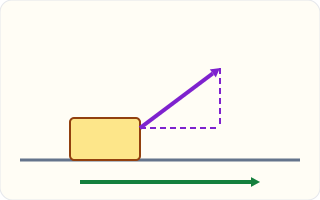
The figure shows a crate pulled by a rope at an angle above the floor. The pull is split into two parts: a horizontal part along the floor, four units long, and a vertical part, three units tall. Only the horizontal part points along the crate's displacement.
So only that part does work. Here it is four-fifths of the pull, so the work is $0.8Fd$. The vertical part slightly reduces the normal force, and so the friction, but does no work itself, because the crate does not move up.
The sign of work tells you whether a force adds energy to an object's motion or removes it. A pitcher's hand does positive work on a baseball, speeding it up. A catcher's mitt does negative work, stopping it. Friction on a sliding box always does negative work.
Zero work happens in two ways: when nothing moves, as when you push on a wall, or when the force is perpendicular to the motion. The normal force on a box sliding across a floor and the tension in a string whirling a ball in a circle both do no work.
Combine the second law with the kinematics equation $v^2 = v_0^2 + 2ad$. Multiply by $\tfrac{1}{2}m$ and use $F_{\text{net}} = ma$: $F_{\text{net}}d = \tfrac{1}{2}mv^2 - \tfrac{1}{2}mv_0^2$. The left side is the net work; the right side is the change in kinetic energy.
This theorem lets you skip the acceleration and time entirely. If you know the forces and the distance, you can find the final speed directly. It holds for any path and for forces that change along the way.
When a force changes as an object moves, $W = Fd$ no longer applies directly. Instead, the work equals the area under a graph of force along the motion against position. For a constant force, that area is a rectangle, $Fd$.
For a spring, whose force grows in proportion to its stretch, $F = kx$, the graph is a straight line from the origin, and the area is a triangle: $W = \tfrac{1}{2}kx^2$. Doubling the stretch quadruples the work, because both the distance and the average force double.
When an object rises a height $h$, gravity does work $-mgh$ on it; when it falls, $+mgh$. Only the vertical change matters, not the path. A skier going down a winding trail and one dropping straight down the same height have the same work done on them by gravity.
Lifting an object at steady speed, you must do work $+mgh$ to cancel gravity's $-mgh$, so the net work and the change in kinetic energy are zero. The energy you supplied is stored as gravitational potential energy, the subject of the next lesson.
Checking an answer. Friction's work is negative. Perpendicular forces do none. The net work must match what kinematics would give, and a positive net work means the object ends up faster.
Work is defined as the product of the force component along the displacement and the displacement, which is the dot product $\vec{F} \cdot \vec{d} = Fd\cos\theta$. It is a scalar, so works from different forces simply add, without any vector geometry.
The work-energy theorem follows directly from Newton's second law, so it holds wherever the second law holds. It applies to a single object treated as a point; for objects that deform or spin, internal energy changes need a fuller account.
A joule is small. Lifting an apple one meter takes about one joule. A pitched baseball carries about a hundred joules; a car at highway speed, about half a million joules. Food energy is measured in Calories, each $4184$ joules.
A $70$ kg person climbing three floors, about $10$ m, does $6860$ J of work against gravity. The body is only about twenty-five percent efficient, so the muscles use about four times that, still well under ten food Calories.
Pushing a box up a ramp takes less force than lifting it straight up, but the force acts over a longer distance. Ignoring friction, the work is the same, $mgh$, because the force needed is $mg\sin\theta$ and the distance is $h/\sin\theta$.
This is why ramps, pulleys and levers are useful: they trade force for distance without changing the work. A wheelchair ramp built to the Americans with Disabilities Act's slope of one in twelve needs only about an eighth of the force of a straight lift.
When a driver brakes, friction in the brakes does negative work on the car, removing its kinetic energy and turning it into heat in the brake pads and rotors. A $1500$ kg car stopping from $30$ m/s must lose $675{,}000$ J, enough to heat the brakes by hundreds of degrees.
Because kinetic energy grows as the square of speed, a car going twice as fast needs four times the braking work, and so, with the same braking force, four times the stopping distance.
When several forces act, find the work of each and add them. For a sled pulled across snow, the rope does positive work, friction negative work, and gravity and the normal force do none on level ground.
Alternatively, find the net force first and multiply by the distance along it. Both approaches give the same net work, which is a useful check. The first also shows where the energy goes: into motion, or into heat through friction.
Work is a transfer of energy into or out of an object. Positive work by a hand adds energy to a ball; negative work by friction removes it from a box, and the surfaces warm up. Energy is not lost, only moved.
Tracking these transfers is the key idea of the whole unit. The next lessons follow energy as it changes form, between motion, height and springs, and as it moves across the boundary of a system.
Work comes out in joules only when force is in newtons and distance in meters. A problem that gives a distance in centimeters or kilometers, or a force in kilonewtons, needs converting first; a kilonewton acting over a kilometer does a million joules, a megajoule.
It also helps to estimate the size before calculating. Pushing a shopping cart across a store takes a few hundred joules; lifting a car onto a truck, tens of thousands. An answer far from the expected size usually means a missing conversion or a forgotten cosine.
Every February, runners race up the $86$ floors of the Empire State Building, $1576$ steps and about $320$ m of height. A $70$ kg runner does about $220$ kJ of work against gravity. The fastest finish in about ten minutes, and the stairs' path, zigzagging upward, does not change the work: only the height gained matters.
Similar climbs raise money at Chicago's Willis Tower and Seattle's Columbia Center. Because the body converts food energy to work at only about a quarter efficiency, a climber burns roughly four times the mechanical work, close to $900$ kJ, or about two hundred food Calories. The rest leaves as heat, which is why climbers finish drenched in sweat even in winter.
A major-league fastball leaves the hand at about $42$ m/s, over ninety miles per hour. The $0.145$ kg ball then carries about $128$ J of kinetic energy, all delivered as work by the pitcher's hand over roughly two meters of arm motion.
That means an average force of about $64$ N on the ball, and much more on the arm and shoulder, which must also accelerate themselves. Sports scientists measure this work to understand injuries: the elbow's ligaments absorb large negative work as the arm decelerates after release, which is why teams track pitch counts so carefully. The catcher's mitt then does $-128$ J of work to stop the ball, turning its energy into sound and heat.
It is natural to think that any force on a moving object does work, or that holding something heavy is hard work. In physics, work needs a displacement along the force. The normal force on a sliding box and the tension on a whirling ball act at right angles to the motion and do none.
Holding a heavy box still does no work on it either, although your muscles tire, because muscle fibers constantly contract and relax internally. The box's energy does not change, so no work is done on it.
A child pulls a wagon $15$ m with $40$ N at $30°$ above the horizontal. Find the along-motion part.
$F\cos 30° = 40 \times 0.866 = 34.6\ \text{N}$
Horizontal part.
Find the pull's work.
$W = 34.6 \times 15 = 520\ \text{J}$
Force along motion times distance.
Find the work by gravity.
$W_g = 0$
Perpendicular to the motion.
Find the work by the normal force.
$W_N = 0$
Also perpendicular.
Find the net work if friction is $20$ N.
$W_{\text{net}} = 520 - 20 \times 15 = 220\ \text{J}$
Friction's work is negative.
A $0.17$ kg puck slides at $12$ m/s on ice. Find its kinetic energy.
$K = \tfrac{1}{2} \times 0.17 \times 12^2 = 12.24\ \text{J}$
Energy of motion.
Friction is $0.10$ N. Write the work needed to stop it.
$-0.10\, d = 0 - 12.24$
Work-energy theorem.
Solve for the distance.
$d = 122.4\ \text{m}$
Longer than a rink.
Find the distance at half the speed.
$d = \tfrac{1}{4} \times 122.4 = 30.6\ \text{m}$
Kinetic energy is a quarter.
Find the distance at double the friction.
$d = 61.2\ \text{m}$
Twice the force, half the distance.
Check with kinematics.
$a = \dfrac{0.10}{0.17} = 0.588,\ d = \dfrac{12^2}{2 \times 0.588} = 122.4$
The same answer.
A toy launcher's spring has $k = 400$ N/m and is compressed $0.10$ m. Find the largest force.
$F = 400 \times 0.10 = 40\ \text{N}$
At full compression.
Find the average force.
$\bar{F} = \tfrac{1}{2} \times 40 = 20\ \text{N}$
It grows steadily.
Find the work done compressing it.
$W = 20 \times 0.10 = 2.0\ \text{J}$
Average force times distance.
Check with the formula.
$W = \tfrac{1}{2} \times 400 \times 0.10^2 = 2.0\ \text{J}$
The triangle's area.
The spring launches a $0.020$ kg ball. Write the energy equation.
$2.0 = \tfrac{1}{2} \times 0.020 \times v^2$
All the work becomes kinetic energy.
Solve for the launch speed.
$v = \sqrt{200} = 14.1\ \text{m/s}$
Positive root.
Find the speed with twice the compression.
$v = 28.3\ \text{m/s}$
Four times the energy, twice the speed.
Find the angle.
$\theta = 0°$
Force along the motion.
Write the work.
$W = 25 \times 8.0 \times \cos 0°$
$W = Fd\cos\theta$.
Evaluate the work.
A rope pulls a crate $20$ m across a level floor with a force of $30$ N, directed $60°$ above the horizontal. How much work does the rope do on the crate, in J?
Complete the worked solution: a rope pulls a sled $12$ m across level snow with $100$ N, at an angle whose cosine is $0.8$, against $50$ N of friction. Find the part of the pull along the motion in N, the work done by the pull in J, and the kinetic energy the sled gains in J.
Find the along-motion part of the pull.
$F\cos\theta =$ p
The horizontal side of the triangle.
Find the pull's work.
$W = F\cos\theta \times d =$ w
Force along motion times distance.
Find the kinetic energy gained.
$\Delta K = W - fd =$ k
Net work.
Note the vertical part of the pull.
$\text{does no work}$
Perpendicular to the motion.
Match each force to the work it does.
| positive work | negative work | zero work | work equal to the change in kinetic energy | |
|---|---|---|---|---|
| a pull along the motion | ||||
| friction on a sliding box | ||||
| the floor's normal force on a sliding box | ||||
| the net force on an object |
A $12$ kg crate starts at rest and is pushed $6$ m across a floor with a horizontal $60$ N force, against $24$ N of kinetic friction. Fill in the work done by the push in J, the work done by friction in J, and the final speed in m/s.
| value | |
|---|---|
| work by the push (J) | |
| work by friction (J) | |
| final speed (m/s) |
A spring with spring constant $80$ N/m is slowly stretched from its natural length by a distance $x$, in meters. Its pull grows in step with the stretch, $F = 80x$. Write the work done stretching it, in J, as a function of $x$.
Answer:
A player's throwing arm does $116$ J of work on a $0.145$ kg baseball that starts at rest. Ignoring other forces during the throw, how fast does the ball leave the hand, in m/s?
Answer: m/s
In the Empire State Building Run-Up in New York, a $70$ kg climber gains $320$ m of height. With $g = 9.8$ m/s², how much work does the climber do against gravity, in kJ?
Answer: kJ
Lesson test: one question per skill, one attempt each, no hints. Your answers are checked when you submit.
A spring with spring constant $500$ N/m is slowly stretched from its natural length by a distance $x$, in meters. Its pull grows in step with the stretch, $F = 500x$. Write the work done stretching it, in J, as a function of $x$.
Answer:
You can compute work and apply the work-energy theorem. Explain to someone why the normal force on a box sliding across a floor does no work.
24. Your turn: a $25$ N horizontal force pushes a box $8.0$ m along the floor. How much work does it do?, step 3
$W = 200\ \text{J}$
Positive work.