Back to the on-screen lesson ·
Conservation and quantization of charge, charging by friction, contact and induction, and the inverse-square Coulomb force.
Paper packet. Every task here also exists on screen, where it is checked automatically; answers written on paper are not assessed by Nydus. When you are back at a device, enter your answers there.
By the end of this lesson you will be able to track charge as it moves and use Coulomb's law to find the force between two charges.
From Physics 1 you know Newton's law of gravitation, $F = Gm_1m_2/r^2$, an inverse-square force, and Newton's third law, which makes the two forces of an interaction equal and opposite. You also know from chemistry that atoms contain positive protons and negative electrons. This lesson describes the force between charges.
| Term | What it means |
|---|---|
| Electric charge | A property of matter that comes in two signs; measured in coulombs (C). |
| Elementary charge | $e = 1.602 \times 10^{-19}$ C, the charge of a proton; an electron carries $-e$. |
| Conservation of charge | The total charge of an isolated system never changes. |
| Coulomb's law | $F = k\vert q_1q_2\vert /r^2$, with $k = 8.99 \times 10^9$ N·m²/C². |
| Conductor | A material in which charge moves freely, such as a metal. |
| Insulator | A material in which charge stays put, such as rubber or glass. |
| Induction | Charging an object without touching it, using a nearby charge. |
Charge comes in two kinds, positive and negative. Two point charges $q_1$ and $q_2$ a distance $r$ apart exert forces on each other of size
$$F = \frac{k|q_1q_2|}{r^2}, \quad k = 8.99 \times 10^9\ \text{N·m}^2/\text{C}^2 \approx 9.0 \times 10^9.$$
This is Coulomb's law. The force acts along the line joining the charges: like charges repel, unlike charges attract. The two forces are equal in size and opposite in direction, by Newton's third law, however different the charges. Charge is conserved, never created or destroyed, and quantized, always a whole number of elementary charges.
Another way: picture
Picture two magnets on a table, except that these magnets push or pull along the line between them and get weaker exactly as the square of distance. Move them twice as far apart and the force drops to a quarter. That is Coulomb's law, the same shape as gravity, but with two signs and vastly stronger.
Another way: steps
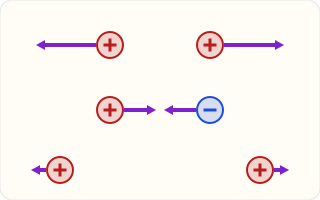
The figure shows three pairs of charged spheres. In every row the two force arrows are the same length, even when the charges differ. That is Newton's third law: each force is one side of the same interaction, and the product $q_1q_2$ in Coulomb's law is the same for both.
In the bottom row the spheres are twice as far apart, and each force has fallen to a quarter. Distance counts twice. A large charge beside a small one pulls it with exactly the same force the small one exerts back; the small one simply accelerates more if it is lighter.
When you rub a balloon on your hair, electrons move from hair to balloon. The balloon becomes negative and your hair positive by exactly the same amount: no charge is created, it is only moved. This conservation law has never been seen to fail in any experiment.
Charge is also quantized. Robert Millikan showed at the University of Chicago in 1909, by suspending tiny charged oil drops in an electric field, that every charge is a whole multiple of $e = 1.602 \times 10^{-19}$ C. A charge of one microcoulomb means about six trillion extra or missing electrons.
In metals, some electrons roam freely, so charge placed on a metal spreads over its surface. In insulators like rubber, glass and plastic, electrons stay bound to their atoms, and charge stays where it is put, which is why rubbing works on insulators.
When two identical metal spheres touch, charge flows until they carry equal amounts. The total, counted with signs, is conserved, so each ends with half the sum. Spheres with $+6$ μC and $-2$ μC each end with $+2$ μC, and their attraction turns into repulsion.
Bring a negatively charged rod near a neutral metal sphere without touching. The sphere's free electrons are pushed to the far side, leaving the near side positive. Now touch the far side with a grounded wire: electrons escape to the ground. Remove the wire, then the rod, and the sphere is left positive.
Even an insulator responds to a nearby charge. Its molecules polarize, their charges shifting slightly, so the near side becomes a little oppositely charged. Because the near side is closer, attraction wins, which is why a charged balloon sticks to a neutral wall and a comb picks up bits of paper.
Checking an answer. The two forces of a pair must be equal. Halving the distance must quadruple the force. Charges shared by touching spheres must add up to the original total.
Coulomb's law is an experimental result. Charles-Augustin de Coulomb measured it in 1785 with a torsion balance, a fine wire twisted by the force between two charged spheres. Modern tests confirm the inverse square to extraordinary precision.
The law applies to point charges, or to spheres of charge seen from outside, which act as if their charge were at the center. For other shapes the forces from each small piece must be added as vectors, the subject of the superposition lesson.
Compare two protons. Their electric repulsion is about $10^{36}$ times their gravitational attraction. Gravity dominates the universe only because large objects are almost exactly neutral, with positive and negative charges canceling.
Yet electric forces hold every solid together, give friction and normal forces their strength, and bind atoms into molecules. When you stand on the floor, the force holding you up is electric repulsion between the electrons of your shoes and the floor.
Walking across a carpet in dry winter air charges you by friction. Touch a doorknob and the charge jumps as a spark: several thousand volts, though too little charge to harm you. In humid summer air, a thin film of water on surfaces lets charge leak away, and shocks are rare.
Static charge matters in industry. Gas stations post warnings because a spark near gasoline vapor can ignite it. Electronics workers wear grounded wrist straps, since a discharge too small to feel can destroy a microchip. Airplanes carry static wicks on their wings to bleed off charge built up in flight.
Chester Carlson, a patent attorney in New York, invented xerography in 1938 using static electricity. A drum coated with a material that conducts only when lit is charged uniformly. Light reflected from the white parts of a page discharges the drum there, leaving charge in the shape of the dark text.
Oppositely charged toner powder sticks only to the charged areas, is transferred to paper, and is melted on. Laser printers write the pattern with a laser instead of reflected light. Every step relies on Coulomb attraction between charges a few micrometers apart.
Coal-fired power plants and cement kilns once poured fine ash into the air. Since the 1910s, when Frederick Cottrell developed them at the University of California, electrostatic precipitators have removed it. Flue gas passes wires held at tens of thousands of volts, which charge the ash particles.
The charged particles are then pulled by Coulomb forces onto large grounded plates, which are rapped periodically to drop the collected ash into hoppers. Precipitators remove over ninety-nine percent of particles, and they were a key tool in meeting the Clean Air Act's limits on particulate pollution.
The Earth is so large that it can give or take almost any amount of charge without its own charge changing noticeably. Connecting an object to the ground with a wire, grounding it, lets charge flow until the object is neutral, or, in induction, until a nearby charge has pushed away all the charge it can.
American homes use this idea for safety. The round third prong of a plug connects the metal case of an appliance to a wire that runs to a rod driven into the earth. If a fault lets a live wire touch the case, current flows to ground instead of through a person, and a breaker trips. The National Electrical Code has required grounded outlets in new homes since the 1960s.
Researchers at the National Severe Storms Laboratory in Norman, Oklahoma, fly balloons carrying electric-field meters up through thunderstorms. They find the upper cloud typically positive and the middle negative, with tens of coulombs in each region, separated when ice crystals and soft hail collide in updrafts.
Treating $\pm 40$ C a few kilometers apart as point charges gives forces of hundreds of kilonewtons, and the electric field in the air between grows until the air breaks down. A lightning flash carries a few coulombs in a fraction of a second, neutralizing part of the charge, and the cloud recharges within seconds. The United States sees about twenty-five million cloud-to-ground flashes a year.
Rubbing a balloon on dry hair moves roughly $50$ nC of charge, about three hundred billion electrons, from hair to balloon. Held ten centimeters away, the balloon and hair attract with a couple of millinewtons, enough to lift individual strands of hair, which weigh only a few micronewtons each.
Laundry clings for the same reason: tumbling in a dryer, fabrics rub and exchange electrons. Dryer sheets coat fabrics with a thin layer that conducts slightly, letting the charge leak away. In humid air the effect nearly vanishes, which is why static cling and doorknob shocks are winter problems in much of the country.
It is natural to think that a large charge pushes harder on a small one than the small one pushes back. Newton's third law says otherwise: the forces of a pair are always equal in size and opposite in direction. Coulomb's law contains the product $q_1q_2$, the same for both.
A related error is to think rubbing creates charge. It only moves electrons from one object to another. The two objects end with equal and opposite charges, and the total is unchanged.
Charges of $+2.0$ μC and $-3.0$ μC sit $30$ cm apart. Convert to SI units.
$2.0 \times 10^{-6}\ \text{C}, \ 3.0 \times 10^{-6}\ \text{C}, \ 0.30\ \text{m}$
Coulombs and meters.
Multiply the sizes of the charges.
$q_1q_2 = 6.0 \times 10^{-12}\ \text{C}^2$
Signs set direction only.
Square the distance.
$r^2 = 0.090\ \text{m}^2$
Inverse square.
Apply Coulomb's law.
$F = \dfrac{9.0 \times 10^9 \times 6.0 \times 10^{-12}}{0.090} = 0.60\ \text{N}$
The size of each force.
State the direction.
$\text{attraction}$
Opposite signs pull together.
Two charges $10$ cm apart attract with $0.80$ N. They are moved to $40$ cm. Find the distance factor.
$\dfrac{40}{10} = 4$
Only the distance changes.
Square the distance factor.
$4^2 = 16$
Inverse square.
Divide the force.
$F = \dfrac{0.80}{16} = 0.050\ \text{N}$
A sixteenth.
Now double one charge as well. Scale again.
$F = 2 \times 0.050 = 0.10\ \text{N}$
Proportional to each charge.
Find the distance that restores $0.80$ N with the doubled charge.
$r = 10\sqrt{2} = 14.1\ \text{cm}$
Doubling $q$ is undone by $\sqrt{2}$ in $r$.
Check with the formula.
$0.80 \times 2 \div (\sqrt{2})^2 = 0.80$
Consistent.
Sphere A carries $+9.0$ μC, identical sphere B carries $-3.0$ μC, $20$ cm apart. Find the force before.
$F = \dfrac{9.0 \times 10^9 \times 27 \times 10^{-12}}{0.040} = 6.08\ \text{N}$
Attraction.
They touch. Find the total charge.
$9.0 + (-3.0) = 6.0\ \mu\text{C}$
Conserved.
Share it equally.
$q = 3.0\ \mu\text{C each}$
Identical spheres.
Find the force after, at $20$ cm.
$F = \dfrac{9.0 \times 10^9 \times 9.0 \times 10^{-12}}{0.040} = 2.03\ \text{N}$
Now repulsion.
Count electrons moved from B to A.
$\dfrac{6.0 \times 10^{-6}}{1.602 \times 10^{-19}} = 3.7 \times 10^{13}$
Electrons left A, making B less negative.
Note the change of direction.
$\text{attraction became repulsion}$
Both now positive.
Write Coulomb's law.
$F = \dfrac{kq_1q_2}{r^2}$
Inverse square.
Substitute in SI units.
$F = \dfrac{9.0 \times 10^9 \times 10^{-12}}{0.010}$
Charges and distance converted.
Evaluate the force.
Two point charges attract with some force. One charge is multiplied by $2$, the other by $1$, and the distance between them by $2$. By what factor does the force change?
Complete the worked solution: rubbing a balloon on hair moves $50$ nC of charge from the hair to the balloon. Treating both as point charges $10$ cm apart, with $e = 1.602 \times 10^{-19}$ C and $k = 9.0 \times 10^9$ N·m²/C², find the number of electrons moved in units of $10^{11}$, the attraction in mN, and the attraction in mN at twice that distance.
Count the electrons moved.
$N = \dfrac{q}{e} =$ n
In units of $10^{11}$.
Find the attraction.
$F = \dfrac{kq^2}{d^2} =$ f
Equal and opposite charges.
Find the attraction at twice the distance.
$F' = \dfrac{F}{4} =$ h
The inverse square.
Compare with the balloon's weight.
$\text{a few grams weigh tens of mN}$
Enough to lift hair strands.
Match each way of charging to what happens.
| rubbing transfers electrons between surfaces | touching lets charge spread onto a second object | a nearby charge separates charge, and grounding removes one sign | charge shifts within a neutral object, which stays neutral | |
|---|---|---|---|---|
| friction | ||||
| conduction | ||||
| induction | ||||
| polarization |
Two identical small metal spheres carry $5$ μC and $-1$ μC and sit $30$ cm apart. They are touched together and returned to the same places. With $k = 9.0 \times 10^9$ N·m²/C², fill in each sphere's charge afterward in μC, and the size of the force between them before and after, in N.
| value | |
|---|---|
| charge on each sphere after (μC) | |
| force before (N) | |
| force after (N) |
Two point charges of $2$ μC and $3$ μC are a distance $r$ apart, in meters. With $k = 9.0 \times 10^9$ N·m²/C², write the size of the force between them, in N, as a function of $r$.
Answer:
Two small spheres each carry $5$ μC and repel with a force of $1.0$ N. With $k = 9.0 \times 10^9$ N·m²/C², how far apart are they, in centimeters?
Answer: cm
Balloon soundings in Oklahoma thunderstorms find about $+40$ C of charge high in a cloud and $-40$ C lower down, their centers about $6$ km apart. Treating them as point charges with $k = 9.0 \times 10^9$ N·m²/C², what is the force between them, in kN?
Answer: kN
Lesson test: one question per skill, one attempt each, no hints. Your answers are checked when you submit.
Two point charges of $1$ μC and $4$ μC are a distance $r$ apart, in meters. With $k = 9.0 \times 10^9$ N·m²/C², write the size of the force between them, in N, as a function of $r$.
Answer:
You can use Coulomb's law. Explain to someone why a large charge and a small charge push on each other equally hard.
22. Your turn: two $1.0$ μC charges are $10$ cm apart. What is the force between them?, step 3
$F = 0.90\ \text{N}$
Repulsion.