Back to the on-screen lesson ·
Emf and internal resistance, terminal voltage under load, where a circuit's energy goes, and paying for energy in kilowatt-hours.
Paper packet. Every task here also exists on screen, where it is checked automatically; answers written on paper are not assessed by Nydus. When you are back at a device, enter your answers there.
By the end of this lesson you will be able to account for energy in circuits with real batteries and compute energy costs.
From the last lessons you know Ohm's law, series and parallel circuits, and that power is $P = IV = I^2R$. So far batteries have been ideal, delivering their rated voltage at any current. This lesson makes them real and follows energy from the source to the load and onto the electric bill.
| Term | What it means |
|---|---|
| Emf | $\mathcal{E}$, the energy per coulomb a source supplies, in volts. |
| Internal resistance | $r$, the resistance of the source itself. |
| Terminal voltage | $V = \mathcal{E} - Ir$, the voltage available to the circuit. |
| Load | The component or device the source powers. |
| Kilowatt-hour | $1$ kWh $= 3.6 \times 10^6$ J, the energy of $1$ kW for one hour. |
| Short-circuit current | $\mathcal{E}/r$, the largest current a source can drive. |
A battery's emf $\mathcal{E}$ is the energy it gives each coulomb. But the charge must pass through the battery's own materials, which have an internal resistance $r$. Part of the emf is spent there, so the voltage at the terminals is
$$V = \mathcal{E} - Ir.$$
With no current, $V = \mathcal{E}$; as the current grows, the terminal voltage sags. Connected to a load $R$, the current is $I = \mathcal{E}/(R + r)$, the load receives power $I^2R$, and the battery wastes $I^2r$ as heat inside. Energy used over time is measured in kilowatt-hours.
Another way: picture
Picture a water pump pushing water through a garden hose. The pump's own pipes have some friction, so the pressure at its outlet is a little less than the pressure it produces, and the loss grows as more water flows. A battery's internal resistance is that friction inside the pump.
Another way: steps
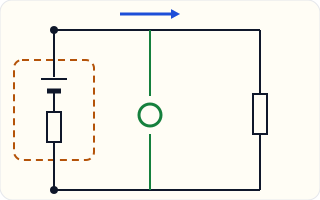
The figure draws a real cell as a dashed box containing an ideal cell and a small resistor, its internal resistance. Wires from the box's terminals lead to the load, and a voltmeter across the terminals reads the terminal voltage.
The current passes through both the load and the internal resistance, in series. The voltmeter outside the box cannot see the drop across $r$; it reads only what is left, $\mathcal{E} - Ir$. Open the circuit and the reading rises to the full emf, which is how emf is measured.
Turn on a car's headlights and then crank the engine: the lights dim. The starter motor draws hundreds of amperes, and even a car battery's small internal resistance, about $0.02$ Ω, then takes several volts. Once the engine starts and the current drops, the lights brighten.
A flashlight battery behaves the same way on a smaller scale. As it ages, its internal resistance rises, so it sags more under load. A tired AA cell may still read $1.5$ V on a voltmeter, which draws almost no current, yet fail to run a toy that needs an ampere.
The battery supplies energy at a rate $\mathcal{E}I$. The load receives $I^2R$ and the internal resistance wastes $I^2r$ as heat inside the battery. Energy is conserved: $\mathcal{E}I = I^2R + I^2r$.
When the load is much larger than $r$, almost all the power reaches it. When they are comparable, much is wasted. A short circuit, $R$ near zero, sends all the power into the battery's own resistance, which is why shorted batteries get hot and can catch fire.
Utilities bill energy in kilowatt-hours: $1$ kW used for one hour, $3.6$ million joules. The average American home uses about $900$ kWh a month, at an average price near $16$ cents, roughly $\$145$.
To estimate an appliance's cost, multiply its power in kilowatts by the hours it runs and by the price. A $1500$ W space heater running $8$ hours a day uses $12$ kWh daily, $360$ in a month, about $\$58$. A $10$ W LED bulb left on around the clock uses only $7.2$ kWh a month.
Checking an answer. Terminal voltage must be less than the emf when current flows. The powers to load and internal resistance must add to $\mathcal{E}I$. Bills must come out in sensible dollars.
Modeling a battery as an ideal emf plus a resistor is an approximation that works well over a battery's normal range. The chemistry sets the emf: a zinc-carbon cell gives $1.5$ V, a lead-acid cell $2.1$ V, a lithium-ion cell $3.7$ V. The resistance comes from the electrolyte and electrodes.
Energy conservation guarantees that the power supplied equals the power dissipated. The kilowatt-hour is just a convenient unit: $1000$ W times $3600$ s.
For a source with fixed emf and internal resistance, which load receives the most power? A tiny load gets a big current but little voltage; a huge load gets full voltage but little current. The best is in between: the load receives maximum power when $R = r$.
At that point exactly half the power is wasted inside the source, so the efficiency is only fifty percent. Power grids never operate this way; they keep the load's resistance far above the source's to waste little. But in radio receivers and audio amplifiers, matching resistances to get the most signal power is standard practice.
A car's lead-acid battery has a tiny internal resistance so it can deliver the several hundred amperes a starter motor needs. Its cold-cranking amps rating tells how much current it can supply at $0$ °F while keeping its terminal voltage above $7.2$ V. Cold weather raises internal resistance, which is why cars struggle to start in a Minnesota winter.
Lithium-ion phone batteries have more internal resistance but need far less current. Their protection chips watch the terminal voltage and shut the phone down if it sags too far, which is why a phone with an old battery may die at twenty percent charge on a cold day.
The electric meter on every American home measures energy, not power. Old meters had a spinning aluminum disk whose speed was proportional to the power, turning dials that counted kilowatt-hours. Most utilities now install smart meters that record usage every fifteen minutes and report it wirelessly.
Plug-in meters sold in hardware stores let you measure a single appliance. They often reveal standby power: televisions, game consoles and chargers that draw a few watts all day. Across a household, standby loads can add up to a hundred watts around the clock, costing over a hundred dollars a year.
A solar cell is a source whose emf comes from light: photons knock electrons across a junction in silicon, giving each coulomb about $0.6$ V. Cells are wired in series to raise the voltage, sixty or seventy-two to a rooftop panel, and panels in series strings to reach several hundred volts.
Like a battery, a solar panel's terminal voltage sags as it delivers more current. Inverters on American rooftops constantly adjust the load to find the point on that curve where the panel delivers the most power, called maximum power point tracking, gaining several percent more energy over a day.
Batteries connected in series add their emfs and their internal resistances: four $1.5$ V cells end to end give $6$ V, the way a flashlight or a TV remote stacks its cells. Connected in parallel, identical cells keep the same emf but divide their internal resistance, so together they can deliver more current with less sag and last longer.
An electric car's battery pack uses both. A Tesla pack wires thousands of small lithium-ion cells in parallel groups to share the current, then connects about ninety-six such groups in series to reach roughly $400$ V. The pack's management system watches every group's terminal voltage, because a single weak group, with higher internal resistance, would sag first and limit the whole car.
A car battery's emf is about $12.6$ V and its internal resistance about $0.02$ Ω when warm. A starter motor behaves roughly like a $0.06$ Ω resistor while turning the engine, so the current is about $160$ A and the motor receives nearly $1500$ W, about two horsepower. The terminal voltage sags to about $9.4$ V while cranking, which is why the dashboard lights dim.
On a $-10$ °F morning in Minneapolis, the battery's internal resistance can double while the cold, thick engine oil demands more power. The current falls, the voltage sags further, and the engine may not turn over. Engine block heaters, plugged into outlets in parking lots across the northern states, keep both the oil and the battery warm enough to start.
An American utility bill lists kilowatt-hours used and the price per kWh, which ranges from about $11$ cents in Louisiana to over $40$ cents in Hawaii. A $1500$ W space heater run two hours a day uses $3$ kWh daily, $90$ kWh a month, about $\$13.50$ at $15$ cents.
Heating and cooling dominate most bills, followed by water heating and appliances. The Department of Energy's Energy Star program labels appliances with their expected yearly kWh, letting buyers compare running costs. A modern refrigerator uses about a quarter of the energy of one from 1980, saving over a hundred dollars a year.
It is natural to think a $12$ V battery always supplies $12$ V. That is its emf, which appears at the terminals only when no current flows. Under load, the internal resistance takes $Ir$, and the terminal voltage sags, more so as the current grows or the battery ages.
A related error is to think a battery stores a fixed amount of current. It stores energy; how much current it delivers depends on the load connected to it, and the energy runs out faster at high currents, partly because more is wasted inside.
Two AA cells in series give $\mathcal{E} = 3.0$ V with total internal resistance $0.60$ Ω. The bulb is $4.4$ Ω. Find the current.
$I = \dfrac{3.0}{4.4 + 0.60} = 0.60\ \text{A}$
Internal resistance in series.
Find the terminal voltage.
$V = 3.0 - 0.60 \times 0.60 = 2.64\ \text{V}$
Sagged below the emf.
Find the power to the bulb.
$P = 0.60^2 \times 4.4 = 1.58\ \text{W}$
Useful light and heat.
Find the power wasted in the cells.
$P_r = 0.60^2 \times 0.60 = 0.22\ \text{W}$
Warming the batteries.
Check the energy balance.
$\mathcal{E}I = 3.0 \times 0.60 = 1.80 = 1.58 + 0.22$
Conserved.
A $9$ V battery reads $9.3$ V open. Connected to a $15$ Ω resistor, it reads $8.4$ V. Find the emf.
$\mathcal{E} = 9.3\ \text{V}$
No current, no internal drop.
Find the current with the resistor.
$I = \dfrac{8.4}{15} = 0.56\ \text{A}$
Ohm's law on the load.
Find the internal drop.
$Ir = 9.3 - 8.4 = 0.90\ \text{V}$
The sag.
Find the internal resistance.
$r = \dfrac{0.90}{0.56} = 1.6\ \Omega$
Typical for a $9$ V battery.
Find the short-circuit current.
$I_{\text{sc}} = \dfrac{9.3}{1.6} = 5.8\ \text{A}$
Enough to heat a wire.
Find the load for maximum power.
$R = r = 1.6\ \Omega$
Matched load.
A refrigerator averages $150$ W around the clock. Find the daily energy.
$E = 0.150 \times 24 = 3.6\ \text{kWh}$
Kilowatts times hours.
Find the monthly energy.
$3.6 \times 30 = 108\ \text{kWh}$
A billing cycle.
Find the monthly cost at $16$ cents per kWh.
$108 \times 0.16 = \$17.28$
A large share of the bill.
Convert the monthly energy to joules.
$108 \times 3.6 \times 10^6 = 3.9 \times 10^8\ \text{J}$
Hundreds of megajoules.
Compare a new model at $40$ W average.
$0.040 \times 24 \times 30 \times 0.16 = \$4.61$
Much cheaper to run.
Find the yearly savings.
$(17.28 - 4.61) \times 12 = \$152$
Why Energy Star labels matter.
Find the internal drop.
$Ir = 2.0 \times 0.50 = 1.0\ \text{V}$
Lost inside.
Subtract from the emf.
$V = 6.0 - 1.0$
What remains.
Evaluate the terminal voltage.
A battery with an emf of $9$ V and internal resistance $1$ Ω delivers $2$ A to a circuit. What is the voltage across its terminals?
Complete the worked solution: an appliance uses $2200$ W for $1$ hours every day. Electricity costs $20$ cents per kWh. Find the energy it uses each day in kWh, over $30$ days in kWh, and the cost for those $30$ days in dollars.
Find the daily energy.
$E_{\text{day}} = \dfrac{P \times h}{1000} =$ d
Kilowatt-hours.
Multiply by thirty days.
$E_{\text{month}} = 30E_{\text{day}} =$ m
A billing cycle.
Multiply by the price.
$\text{cost} = E_{\text{month}} \times \text{price} =$ b
Convert cents to dollars.
Convert the monthly energy to joules.
$E \times 3.6 \times 10^6\ \text{J}$
One kWh is $3.6$ MJ.
Match each term to its meaning.
| energy per coulomb the source supplies | the emf minus the drop inside the source | the resistance of the source itself | 3.6 million joules of energy | |
|---|---|---|---|---|
| emf | ||||
| terminal voltage | ||||
| internal resistance | ||||
| kilowatt-hour |
A battery with emf $9$ V and internal resistance $1$ Ω is connected to a $8$ Ω load. Fill in the current in A, the terminal voltage in V, and the power delivered to the load in W.
| value | |
|---|---|
| current (A) | |
| terminal voltage (V) | |
| power to the load (W) |
A battery has an emf of $12$ V and internal resistance $0.5$ Ω. Write its terminal voltage, in volts, as a function of the current $I$ it delivers, in amperes.
Answer:
A battery reads $9.4$ V with nothing connected. When it delivers $0.6$ A, its terminal voltage drops to $8.2$ V. What is its internal resistance, in Ω?
Answer: Ω
A car battery has an emf of $12.6$ V and internal resistance $0.020$ Ω. It cranks a starter motor that behaves as a $0.10$ Ω resistance. What power, in W, does the motor receive?
Answer: W
Lesson test: one question per skill, one attempt each, no hints. Your answers are checked when you submit.
A battery has an emf of $9$ V and internal resistance $1.5$ Ω. Write its terminal voltage, in volts, as a function of the current $I$ it delivers, in amperes.
Answer:
You can track circuit energy. Explain to someone why a car's headlights dim while the engine is cranking.
22. Your turn: a $6.0$ V battery with $0.50$ Ω internal resistance supplies $2.0$ A. What is its terminal voltage?, step 3
$V = 5.0\ \text{V}$
Below the rating.