Back to the on-screen lesson ·
Charging and discharging capacitors, the time constant $RC$, capacitors at switch-on and steady state, and where steady-current rules stop.
Paper packet. Every task here also exists on screen, where it is checked automatically; answers written on paper are not assessed by Nydus. When you are back at a device, enter your answers there.
By the end of this lesson you will be able to find time constants and follow the voltage and current in charging and discharging RC circuits.
From the last lessons you know how steady currents divide in resistor networks, and from lesson 9 you know that a capacitor stores charge $Q = CV$ and energy $\tfrac{1}{2}CV^2$. From the half-life and decay topics you may have met exponential change. This lesson puts a capacitor in a circuit and watches the current change with time.
| Term | What it means |
|---|---|
| RC circuit | A resistor and capacitor in series with a source. |
| Time constant | $\tau = RC$, in seconds; the time to reach 63 percent of the final change. |
| Charging | $V_C = \mathcal{E}(1 - e^{-t/RC})$, current $I = I_0e^{-t/RC}$. |
| Discharging | $V_C = V_0e^{-t/RC}$. |
| Transient | The changing behavior just after a switch opens or closes. |
| Steady state | The final condition, when currents no longer change. |
Connect an uncharged capacitor through a resistor to a battery. At first the capacitor has no voltage, so it acts like a plain wire and the current is $\mathcal{E}/R$. As charge builds on its plates, its voltage rises, opposing the battery, and the current falls. Eventually the capacitor's voltage equals the emf and the current stops.
The change is exponential, with a time constant $\tau = RC$:
$$V_C = \mathcal{E}\left(1 - e^{-t/RC}\right), \qquad I = \frac{\mathcal{E}}{R}e^{-t/RC}.$$
After one $\tau$ the capacitor has 63 percent of its final charge; after five, over 99 percent. Discharging through a resistor follows $V = V_0e^{-t/RC}$.
Another way: picture
Picture filling a bathtub from a tap whose flow weakens as the water level rises, because the rising water pushes back. It fills quickly at first, then ever more slowly, approaching full without quite reaching it. A capacitor charging through a resistor fills exactly like that tub.
Another way: steps
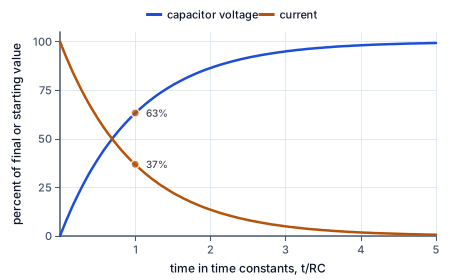
The chart plots a charging capacitor's voltage and the circuit's current against time measured in time constants. The voltage climbs steeply at first and then levels off toward the battery's emf: $63$ percent at one time constant, $86$ at two, $95$ at three. The current does the mirror image, falling from its starting value to $37$ percent after one time constant.
Each time constant closes the same fraction, $63$ percent, of whatever gap remains. That is the signature of exponential change, the same pattern as radioactive decay or a cooling cup of coffee. In theory the capacitor never finishes; in practice five time constants is complete.
Two simple rules handle most circuit questions without exponentials. At the instant a switch closes, an uncharged capacitor has zero voltage, so it behaves like a wire: current flows as if it were not there. Long afterward, it is fully charged and carries no current, so it behaves like a break in the circuit.
In a network with several branches, apply these rules to find the currents just after switching and in the steady state. The exponential only describes the journey between them.
A larger resistance limits the current, so charge arrives more slowly. A larger capacitance needs more charge to reach the same voltage. Both lengthen the time, and their product, ohms times farads, has units of seconds.
With $10$ kΩ and $100$ μF, $\tau = 1$ s. With $1$ kΩ and $1$ μF, it is a millisecond; with $1$ MΩ and $1000$ μF, $17$ minutes. By choosing $R$ and $C$, engineers make timers from microseconds to hours with two cheap parts.
Disconnect the battery and connect the charged capacitor across a resistor. Now the capacitor drives the current, which flows the opposite way. As it loses charge, its voltage falls and so does the current: $V = V_0e^{-t/RC}$, halving every $0.693RC$.
Camera flashes, defibrillators and the memory backup in some clocks use discharge. So does a safety feature in televisions and microwave ovens: bleeder resistors across large capacitors drain them within seconds after unplugging, so a repair technician is not shocked by stored charge.
Checking an answer. The capacitor's voltage must lie between its starting and final values. After one time constant, $63$ percent of the change must be done. Times must scale with both $R$ and $C$.
The loop rule still holds at every instant: $\mathcal{E} = IR + Q/C$. Since the current is the rate of change of charge, this becomes an equation relating $Q$ to how fast it changes, whose solution is the exponential. The rate of charging is proportional to how far the capacitor has left to go, which always gives exponential approach.
The switch-on and steady-state rules follow from the capacitor's voltage being $Q/C$: it cannot jump instantly, since that would need infinite current, so an uncharged capacitor starts at zero volts; and with no current, the resistor has no voltage, so the capacitor takes all of it.
Steady-current rules assume nothing in the circuit stores energy that changes over time. Capacitors store it in electric fields, and inductors, met in the induction lessons, store it in magnetic fields. Whenever a switch opens or closes, such circuits pass through transients before settling.
Real wires have tiny capacitance and inductance, so even plain circuits have transients, but they last nanoseconds, too brief to matter for household wiring. In computer chips switching billions of times a second, those nanoseconds are exactly what limits speed, and designers fight RC delays in every wire.
The 555 timer chip, designed in 1971 by Hans Camenzind for Signetics in California, uses a capacitor charging through a resistor to set a delay or a blinking rate. Billions have been made, in toys, traffic signals, appliances and alarm systems.
Turn signals in cars, the flashing lights on bicycles, the delay before a bathroom fan shuts off: many use RC timing. Changing the resistor with a knob changes the time, which is how intermittent windshield wipers let the driver choose the delay. Photographers know RC timing too: the self-timer on an old camera and the slow recharge of a flash both come from a capacitor filling through a resistor, and the flash's ready light turns on when the voltage passes a threshold.
A nerve cell's membrane acts as a capacitor, storing charge across its thin insulating layer, and its ion channels act as resistors. Together they give the membrane a time constant of a few milliseconds, which sets how quickly a nerve responds to input.
In long nerve fibers, the RC properties also limit how fast signals can travel. Nature's solution is myelin, a fatty insulating sheath that lowers the membrane's capacitance, speeding signals up to a hundred meters per second. Diseases such as multiple sclerosis damage myelin and slow nerve signals.
Because a capacitor takes time to charge, an RC circuit smooths out rapid changes while passing slow ones. Placed across a power supply's output, a large capacitor fills in the dips between pulses, turning a bumpy voltage into a nearly steady one.
Audio equipment uses RC filters to separate high and low frequencies: a signal that changes much faster than the time constant cannot charge the capacitor, so it passes through or is blocked depending on how the parts are arranged. The bass and treble controls on a stereo are adjustable RC filters. The dividing line between frequencies that pass and those that are blocked is roughly one over two pi times the time constant, so a $1$ kΩ resistor with a $1$ μF capacitor splits signals near $160$ hertz, in the middle of the bass range. Hearing aids, radios and the noise-canceling circuits in headphones all rely on filters built this way.
Robert Kearns, an engineering professor in Detroit, invented intermittent windshield wipers in the 1960s, modeling the delay on the blink of the human eye. His circuit let a capacitor charge through a resistor the driver set with a knob; when the capacitor's voltage reached a threshold, a switch triggered one sweep and reset the timer.
With a $100$ μF capacitor charging from $12$ V to an $8.0$ V threshold, the delay is $RC \ln 3$: about $2.2$ s with $20$ kΩ, $5.5$ s with $50$ kΩ. Kearns patented the idea, and after automakers adopted it without licensing it, he spent decades in court, eventually winning judgments against Ford and Chrysler, a story told in the film Flash of Genius.
An implanted cardiac pacemaker delivers a small electrical pulse to the heart when the heart's own rhythm falters. Early pacemakers, like the first fully implantable one built by Wilson Greatbatch in Buffalo, New York, in 1960, used RC circuits to time the pulses: a capacitor charged through a resistor, and each time it reached a threshold, it discharged into the heart.
Choosing the time constant set the heart rate, about seventy beats a minute. Modern pacemakers use microchips and sense the heart's own signals, but they still store each pulse's energy in a small capacitor, and their batteries last a decade, thanks to circuits that draw only microamperes between pulses.
It is natural to think a capacitor charges instantly when connected. The resistor limits how fast charge can arrive, so charging takes several time constants. Only with no resistance at all would it be instant, and real circuits always have some.
A related error is to think current flows through the capacitor. Charge piles up on one plate and leaves the other, so current flows in the wires on both sides, but no charge crosses the insulating gap. When the plates are full, the current stops.
A $470$ μF capacitor charges through $10$ kΩ from $9.0$ V. Find the time constant.
$\tau = 10 \times 10^3 \times 470 \times 10^{-6} = 4.7\ \text{s}$
Ohms times farads.
Find the starting current.
$I_0 = \dfrac{9.0}{10{,}000} = 0.90\ \text{mA}$
Capacitor acts as a wire.
Find the voltage after $4.7$ s.
$V_C = 9.0(1 - e^{-1}) = 5.69\ \text{V}$
One time constant.
Find the voltage after $10$ s.
$V_C = 9.0(1 - e^{-10/4.7}) = 9.0(1 - 0.119) = 7.93\ \text{V}$
About two time constants.
Find the current then.
$I = 0.90 \times 0.119 = 0.107\ \text{mA}$
Mostly died away.
A capacitor charges from $0$ toward $12$ V with $\tau = 2.0$ s. When does it reach $9.0$ V? Write the equation.
$9.0 = 12(1 - e^{-t/2.0})$
Charging law.
Isolate the exponential.
$e^{-t/2.0} = 1 - 0.75 = 0.25$
Divide and rearrange.
Take the natural log.
$-\dfrac{t}{2.0} = \ln 0.25 = -1.386$
Bring the exponent down.
Solve for the time.
$t = 2.77\ \text{s}$
About $1.4\tau$.
Check with the chart.
$75\% \text{ lies between } 1\tau \text{ and } 2\tau$
Between $63$ and $86$ percent.
Find the time to reach half.
$t = 2.0 \ln 2 = 1.39\ \text{s}$
$0.693\tau$.
A $150$ μF capacitor at $300$ V discharges through $2.0$ Ω in a flash tube. Find the time constant.
$\tau = 2.0 \times 150 \times 10^{-6} = 3.0 \times 10^{-4}\ \text{s}$
Fractions of a millisecond.
Find the starting current.
$I_0 = \dfrac{300}{2.0} = 150\ \text{A}$
A huge brief current.
Find the voltage after $0.60$ ms.
$V = 300e^{-2} = 40.6\ \text{V}$
Two time constants.
Find the energy at the start.
$U = \tfrac{1}{2} \times 150 \times 10^{-6} \times 300^2 = 6.75\ \text{J}$
Stored in the field.
Find the energy left after $0.60$ ms.
$U = 6.75 \times e^{-4} = 0.124\ \text{J}$
Energy falls as $e^{-2t/\tau}$.
Interpret the result.
$98\% \text{ released in } 0.6\ \text{ms}$
Why the flash is so brief.
Write the time constant.
$\tau = RC$
Ohms times farads.
Substitute in SI units.
$\tau = 2.0 \times 10^6 \times 5.0 \times 10^{-6}$
Mega and micro cancel.
Evaluate the time constant.
A $100$ kΩ resistor charges a $47$ μF capacitor. What is the circuit's time constant?
Complete the worked solution: an uncharged $220$ μF capacitor is charged through a resistor by a $5$ V battery until the current stops. Find the final charge in μC, the energy stored in the capacitor in mJ, and the energy turned to heat in the resistor in mJ.
Find the final charge.
$Q = C\mathcal{E} =$ q
Microcoulombs.
Find the stored energy.
$U = \tfrac{1}{2}C\mathcal{E}^2 =$ u
Millijoules.
Find the heat in the resistor.
$Q\mathcal{E} - U =$ h
The battery supplied twice the stored energy.
Note the surprise.
$\text{half is lost whatever the resistance}$
A larger $R$ only makes it slower.
Match each moment in an RC circuit to what it means.
| acts like a plain wire | acts like a break in the circuit | charged to about 63 percent | charged to over 99 percent | |
|---|---|---|---|---|
| an uncharged capacitor at switch-on | ||||
| a fully charged capacitor | ||||
| one time constant after switch-on | ||||
| five time constants after switch-on |
An uncharged $100$ μF capacitor is connected through a $10$ kΩ resistor to a $12$ V battery. Fill in the time constant in s, the current at the instant of connection in mA, and the capacitor's voltage one time constant later, in V.
| value | |
|---|---|
| time constant (s) | |
| starting current (mA) | |
| voltage after one τ (V) |
An uncharged capacitor is connected through a resistor to a $9$ V battery; the time constant is $5$ s. Write the capacitor's voltage, in V, as a function of the time $t$ in seconds.
Answer:
A $400$ μF capacitor charged to $24$ V discharges through a $5$ kΩ resistor. What is its voltage after $1.5$ s, in V?
Answer: V
Intermittent windshield wipers wait while a $100$ μF capacitor charges from $0$ V through a resistor set by the driver's knob, from a $12$ V supply. When the capacitor reaches $8.0$ V, the wipers sweep. With the knob at $80$ kΩ, how long is the delay, in s?
Answer: s
Lesson test: one question per skill, one attempt each, no hints. Your answers are checked when you submit.
An uncharged capacitor is connected through a resistor to a $12$ V battery; the time constant is $2$ s. Write the capacitor's voltage, in V, as a function of the time $t$ in seconds.
Answer:
You can analyze RC circuits. Explain to someone why a capacitor acts like a wire at first and like a break later.
21. Your turn: what is the time constant of a $2.0$ MΩ resistor with a $5.0$ μF capacitor?, step 3
$\tau = 10\ \text{s}$
Seconds.