Back to the on-screen lesson ·
How series and parallel connections divide current and voltage, equivalent resistance, and Kirchhoff's junction and loop rules.
Paper packet. Every task here also exists on screen, where it is checked automatically; answers written on paper are not assessed by Nydus. When you are back at a device, enter your answers there.
By the end of this lesson you will be able to reduce series-parallel networks and find every current and voltage in them.
From the last two lessons you know current, potential difference and Ohm's law, $V = IR$, and that charge is conserved at a junction. This lesson connects several resistors together and finds how current and voltage divide among them.
| Term | What it means |
|---|---|
| Series | Connected end to end, one path: the same current through each; $R = R_1 + R_2 + \ldots$ |
| Parallel | Connected across the same two points: the same voltage; $1/R = 1/R_1 + 1/R_2 + \ldots$ |
| Equivalent resistance | The single resistance that would draw the same current from the source. |
| Junction rule | The currents into a junction equal the currents out. |
| Loop rule | The potential changes around any closed loop add to zero. |
| Short circuit | A path of almost zero resistance that bypasses components. |
Components can be joined in two basic ways.
Behind both are Kirchhoff's rules: at any junction, current in equals current out (charge is conserved); around any closed loop, the voltage rises and drops add to zero (energy is conserved). Any network can be solved with them.
Another way: picture
Picture traffic. Cars on a single-lane road with several toll booths in a row all pass every booth: series, same flow, delays add up. Open several booths side by side at a plaza and the traffic splits among them: parallel, more lanes, less total delay. Adding a booth in a row slows traffic; adding one alongside speeds it.
Another way: steps
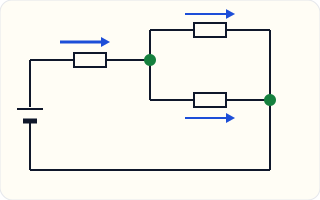
The figure shows a cell driving current through one resistor, then a junction where the current splits between two parallel branches, which rejoin before returning to the cell. The thick arrow shows the full current through the first resistor; thinner arrows show it divided in the branches.
To solve it, replace the parallel pair with its equivalent, add the first resistor in series, and find the total current. Then the voltage across the pair is that current times the pair's equivalent resistance, and each branch's current follows from Ohm's law.
In series, every coulomb passes through each resistor in turn, losing energy in each. The total voltage drop is the sum of the drops, $IR_1 + IR_2$, and since the current is the same, the total resistance is $R_1 + R_2$.
Voltage divides in proportion to resistance: the larger resistor gets the larger share. That is a voltage divider, used in every electronic device to produce a smaller voltage from a larger one. A volume knob is often a variable resistor splitting a signal voltage this way.
In parallel, each branch offers charge another path. Each branch draws its own current, $V/R_1$ and $V/R_2$, and the total current is their sum. More current at the same voltage means less resistance overall.
The equivalent resistance is always less than the smallest branch. Two equal resistors in parallel give half of either; ten give a tenth. Current divides inversely with resistance: the easier path carries more.
Gustav Kirchhoff stated his two rules in 1845 as a student in Königsberg. The junction rule says no charge piles up at a junction. The loop rule says that a charge going around any closed path returns to its starting potential, so the gains and losses cancel.
For networks that cannot be reduced to series and parallel groups, such as a bridge or a circuit with two batteries in different branches, the rules give enough equations to find every current. Circuit simulation programs used by engineers solve thousands of such equations at once.
Checking an answer. Parallel combinations must be smaller than any branch. Branch currents must add to the current entering the junction. Voltage drops around any loop must add up to the source emf.
Replacing a group with its equivalent is valid because the rest of the circuit only cares about the current and voltage at the group's two ends. Any group with the same voltage-current relation between its terminals behaves identically from outside.
Kirchhoff's rules are conservation laws applied to steady currents. They assume the wires have negligible resistance, so every point along a wire is at the same potential, and that currents are steady, so no charge accumulates anywhere.
Every outlet and light in an American home is wired in parallel across $120$ V, so each device gets the full voltage and can be switched independently. Turning on another appliance adds another branch, lowering the total resistance and raising the total current.
That is why circuit breakers are needed: too many appliances on one circuit draw more current than the wires can safely carry. A $20$ A kitchen circuit can handle a toaster and a coffee maker together but may trip if a microwave joins them.
Old strings of Christmas lights were wired in series: fifty bulbs on $120$ V, each getting about $2.4$ V. If one bulb burned out, the whole string went dark, and finding the bad bulb meant testing each one.
Modern mini-light bulbs contain a shunt, a tiny wire that shorts across the filament when it burns out, keeping the rest of the string lit. Many LED strings use series groups wired in parallel, a mix that balances simple wiring against reliability.
A short circuit is a path of nearly zero resistance, such as a wire accidentally connecting the two terminals of a battery. By Ohm's law the current becomes huge, limited only by the battery's internal resistance, and the wire heats rapidly.
Shorts cause electrical fires, which is why fuses and breakers exist, and why lithium-ion batteries in phones and laptops have protection circuits. In a network, a short across one component carries all the current around it, leaving that component dark.
Kirchhoff's rules explain the rules for meters. An ammeter must go in series, because only then does the full current pass through it; a perfect ammeter has zero resistance, so it adds nothing to the loop. A voltmeter must go in parallel, across the component, and ideally has infinite resistance, so it draws no current and does not change the junction currents.
Real meters come close. A good digital voltmeter has about ten million ohms of internal resistance; across a thousand-ohm resistor, it draws a negligible share of the current. Across a million-ohm resistor, though, it forms a parallel combination that noticeably lowers the resistance it is meant to measure the voltage across.
Circuit diagrams show connections, not physical positions. Two resistors drawn far apart on the page are in parallel if both connect the same two junctions, however the wires wander between them. A useful habit is to color each wire segment: all points joined by wire with no component between them share one color and one potential. Components whose ends touch the same two colors are in parallel.
Series is the opposite test: two components are in series only if nothing else branches off at the point between them, so every coulomb through one must pass through the other. Many mistakes on circuit problems come from judging by appearance, calling resistors in parallel because they are drawn side by side. Engineers redraw a tangled diagram into a tidy ladder before calculating, and that small step usually makes the arrangement obvious.
In an American kitchen, outlets are wired in parallel on $20$ A circuits, as the National Electrical Code requires. Each appliance draws $I = P/V$: a $1200$ W toaster $10$ A, a $1000$ W microwave $8.3$ A, a $900$ W coffee maker $7.5$ A.
Run all three on one circuit and the currents add to about $26$ A, over the breaker's rating. The breaker trips to protect the $12$-gauge wire in the walls, which would overheat at that current. Electricians therefore put at least two separate circuits on kitchen counters, and many modern kitchens have four or more, plus dedicated circuits for the refrigerator and dishwasher.
A car's lights are wired in parallel across its $12$ V battery. Each headlight, taillight and dashboard lamp gets the full voltage, and one burned-out bulb does not darken the others. Turning on more lights adds branches, drawing more total current from the battery.
Leave the headlights on overnight, two $55$ W lamps drawing about $9$ A together, plus the taillights, and a car battery rated at $50$ ampere-hours can be drained in a few hours, too weak to crank the engine. Modern cars switch the lights off automatically after the engine stops, a small computer doing the job Kirchhoff's arithmetic warns about.
It is natural to think that adding a resistor always increases the total. That is true in series, but adding a resistor in parallel opens a new path for current, lowering the total resistance and raising the current drawn from the source.
A related error is to think current splits equally at a junction. It divides inversely with resistance: a branch with half the resistance carries twice the current. Only equal branches share equally.
Resistors of $2$, $4$ and $6$ Ω are in series with a $24$ V battery. Find the equivalent resistance.
$R = 2 + 4 + 6 = 12\ \Omega$
Series resistances add.
Find the current.
$I = \dfrac{24}{12} = 2.0\ \text{A}$
The same through each.
Find each voltage.
$V = 4, \ 8, \ 12\ \text{V}$
$IR$ for each.
Check the loop rule.
$4 + 8 + 12 = 24\ \text{V}$
The drops use up the emf.
Find the power in the largest resistor.
$P = 2.0^2 \times 6 = 24\ \text{W}$
Largest resistance, largest share.
Resistors of $6$, $12$ and $4$ Ω are in parallel across a $12$ V battery. Add the reciprocals.
$\dfrac{1}{R} = \dfrac{1}{6} + \dfrac{1}{12} + \dfrac{1}{4} = \dfrac{6}{12}$
Common denominator $12$.
Invert to find the equivalent.
$R = 2.0\ \Omega$
Less than the smallest.
Find each branch current.
$I = 2.0, \ 1.0, \ 3.0\ \text{A}$
$12$ V over each resistance.
Add the currents.
$2.0 + 1.0 + 3.0 = 6.0\ \text{A}$
Junction rule.
Check with the equivalent resistance.
$I = \dfrac{12}{2.0} = 6.0\ \text{A}$
Consistent.
Find the total power.
$P = 12 \times 6.0 = 72\ \text{W}$
From the battery.
A $4$ Ω resistor is in series with a parallel pair of $6$ Ω and $3$ Ω, across $12$ V. Reduce the pair.
$R_p = \dfrac{6 \times 3}{6 + 3} = 2.0\ \Omega$
Product over sum.
Add the series resistor.
$R = 4 + 2 = 6.0\ \Omega$
Equivalent of the whole.
Find the battery current.
$I = \dfrac{12}{6.0} = 2.0\ \text{A}$
Through the $4$ Ω resistor.
Find the voltage across the pair.
$V_p = 2.0 \times 2.0 = 4.0\ \text{V}$
Leaving $8.0$ V across the $4$ Ω resistor.
Find the branch currents.
$I_6 = \dfrac{4.0}{6} = 0.67, \quad I_3 = \dfrac{4.0}{3} = 1.33\ \text{A}$
More through the smaller resistor.
Check the junction.
$0.67 + 1.33 = 2.0\ \text{A}$
Charge conserved.
Write the product over sum.
$R = \dfrac{8 \times 8}{8 + 8}$
Two in parallel.
Simplify the fraction.
$R = \dfrac{64}{16}$
Numerator and denominator.
Evaluate the combination.
Resistors of $12$ Ω and $4$ Ω are connected in parallel. What is their equivalent resistance?
Complete the worked solution: a $12$ V battery drives current through a $1$ Ω resistor and a $5$ Ω resistor in series. Find the current in A and the voltage across each resistor in V.
Find the current.
$I = \dfrac{\mathcal{E}}{R_1 + R_2} =$ i
One current through both.
Find the first voltage.
$V_1 = IR_1 =$ x
Ohm's law.
Find the second voltage.
$V_2 = IR_2 =$ y
Ohm's law.
Check with the loop rule.
$V_1 + V_2 = \mathcal{E}$
The drops use up the emf.
Match each arrangement or rule to what it says.
| the same current passes through each | each has the same voltage across it | the potential changes around a closed loop add to zero | the current into a junction equals the current out | |
|---|---|---|---|---|
| resistors in series | ||||
| resistors in parallel | ||||
| Kirchhoff's loop rule | ||||
| Kirchhoff's junction rule |
A $12$ V battery drives current through a $4$ Ω resistor in series with a parallel pair of $6$ Ω and $3$ Ω. Fill in the circuit's equivalent resistance in Ω, the battery current in A, and the voltage across the parallel pair in V.
| value | |
|---|---|
| equivalent resistance (Ω) | |
| battery current (A) | |
| voltage across the pair (V) |
A $10$ Ω resistor is connected in parallel with a variable resistor set to $R$ ohms. Write their equivalent resistance, in ohms, as a function of $R$.
Answer:
A $24$ V battery drives current through a $10$ Ω resistor in series with a parallel pair of $20$ Ω and $20$ Ω. What current flows through the $20$ Ω resistor, in A?
Answer: A
On one $120$ V kitchen circuit protected by a $20$ A breaker, three appliances run at once: $800$ W, $700$ W and $600$ W. They are wired in parallel. What total current does the circuit carry, in A?
Answer: A
Lesson test: one question per skill, one attempt each, no hints. Your answers are checked when you submit.
A $10$ Ω resistor is connected in parallel with a variable resistor set to $R$ ohms. Write their equivalent resistance, in ohms, as a function of $R$.
Answer:
You can analyze circuit networks. Explain to someone why adding a resistor in parallel lowers the total resistance.
22. Your turn: what is the equivalent of $8$ Ω and $8$ Ω in parallel?, step 3
$R = 4\ \Omega$
Half of either.