Back to the on-screen lesson ·
Current as charge per second, potential difference as energy per charge, the same current around a loop, junctions, meters and drift speed.
Paper packet. Every task here also exists on screen, where it is checked automatically; answers written on paper are not assessed by Nydus. When you are back at a device, enter your answers there.
By the end of this lesson you will be able to find currents, charges and energies in a circuit and place meters correctly.
From the electrostatics lessons you know that charge is conserved, that a potential difference is energy per coulomb, and that charges in a field feel forces. This lesson sets charge moving around a closed loop, the circuit, and names the two quantities that describe it: current and potential difference.
| Term | What it means |
|---|---|
| Electric current | $I = \Delta Q/\Delta t$, charge passing a point per second, in amperes (A). |
| Conventional current | The direction positive charge would flow, from + to − outside the source. |
| Potential difference | Energy per coulomb between two points, in volts; also called voltage. |
| Emf | The energy per coulomb a source such as a battery supplies. |
| Ammeter | Measures current; placed in series. |
| Voltmeter | Measures potential difference; placed in parallel. |
| Junction rule | The total current into a junction equals the total current out. |
In a circuit, a source such as a battery pushes charge around a closed loop. Two quantities describe what happens:
Charge is conserved, so in a single loop the current is the same everywhere, and at a junction the current in equals the current out. What the components use up is not charge but energy: each coulomb leaves the battery with energy and returns without it.
Another way: picture
Picture a bicycle chain. The pedals push the chain around; every link moves at the same rate everywhere around the loop, and no links are used up. What the chain delivers to the rear wheel is energy. Current is the chain's rate of motion; potential difference is how much energy each link carries from the pedals to the wheel.
Another way: steps
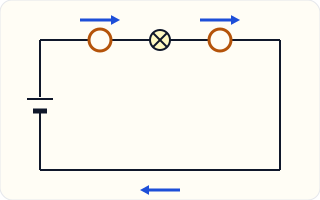
The figure shows a single loop with a cell, a lamp, and an ammeter on each side of the lamp. The blue arrows, all the same length, show the current: the same before the lamp, after it, and all the way around.
Both ammeters read the same. The lamp does not consume current; it converts the energy the charges carry into light and heat. If current were used up, charge would pile up somewhere in the loop, and charge conservation forbids it.
Benjamin Franklin guessed that electricity was the flow of a positive fluid, and the convention stuck: current is drawn from the positive terminal around the circuit to the negative one. In metal wires, the moving charges are actually electrons, flowing the opposite way.
For almost every purpose it makes no difference: a positive charge moving right and a negative charge moving left carry the same current. Circuit diagrams, engineers and the AP exam use conventional current, and so will this course.
A $9$ V battery gives each coulomb that passes through it $9$ joules of energy. As the coulomb flows around the circuit, it hands this energy to the components, dropping in potential across each. By the time it returns to the battery, all $9$ joules are gone.
A voltmeter measures this drop between two points. Because potential differences around a loop must add to zero, the drops across the components add up to the battery's emf. That is Kirchhoff's loop rule, developed in the lessons on resistance and circuit networks.
Electrons in a copper wire carrying a few amperes drift along at a fraction of a millimeter per second, slower than a snail. Yet a light switches on the instant you flip the switch.
The wire is already full of free electrons. When the switch closes, the electric field spreads along the wire at nearly the speed of light, and every electron starts drifting at once, like water in a full hose: turn the tap and water emerges from the far end immediately, though no single drop has traveled the hose's length.
Checking an answer. Household currents are fractions of an ampere to tens of amperes. Drift speeds are fractions of a millimeter per second. The currents in branches must add up to the current entering the junction.
The junction rule and the constant current around a loop both follow from charge conservation in a steady state: if more charge entered a region than left, charge would accumulate there, raising its potential and slowing the inflow until the flows balance. That balance is reached in nanoseconds.
The energy relation $E = QV$ is the definition of potential difference applied to moving charge. Dividing by time turns it into power: $P = IV$, joules per second, or watts.
An ammeter must be placed in series, so that the whole current passes through it, and it must have almost no resistance, so it does not reduce the current it measures. A voltmeter must be placed in parallel, across the component, and must have enormous resistance, so it draws almost no current.
Connecting an ammeter across a battery by mistake short-circuits it, which is why multimeters have a fuse on their current range. Digital multimeters, sold in every American hardware store, switch between these modes with a dial.
A phone battery is labeled in milliampere-hours, a unit of charge: $1$ mA·h is $0.001$ A for $3600$ s, or $3.6$ C. A $4000$ mA·h battery holds $14{,}400$ C, which at $3.8$ V is about $55$ kJ of energy.
Car batteries are rated in ampere-hours and cold-cranking amps, the current they can deliver at $0$ °F for thirty seconds, often $600$ A or more to turn a starter motor. Electric-car batteries are rated in kilowatt-hours, a unit of energy, because what matters for range is how much energy they store.
American household circuits are protected by breakers rated at $15$ or $20$ A. A $1500$ W hair dryer on a $120$ V circuit draws $12.5$ A; run a space heater on the same circuit and the total exceeds the breaker's rating, which trips to stop the wires overheating.
Big appliances such as dryers, ranges and electric-car chargers use $240$ V circuits, delivering the same power at half the current, which allows thinner wires. The National Electrical Code sets the wire gauge for each breaker: $14$-gauge copper for $15$ A, $12$-gauge for $20$ A.
The body conducts electricity through its salty fluids, and currents, not voltages, cause harm. About $1$ mA through the body can be felt, $10$ mA makes muscles clench so a person cannot let go, and about $100$ mA across the chest can stop the heart.
Dry skin has a high resistance, which limits current at low voltages; wet skin lowers it sharply. That is why bathrooms and kitchens require ground-fault circuit interrupters, which compare the current going out on one wire with the current returning on the other and cut the power in milliseconds if they differ by more than about $5$ mA.
A battery pushes charge one way around a circuit: direct current. The outlets in American homes supply alternating current, which reverses direction sixty times a second. Thomas Edison championed direct current for his first power stations in New York in the 1880s, while George Westinghouse and Nikola Tesla promoted alternating current, which transformers can step up to high voltage for efficient long-distance transmission and back down for safe use.
Alternating current won that contest, and the power grid carries it today. But direct current is returning: solar panels and batteries produce it, electronics run on it, and very long high-voltage direct-current lines, such as the Pacific DC Intertie from Oregon to Los Angeles, carry power more cheaply over great distances. The ideas of current and potential difference in this lesson apply to both kinds.
Most American electric-car owners charge at home. A standard $120$ V outlet, Level 1, supplies about $12$ A, or $1.44$ kW, adding only a few miles of range per hour. A Level 2 charger on a $240$ V circuit, like a clothes dryer's, supplies $32$ A or more, about $7.7$ kW.
At $7.68$ kW, adding $40$ kWh takes a little over five hours, easily done overnight. The charger's current is limited by the circuit breaker and wiring, typically a $40$ A breaker with $8$-gauge copper, sized so the wires stay cool during hours of steady current. Public DC fast chargers deliver hundreds of amperes at several hundred volts, adding the same energy in under half an hour.
The $14$-gauge copper wire in a typical American wall carries up to $15$ A. With $8.5 \times 10^{28}$ free electrons in every cubic meter of copper, the electrons need drift at only about a third of a millimeter per second to carry that current, taking nearly an hour to move a meter.
In an alternating-current home circuit, they do not even travel that far: they jiggle back and forth sixty times a second, moving a few micrometers each way. The energy reaches your lamp through the electric and magnetic fields surrounding the wires, which travel at nearly the speed of light, while the electrons themselves barely move.
It is natural to think a lamp uses up some of the current, so less flows back to the battery. Ammeters on either side of a lamp read exactly the same. What the lamp uses is energy: each coulomb arrives carrying energy and leaves with less.
A related error is to think a battery stores charge that it releases into the circuit. A battery is a pump: the charge that flows out of one terminal flows back into the other. What it stores and releases is chemical energy.
A toaster passes $5400$ C of charge in $10$ minutes. Convert the time.
$\Delta t = 600\ \text{s}$
Seconds.
Find the current.
$I = \dfrac{5400}{600} = 9.0\ \text{A}$
Charge per second.
It runs on $120$ V. Find the energy per coulomb.
$120\ \text{J/C}$
The meaning of a volt.
Find the total energy.
$E = QV = 5400 \times 120 = 648{,}000\ \text{J}$
About $650$ kJ.
Find the power.
$P = IV = 9.0 \times 120 = 1080\ \text{W}$
Matches $648{,}000/600$.
A charger supplies $2.0$ A for $90$ minutes. Find the charge.
$Q = 2.0 \times 5400 = 10{,}800\ \text{C}$
$90$ minutes is $5400$ s.
Count the electrons.
$N = \dfrac{10{,}800}{1.602 \times 10^{-19}} = 6.7 \times 10^{22}$
An enormous number.
Convert to milliampere-hours.
$\dfrac{10{,}800}{3.6} = 3000\ \text{mA·h}$
The battery-label unit.
Find the energy at $5.0$ V.
$E = 10{,}800 \times 5.0 = 54{,}000\ \text{J}$
$54$ kJ.
Express it in watt-hours.
$\dfrac{54{,}000}{3600} = 15\ \text{W·h}$
The unit on laptop batteries.
Compare with a food Calorie.
$\dfrac{54{,}000}{4184} = 12.9\ \text{Calories}$
Less than a stick of gum.
A $12$ V battery supplies $2.0$ A to two lamps in parallel. One lamp draws $0.80$ A. Find the other lamp's current.
$I_2 = 2.0 - 0.80 = 1.2\ \text{A}$
Junction rule.
Find the voltage across each lamp.
$12\ \text{V each}$
Parallel branches share the same ends.
Find the first lamp's power.
$P_1 = 0.80 \times 12 = 9.6\ \text{W}$
$P = IV$.
Find the second lamp's power.
$P_2 = 1.2 \times 12 = 14.4\ \text{W}$
The brighter lamp.
Check against the battery's output.
$P = 2.0 \times 12 = 24\ \text{W} = 9.6 + 14.4$
Energy is conserved.
Find the charge through the battery in a minute.
$Q = 2.0 \times 60 = 120\ \text{C}$
All returning to it.
Write the definition of current.
$I = \dfrac{\Delta Q}{\Delta t}$
Charge per second.
Substitute the values.
$I = \dfrac{45}{30}$
Coulombs over seconds.
Evaluate the current.
$180$ C of charge passes through a lamp in $5$ minutes. What is the current?
Complete the worked solution: a $9$ V battery drives $2.5$ A into a junction, where the current splits into two branches. The first branch carries $0.7$ A. Find the current in the second branch in A, the charge through the second branch in $60$ s in C, and the energy the battery supplies in $60$ s in J.
Apply the junction rule.
$I_2 = I - I_1 =$ b
Charge is conserved at a junction.
Find the charge through the second branch.
$Q_2 = I_2 \times 60 =$ q
Charge equals current times time.
Find the energy from the battery.
$E = VIt =$ e
All the current passes through the battery.
Check where the branches meet again.
$I_1 + I_2 = I$
The full current returns to the battery.
Match each term to its description.
| connected in series, with very low resistance | connected in parallel, with very high resistance | charge passing a point per second | energy transferred per coulomb between two points | |
|---|---|---|---|---|
| ammeter | ||||
| voltmeter | ||||
| current | ||||
| potential difference |
A charger delivers a steady $3$ A at $9$ V to a phone for $1.5$ hours. With $e = 1.602 \times 10^{-19}$ C, fill in the charge delivered in C, the number of electrons in units of $10^{22}$, and the energy delivered in kJ.
| value | |
|---|---|
| charge (C) | |
| electrons (10²²) | |
| energy (kJ) |
A device draws a steady $500$ mA from its battery. Write the charge that has flowed, in coulombs, as a function of the time $t$ in hours.
Answer:
A $14$-gauge copper wire, cross section $2.08$ mm², carries $10$ A. Copper has $8.5 \times 10^{28}$ free electrons per cubic meter, each with charge $1.602 \times 10^{-19}$ C. What is the electrons' drift speed, in mm/s?
Answer: mm/s
A home Level 2 charger in a garage supplies an electric car with $32$ A at $240$ V. Ignoring losses, how many hours does it take to add $20$ kWh to the battery?
Answer: h
Lesson test: one question per skill, one attempt each, no hints. Your answers are checked when you submit.
A device draws a steady $2000$ mA from its battery. Write the charge that has flowed, in coulombs, as a function of the time $t$ in hours.
Answer:
You can describe current and voltage. Explain to someone why a lamp does not use up current.
22. Your turn: $45$ C passes a point in $30$ s. What is the current?, step 3
$I = 1.5\ \text{A}$
Amperes.