Back to the on-screen lesson ·
Single-slit patterns, diffraction gratings and spectra, and the diffraction limit on resolution for eyes, telescopes and microscopes.
Paper packet. Every task here also exists on screen, where it is checked automatically; answers written on paper are not assessed by Nydus. When you are back at a device, enter your answers there.
By the end of this lesson you will be able to predict diffraction patterns and the resolution limits they set.
From the last lesson you know interference: waves from two sources reinforce or cancel depending on path difference, and two slits make evenly spaced fringes. This lesson looks at what happens with one wide opening, and with many openings, and finds the limit diffraction sets on every optical instrument.
| Term | What it means |
|---|---|
| Diffraction | The spreading of waves through an opening or around an obstacle. |
| Single-slit minima | Dark bands where $a\sin\theta = m\lambda$, for a slit of width $a$. |
| Central maximum | The bright middle band, twice as wide as the others. |
| Diffraction grating | Many equally spaced slits; bright orders where $d\sin\theta = m\lambda$. |
| Resolution | The ability to see two close objects as separate. |
| Rayleigh criterion | $\theta_{\min} = 1.22\lambda/D$ for a circular aperture of diameter $D$. |
When a wave passes through an opening, it spreads out; the narrower the opening compared with the wavelength, the more it spreads. Light through a single slit of width $a$ makes a bright central band with dark minima at
$$a\sin\theta = m\lambda, \quad m = 1, 2, \ldots$$
A diffraction grating, thousands of evenly spaced slits a distance $d$ apart, sends light into sharp bright orders at $d\sin\theta = m\lambda$, separating colors precisely. Every lens and mirror is an opening too, so diffraction sets the finest detail it can show: $\theta_{\min} = 1.22\lambda/D$.
Another way: picture
Picture ocean waves reaching a gap in a harbor wall. If the gap is wide, the waves pass through mostly straight; if it is about as wide as the distance between wave crests, they fan out in semicircles into the harbor. Light does the same, but its wavelength is so small that only very narrow slits show the effect plainly.
Another way: steps
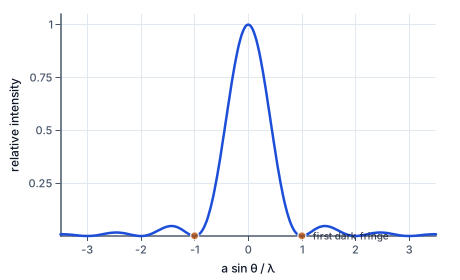
The figure shows the result: a tall central band twice as wide as the rest, dark bands where a sin θ is a whole number of wavelengths, and faint fringes between them.
Think of a single slit as a row of many small sources, each sending out waves. Straight ahead, all arrive in step: a bright center. At the angle where the far edge is one wavelength farther from the screen than the near edge, the slit can be split into two halves whose waves pair off half a wavelength apart and cancel: the first dark minimum, $a\sin\theta = \lambda$.
The central band stretches between the two first minima, so its width on a distant screen is $2\lambda L/a$. Narrow the slit and the band widens, the reverse of what the ray model would predict. Diffraction is the wave nature of light showing itself.
Rule thousands of fine, evenly spaced lines on glass and you have a diffraction grating. Light from every slit reinforces only at angles where neighbors differ in path by a whole number of wavelengths, $d\sin\theta = m\lambda$. With so many slits, the bright orders are extremely sharp and everything between is dark.
Because the angle depends on wavelength, a grating spreads light into a spectrum far more precisely than a prism. Astronomers attach gratings to telescopes to analyze starlight; chemists use them in spectrometers to identify compounds by the wavelengths they absorb.
Light from a point source passing through a circular lens does not focus to a point but to a small blurred disk ringed by faint circles, the Airy pattern. Two point sources closer together than about the disk's radius blur into one. The Rayleigh criterion puts the limit at $\theta_{\min} = 1.22\lambda/D$.
Larger apertures and shorter wavelengths resolve finer detail. That is why large telescopes see sharper images, why microscopes cannot resolve details much smaller than half a wavelength of light, and why electron microscopes, with far shorter wavelengths, see atoms.
You can hear around a corner but not see around it, because sound waves, about a meter long, diffract around doorways, while light waves, half a micrometer long, barely do. Radio waves hundreds of meters long bend around hills, which is why AM radio reaches valleys that FM, with meter-long waves, cannot.
Look at a distant streetlight through a window screen or a thin fabric and you see a cross of colored spots: diffraction by the fine mesh. The colors on a CD or DVD come from its closely spaced tracks acting as a reflection grating.
Checking an answer. Narrower slits must give wider patterns. Red must diffract more than blue. Larger telescopes must resolve smaller features.
Diffraction follows from Huygens's principle: every point on a wavefront acts as a source of new wavelets. Adding the wavelets from across an opening, with their path differences, gives the pattern; the single-slit minima are where they cancel in pairs.
The grating formula is the two-slit condition applied to every neighboring pair; with many slits the maxima sharpen because even a small departure from the right angle makes distant slits cancel. The factor $1.22$ comes from the geometry of a circular opening instead of a slit.
Heated gases emit light only at particular wavelengths, a fingerprint of each element. A grating spectrometer spreads that light into sharp lines whose angles give the wavelengths. Helium was discovered in the Sun's spectrum in 1868, decades before it was found on Earth.
The Sloan Digital Sky Survey, run from Apache Point Observatory in New Mexico, used grating spectrographs to measure the spectra of millions of galaxies and stars, mapping the universe in three dimensions. In hospitals, pulse oximeters and blood analyzers rely on similar measurements of how light is absorbed by wavelength.
The Hubble Space Telescope's $2.4$ m mirror could in principle resolve features about $100$ m across on the Moon. Ground-based telescopes rarely reach their diffraction limit, because turbulence in the atmosphere blurs images more than diffraction does.
Adaptive optics fixes that. Telescopes such as Keck in Hawaii shine a laser into the upper atmosphere to make an artificial star, measure how turbulence distorts it, and reshape a deformable mirror hundreds of times a second to cancel the distortion, letting a $10$ m mirror approach its diffraction limit.
Your pupil, a few millimeters across, limits your eye's resolution to about an arcminute. That is why Apple and other makers match phone pixel densities to viewing distance: once pixels are smaller than the eye can resolve at arm's length, adding more makes no visible difference.
Eagles, with larger pupils and more tightly packed receptors, resolve detail two to three times finer than people. At night, when the pupil widens, the diffraction limit improves, but the eye's lens then blurs more, so night vision is not sharper in practice.
Crystals are natural three-dimensional gratings, with atoms spaced a fraction of a nanometer apart, comparable to X-ray wavelengths. X-rays scattered from a crystal make a pattern of spots from which the arrangement of atoms can be worked out. William and Lawrence Bragg shared the 1915 Nobel Prize for the method.
Rosalind Franklin's X-ray diffraction photograph of DNA, Photo 51, revealed its helical shape and helped James Watson and Francis Crick build their double-helix model in 1953. Today synchrotrons such as the Advanced Photon Source at Argonne National Laboratory near Chicago determine the structures of proteins and drug targets this way.
Radio waves are much longer than light, so a radio dish must be enormous to resolve fine detail. The $100$ m Green Bank Telescope in West Virginia, among the largest steerable dishes in the world, still resolves only about as finely as a small backyard optical telescope.
Astronomers get around this by linking dishes thousands of kilometers apart, whose effective aperture is the distance between them. The Event Horizon Telescope, combining dishes from Hawaii to Spain to the South Pole, made the first image of a black hole's shadow in 2019, a feature smaller than an orange on the Moon.
Computer chips are printed by shining light through a mask onto a light-sensitive coating on silicon, a process called photolithography. Diffraction limits how small a feature the light can print: roughly the wavelength divided by the numerical aperture of the projection lens. For decades the industry shortened the wavelength, from mercury-lamp ultraviolet to deep-ultraviolet lasers at 193 nm, to keep shrinking transistors.
The newest machines use extreme ultraviolet light at 13.5 nm, made by blasting droplets of molten tin with a laser fifty thousand times a second. Because no glass lens transmits such light, the machines use curved multilayer mirrors, each a stack of alternating thin films that reflect by interference. The smallest features on today's chips are narrower than a hundred atoms, and every step in shrinking them has been a fight against diffraction.
No telescope on Earth or in orbit can photograph the Apollo landers left on the Moon. The descent stages are about $4$ m across. The Hubble Space Telescope, with a $2.4$ m mirror, is limited by diffraction to $1.22\lambda/D$, about $2.8 \times 10^{-7}$ rad, which at the Moon's distance of $384{,}000$ km is about $107$ m, far larger than a lander.
Seeing the landers required going there: NASA's Lunar Reconnaissance Orbiter, circling only $50$ km above the surface, has photographed all six Apollo landing sites, showing the descent stages, rovers and even the astronauts' footpaths. Its camera's small aperture is enough because it is so close.
At night, as an oncoming car approaches on a straight rural highway, it first appears as a single light and then resolves into two headlights. The diffraction limit of the pupil sets the best possible distance: with a $5$ mm pupil and $550$ nm light, headlights $1.5$ m apart can be told apart from about $11$ km.
Real eyes do worse, because the eye's lens is not perfect and the receptors on the retina have finite spacing; most people resolve the pair at a few kilometers. Highway engineers use these limits when designing sight distances and the spacing of warning lights, and astronomers use the same Rayleigh criterion for their telescopes.
The ray model suggests that a narrower slit should make a narrower beam. Once the slit is comparable to the wavelength, the opposite happens: the central band widens as $\lambda/a$. Squeezing a wave makes it spread.
A related error is to think a bigger magnification always shows more detail. Diffraction sets a limit on detail fixed by the aperture; magnifying beyond it only enlarges the blur, what microscopists call empty magnification.
Red light, $650$ nm, passes through a slit $0.10$ mm wide onto a wall $2.0$ m away. Find the first minimum's angle.
$\sin\theta = \dfrac{650 \times 10^{-9}}{1.0 \times 10^{-4}} = 0.0065 \Rightarrow \theta = 0.37°$
Small angle.
Find its position on the wall.
$y_1 = 2.0 \times 0.0065 = 0.013\ \text{m}$
$L\sin\theta$ for small angles.
Find the central band's width.
$W = 2 \times 13 = 26\ \text{mm}$
Between the first minima.
Halve the slit width. Find the new width.
$W = 52\ \text{mm}$
Narrower slit, wider band.
Compare with the slit itself.
$\dfrac{26}{0.10} = 260$
The pattern is far wider than the slit.
A grating has $500$ lines per mm. Find the line spacing.
$d = \dfrac{1}{500}\ \text{mm} = 2.0 \times 10^{-6}\ \text{m}$
Two micrometers.
Find the first-order angle for violet, $400$ nm.
$\sin\theta = \dfrac{400 \times 10^{-9}}{2.0 \times 10^{-6}} = 0.20 \Rightarrow \theta = 11.5°$
Grating equation.
Find it for red, $700$ nm.
$\sin\theta = 0.35 \Rightarrow \theta = 20.5°$
Red bends more.
Find the spread of the first-order spectrum.
$20.5° - 11.5° = 9.0°$
A full rainbow.
Find the highest order for red.
$m \le \dfrac{d}{\lambda} = \dfrac{2000}{700} = 2.86 \Rightarrow m = 2$
The sine cannot exceed one.
Explain why the orders overlap at higher $m$.
$\text{violet's third order falls inside red's second}$
Spectra blend.
A backyard telescope has a $20$ cm mirror. Find its limiting angle at $550$ nm.
$\theta = 1.22 \times \dfrac{550 \times 10^{-9}}{0.20} = 3.36 \times 10^{-6}\ \text{rad}$
Rayleigh criterion.
Convert to arcseconds.
$3.36 \times 10^{-6} \times 206{,}265 = 0.69''$
Radians to arcseconds.
Two stars are $1.2''$ apart. Decide.
$1.2'' > 0.69'' \Rightarrow \text{resolved}$
Seen as two.
Another pair is $0.4''$ apart. Decide.
$0.4'' < 0.69'' \Rightarrow \text{not resolved}$
One blur.
Find the aperture needed for the second pair.
$D = 1.22 \times \dfrac{550 \times 10^{-9} \times 206{,}265}{0.4} = 0.35\ \text{m}$
A $35$ cm mirror.
Note the practical limit.
$\text{turbulence blurs to about } 1''$
Steady nights matter more than size.
Find the line spacing.
$d = \dfrac{1}{400}\ \text{mm} = 2.5 \times 10^{-6}\ \text{m}$
One over lines per length.
Find the sine of the angle.
$\sin\theta = \dfrac{500 \times 10^{-9}}{2.5 \times 10^{-6}} = 0.20$
Wavelength over spacing.
Take the inverse sine.
Light of wavelength $500$ nm strikes a diffraction grating with $600$ lines per millimeter. At what angle, in degrees, is the first-order bright line?
Complete the worked solution: a CD's tracks are $1.6$ μm apart, so it acts as a reflection grating. For light of wavelength $650$ nm, find the first-order angle in degrees, the next order's angle in degrees, and the number of tracks per millimeter.
Find the first-order angle.
$\theta_{\text{I}} = \sin^{-1}\dfrac{\lambda}{d} =$ a
First bright order.
Find the next order's angle.
$\theta_{\text{II}} = \sin^{-1}\dfrac{m\lambda}{d} =$ b
The next whole number of wavelengths.
Find the tracks per millimeter.
$N = \dfrac{1}{d} =$ n
With $d$ in millimeters.
Explain the rainbow on a disc.
$\text{each color at its own angle}$
Longer wavelengths bend more.
Match each change to its effect on diffraction.
| a wider central bright band | more spreading at the same opening | orders spread farther apart and sharper | finer detail can be resolved | |
|---|---|---|---|---|
| a narrower single slit | ||||
| a longer wavelength | ||||
| a grating with more lines per millimeter | ||||
| a larger telescope aperture |
Light of wavelength $550$ nm passes through a single slit $25$ μm wide onto a screen $1.2$ m away. Fill in the angle of the first dark minimum in degrees, its distance from the center of the pattern in mm, and the width of the central bright band in mm.
| value | |
|---|---|
| angle of first minimum (degrees) | |
| position of first minimum (mm) | |
| central band width (mm) |
Light of wavelength $650$ nm passes through a single slit onto a screen $3$ m away. Write the width of the central bright band, in mm, as a function of the slit width $a$ in mm.
Answer:
What is the smallest feature on the Moon, $3.84 \times 10^8$ m away, that a backyard telescope, with an aperture of $0.2$ m, can resolve in $550$ nm light? Give it in meters, ignoring the atmosphere.
Answer: m
A car's headlights are $1.8$ m apart. At night your pupil is $6$ mm wide. Using $550$ nm light and the diffraction limit alone, from how far away, in km, can your eye just tell the two lights apart?
Answer: km
Lesson test: one question per skill, one attempt each, no hints. Your answers are checked when you submit.
Light of wavelength $450$ nm passes through a single slit onto a screen $2.5$ m away. Write the width of the central bright band, in mm, as a function of the slit width $a$ in mm.
Answer:
You can analyze diffraction. Explain to someone why making a slit narrower makes the light spread more.
23. Your turn: light of $500$ nm meets a grating with $400$ lines per mm. What is the first-order angle?, step 3
$\theta = 11.5°$
First order.