Back to the on-screen lesson ·
The field as force per charge, the inverse-square field of a point charge, field lines, uniform fields between plates, and forces on charges.
Paper packet. Every task here also exists on screen, where it is checked automatically; answers written on paper are not assessed by Nydus. When you are back at a device, enter your answers there.
By the end of this lesson you will be able to find electric fields of point charges and the forces and motions they cause.
From the last lesson you know Coulomb's law, $F = kq_1q_2/r^2$, and that like charges repel. From Physics 1 you know the gravitational field $g$, the force per kilogram near Earth. This lesson builds the same idea for charge: the force per coulomb a charge would feel at each point in space.
| Term | What it means |
|---|---|
| Electric field | $\vec{E} = \vec{F}/q$, the force per unit positive charge, in N/C. |
| Test charge | A small positive charge used to probe a field without disturbing it. |
| Field of a point charge | $E = kQ/r^2$, pointing away from $+Q$ or toward $-Q$. |
| Field line | A line drawn along the field's direction; crowding shows strength. |
| Uniform field | The same size and direction everywhere, as between parallel plates. |
| Force in a field | $\vec{F} = q\vec{E}$; negative charges are pushed against the field. |
A charge $Q$ changes the space around it: any charge $q$ placed nearby feels a force. The electric field at a point is that force per unit positive charge:
$$\vec{E} = \frac{\vec{F}}{q}, \qquad E = \frac{kQ}{r^2} \text{ for a point charge}.$$
The field exists whether or not a charge is there to feel it. Knowing the field, the force on any charge is $\vec{F} = q\vec{E}$: along the field for a positive charge, against it for a negative one. Field lines map the field: they start on positive charges and end on negative ones, point along $\vec{E}$, and crowd together where the field is strong.
Another way: picture
Picture a weather map with wind arrows at every city. The arrows exist whether or not a kite is flying there; a kite simply feels the wind that is already blowing. An electric field is a map like that, of the push a positive charge would feel at each point.
Another way: steps
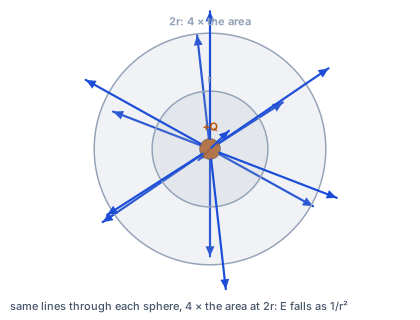
The scene shows a positive point charge with its field lines streaming outward, crossing two spheres of radius $r$ and $2r$. The same lines pierce both spheres, but the outer sphere has four times the area, so the lines are spread four times as thinly. The field there is a quarter as strong.
That is where the inverse square comes from: a fixed number of field lines spreads over a sphere whose area grows as $r^2$. Gravity and light intensity fall off the same way for the same geometric reason.
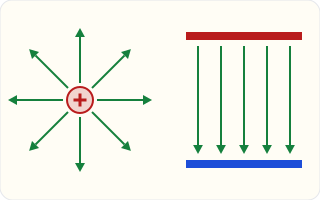
The left panel shows the field of a single positive charge: straight lines radiating out like spokes, crowded near the charge and spreading apart. The right panel shows the field between two parallel plates with opposite charges: straight, parallel, evenly spaced lines running from the positive plate to the negative one.
The plate field is uniform: a charge anywhere between the plates feels the same force. That makes parallel plates the workhorse of electric-field experiments, from Millikan's oil drops to the deflection plates of old television tubes.
Once the field is known, the force on any charge follows: $\vec{F} = q\vec{E}$. A proton in a field of $1000$ N/C feels $1.6 \times 10^{-16}$ N along the field; an electron feels the same size of force, opposite to the field.
That force is enormous for such a light particle. An electron's acceleration in a $1000$ N/C field is $1.8 \times 10^{14}$ m/s², about twenty trillion times gravity. That is why electric fields are used to steer electron beams and why gravity can usually be ignored for electrons and ions. For a dust grain or an oil drop, which is billions of times heavier, weight and electric force can be comparable.
Between 1909 and 1913, Robert Millikan at the University of Chicago sprayed tiny oil drops between two horizontal plates and watched them through a microscope. Some drops picked up extra electrons. By adjusting the field until a drop hung motionless, he balanced its weight against the electric force: $qE = mg$.
Knowing each drop's mass from its falling speed, he found every charge was a whole multiple of $1.6 \times 10^{-19}$ C, the elementary charge. The experiment earned him the 1923 Nobel Prize and remains a classic of American physics.
Checking an answer. Field strengths near everyday charges are hundreds to millions of N/C. Negative charges must be pushed against the field. A field at twice the distance must be a quarter as strong.
Dividing Coulomb's force by the test charge $q$ removes $q$ from the result: $E = kQ/r^2$ depends only on the source. That is what lets us speak of the field as a property of space. The test charge must be small, so it does not push the source charges around and change the field it is measuring.
Fields of several charges add as vectors, which the superposition lesson develops. The uniform field between plates holds well away from the edges, where lines bulge outward; this fringing is small when the plates are wide and close.
Michael Faraday introduced field lines in the 1830s as a way to picture forces. Later, James Clerk Maxwell showed that fields are physically real: they store energy and carry it across space, and changing fields travel as electromagnetic waves at the speed of light.
When sunlight warms your skin, energy has crossed $150$ million km of empty space in the electric and magnetic fields of the light. Fields are not just bookkeeping; they are how charges influence each other without touching.
On a fair-weather day, a field of about $100$ to $150$ N/C points down toward the ground everywhere. Earth's surface is negative and the upper atmosphere positive, charged by thunderstorms around the globe acting like a battery. Between your head and feet there is a potential difference of a couple of hundred volts, though you feel nothing, because you are a conductor and the field rearranges around you.
Under thunderclouds the field can reverse and exceed $10{,}000$ N/C. Hair standing on end outdoors is a warning sign of a strong field and imminent lightning: the National Weather Service advises going indoors immediately.
In a conductor, free charges move until the field inside is zero; otherwise they would keep moving. So a hollow metal box shields its interior from outside fields. This is a Faraday cage.
Cars and airplanes act as rough Faraday cages, which is why they protect occupants from lightning: the charge flows over the metal skin. MRI rooms are lined with copper to keep out radio interference, and your microwave oven's door has a metal mesh that keeps its fields inside while letting you see through the holes.
Nerve and heart cells work by moving ions across their membranes, which sets up electric fields that spread through the body's tissues. The electrocardiogram, or ECG, measures the tiny potential differences these fields produce between electrodes on the skin.
Sharks and platypuses sense electric fields directly. A shark's snout is dotted with jelly-filled pores, the ampullae of Lorenzini, that detect fields as weak as a few billionths of a volt per centimeter, enough to find fish hidden in sand by the fields of their muscles. Engineers have borrowed the idea: some shark deterrents worn by surfers and divers emit a strong electric field that overwhelms these sensors and drives sharks away.
Spiders can travel hundreds of kilometers by ballooning: they climb to a high point, release silk threads and float away, sometimes even on windless days. In 2018, researchers at the University of Bristol showed that spiders sense Earth's atmospheric electric field with the hairs on their legs and take off when it strengthens.
Spider silk picks up negative charge. For a one-milligram spider, holding it up with an upward field of $150$ N/C would need about $65$ nC, a large charge for a thread, so the field likely helps lift the silk while air currents do much of the rest. The fair-weather field points downward, pushing negative silk up; storm fields can be far stronger.
Robert Millikan's oil-drop experiment in Chicago gave the first precise value of the electron's charge. A drop of mass $3.2 \times 10^{-15}$ kg carrying five extra electrons hangs still in a field of about $39{,}000$ N/C: electric force up balancing weight down.
Physics students across the United States repeat a version of the experiment with latex spheres of known size. They find that the charges cluster at whole multiples of one value, the elementary charge. Millikan's result, combined with the charge-to-mass ratio J.J. Thomson measured, gave the electron's mass, and charge's graininess has been a pillar of physics ever since.
A common mistake is to think the electric field exists only where a charge is placed to feel it. The field is created by its source charges and exists at every point around them; a test charge merely reveals it. With no test charge, the field is still there, and it still stores energy.
A related error is to think a field line is the path a charge follows. A charge released from rest starts along the line, but once moving, its inertia carries it off the line wherever the lines curve.
A small sphere carries $+6.0$ nC. Find the field $15$ cm away. Convert units.
$Q = 6.0 \times 10^{-9}\ \text{C}, \ r = 0.15\ \text{m}$
SI units.
Apply the point-charge formula.
$E = \dfrac{9.0 \times 10^9 \times 6.0 \times 10^{-9}}{0.15^2}$
Numerator $54$ N·m²/C.
Evaluate the field.
$E = 2400\ \text{N/C}$
Pointing away from the sphere.
Find the force on a $-2.0$ nC charge placed there.
$F = 2.0 \times 10^{-9} \times 2400 = 4.8 \times 10^{-6}\ \text{N}$
Size of $qE$.
Give the direction.
$\text{toward the sphere}$
Negative charge, against the field.
An electron moving at $2.0 \times 10^7$ m/s enters a $5000$ N/C field between plates $4.0$ cm long, perpendicular to its motion. Find the force.
$F = 1.602 \times 10^{-19} \times 5000 = 8.01 \times 10^{-16}\ \text{N}$
$F = eE$.
Find the acceleration.
$a = \dfrac{8.01 \times 10^{-16}}{9.109 \times 10^{-31}} = 8.79 \times 10^{14}\ \text{m/s}^2$
Newton's second law.
Find the time between the plates.
$t = \dfrac{0.040}{2.0 \times 10^7} = 2.0 \times 10^{-9}\ \text{s}$
Constant forward speed.
Find the sideways deflection.
$y = \tfrac{1}{2} \times 8.79 \times 10^{14} \times (2.0 \times 10^{-9})^2 = 1.76 \times 10^{-3}\ \text{m}$
Projectile-like motion.
Express it in millimeters.
$y = 1.8\ \text{mm}$
Toward the positive plate.
Compare with gravity's effect.
$\tfrac{1}{2} \times 9.8 \times (2.0 \times 10^{-9})^2 = 2 \times 10^{-17}\ \text{m}$
Utterly negligible.
An oil drop of mass $4.0 \times 10^{-15}$ kg hangs still in a field of $49{,}000$ N/C pointing down. Find its weight.
$mg = 4.0 \times 10^{-15} \times 9.8 = 3.92 \times 10^{-14}\ \text{N}$
Downward.
Set the electric force equal.
$qE = 3.92 \times 10^{-14}\ \text{N}$
Upward, to balance.
Solve for the charge.
$q = \dfrac{3.92 \times 10^{-14}}{49{,}000} = 8.0 \times 10^{-19}\ \text{C}$
Size of the charge.
Count the electrons.
$\dfrac{8.0 \times 10^{-19}}{1.602 \times 10^{-19}} = 5.0$
A whole number.
Find the sign.
$\text{negative}$
Force up against a downward field.
Predict what happens if one electron is lost.
$\text{the drop starts to fall}$
Weaker upward force.
Write the force law.
$F = qE$
Field times charge.
Substitute the values.
$F = 1.602 \times 10^{-19} \times 3000$
The proton's charge.
Evaluate the force.
A small sphere carries $+4$ nC. What is the size of the electric field it produces $20$ cm away, where no other charge is present? Use $k = 9.0 \times 10^9$ N·m²/C².
Complete the worked solution: an electron starts at rest in a uniform field of $5000$ N/C between two plates $2.0$ cm apart. With $e = 1.602 \times 10^{-19}$ C and $m_e = 9.109 \times 10^{-31}$ kg, find the force on it in units of $10^{-16}$ N, its acceleration in units of $10^{14}$ m/s², and its speed on reaching the far plate in units of $10^6$ m/s.
Find the force.
$F = eE =$ f
In units of $10^{-16}$ N.
Find the acceleration.
$a = \dfrac{F}{m_e} =$ a
In units of $10^{14}$ m/s².
Find the speed after crossing.
$v = \sqrt{2ad} =$ v
In units of $10^6$ m/s.
Note the direction of motion.
$\text{against the field}$
Electrons are negative.
Match each feature of a field-line diagram to what it means.
| on positive charges | the strength of the field | the direction of force on a positive charge | a uniform field, as between charged plates | |
|---|---|---|---|---|
| where lines start | ||||
| how close together lines are | ||||
| the arrow on a line | ||||
| parallel lines evenly spaced |
A point charge of $8$ nC sits alone. With $k = 9.0 \times 10^9$ N·m²/C², fill in the size of its field in N/C at $20$ cm, at twice that distance, and at three times that distance.
| value | |
|---|---|
| field at r (N/C) | |
| field at 2r (N/C) | |
| field at 3r (N/C) |
A point charge of $2$ nC sits alone. With $k = 9.0 \times 10^9$ N·m²/C², write the size of its electric field, in N/C, as a function of the distance $r$ in meters.
Answer:
In a Millikan apparatus, an oil drop of mass $3.2 \times 10^{-15}$ kg carrying $5$ extra electrons hangs motionless between horizontal plates. With $g = 9.8$ m/s² and $e = 1.602 \times 10^{-19}$ C, what is the size of the field between the plates, in kN/C?
Answer: kN/C
Spiders can take flight on silk threads lifted partly by Earth's atmospheric electric field. For a spider of mass $2.0$ mg in an upward field of $200$ N/C on its negatively charged silk, what charge in nC would the electric force alone need to hold it up? Use $g = 9.8$ m/s².
Answer: nC
Lesson test: one question per skill, one attempt each, no hints. Your answers are checked when you submit.
A point charge of $5$ nC sits alone. With $k = 9.0 \times 10^9$ N·m²/C², write the size of its electric field, in N/C, as a function of the distance $r$ in meters.
Answer:
You can work with electric fields. Explain to someone why the field of a point charge falls as the square of the distance.
21. Your turn: a proton sits in a field of $3000$ N/C. What force does it feel?, step 3
$F = 4.8 \times 10^{-16}\ \text{N}$
Along the field.