Back to the on-screen lesson ·
Pair energy $kq_1q_2/r$, energy conservation for charges crossing voltages, the electron-volt, and energy stored in capacitors.
Paper packet. Every task here also exists on screen, where it is checked automatically; answers written on paper are not assessed by Nydus. When you are back at a device, enter your answers there.
By the end of this lesson you will be able to use energy conservation for moving charges and find the energy stored in a capacitor.
From Physics 1 you know that energy is conserved and that potential energy can turn into kinetic energy, as a falling ball speeds up. From the last lesson you know electric potential, $V = U/q$, measured in volts. This lesson uses energy conservation to follow charges through fields and introduces the capacitor as an energy store.
| Term | What it means |
|---|---|
| Electric potential energy | $U = kq_1q_2/r$ for a pair of charges, zero when far apart. |
| Energy of a charge in a potential | $U = qV$. |
| Electron-volt | $1$ eV $= 1.602 \times 10^{-19}$ J, the energy of one electron across one volt. |
| Capacitor | Two conductors separated by an insulator, storing equal and opposite charges. |
| Capacitance | $C = Q/V$, in farads; for parallel plates $C = \varepsilon_0 A/d$. |
| Energy in a capacitor | $U = \tfrac{1}{2}CV^2 = \tfrac{1}{2}QV$. |
Two charges have electric potential energy
$$U = \frac{kq_1q_2}{r},$$
positive for like charges, which had to be pushed together, and negative for unlike charges, which must be pulled apart. A single charge $q$ at a point where the potential is $V$ has $U = qV$. When a charge moves through a potential difference, energy is conserved:
$$\Delta K = -q\Delta V.$$
A positive charge speeds up moving to lower potential; a negative one, like an electron, speeds up moving to higher potential. A capacitor stores energy $\tfrac{1}{2}CV^2$ in the field between its plates.
Another way: picture
Picture a ball rolling down a hill: it loses height and gains speed, and its total energy stays the same. A positive charge between two plates does the same, rolling from the high-potential plate to the low one. Voltage is the height of the hill, and charge is how much the ball weighs.
Another way: steps
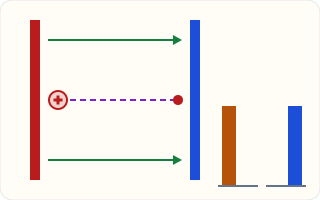
The figure follows a positive charge released at rest beside the positive plate. The field pushes it across the gap. The energy bars show its potential energy, full at the start, draining away as it crosses, while its kinetic energy fills up. On arrival at the negative plate, all the potential energy has become kinetic.
The total never changes. The kinetic energy gained is $q\Delta V$, whatever the gap and whatever the field's strength: a proton crossing $1000$ V always gains $1000$ eV. That is why accelerators are rated in volts.
Push two positive charges together and you do work against their repulsion; that work is stored as positive potential energy, released if you let go. Two unlike charges attract; their energy is negative, meaning you must add energy to pull them apart.
Atoms are bound systems with negative energy. The electron in hydrogen has electric potential energy of about $-27$ eV and kinetic energy $+13.6$ eV, for a total of $-13.6$ eV: you must supply $13.6$ eV to free it. Chemistry is the bookkeeping of these electric energies as atoms rearrange: burning fuel releases energy because the electrons end up more tightly bound, with more negative electric energy, than before.
Joules are enormous for single particles, so physicists use the electron-volt, the energy an electron gains crossing one volt: $1.602 \times 10^{-19}$ J. An electron crossing $100$ V gains $100$ eV; a doubly charged ion crossing $100$ V gains $200$ eV.
Converting to speed requires joules and kilograms. An electron with $100$ eV moves at about $5.9$ million meters per second, two percent of light speed. At tens of thousands of eV, relativity begins to matter, and the simple formula $\tfrac{1}{2}mv^2$ must be corrected.
A capacitor is two conductors, often flat plates, separated by an insulator. Connect it to a battery and charge $+Q$ collects on one plate and $-Q$ on the other. The charge is proportional to the voltage: $Q = CV$, where the capacitance $C$ is measured in farads. For parallel plates, $C = \varepsilon_0 A/d$: bigger plates and smaller gaps store more charge.
Charging takes work, because each new bit of charge must be pushed onto a plate that already repels it. The energy stored is $U = \tfrac{1}{2}CV^2$, held in the electric field between the plates. Doubling the voltage quadruples the energy.
Checking an answer. Unlike charges must have negative pair energy. A charge released from rest must gain kinetic energy. Capacitor energy must quadruple when voltage doubles.
Energy conservation holds because the electric force is conservative: the work it does depends only on the endpoints. The pair energy formula comes from adding up that work as one charge is brought in from far away, integrating Coulomb's force.
The capacitor energy has a factor of one half because the voltage rises from zero to $V$ during charging: the average voltage the charge is pushed against is $V/2$. The same reasoning gives $\tfrac{1}{2}kx^2$ for a spring.
Every particle accelerator uses $\Delta K = q\Delta V$. Early accelerators used a single large voltage: Robert Van de Graaff built generators at MIT in the 1930s reaching millions of volts. Modern machines pass particles through many gaps in succession, each adding a little energy.
At Fermilab near Chicago, the Tevatron accelerated protons to a trillion electron-volts. SLAC's two-mile linear accelerator in California gave electrons $50$ billion eV. Hospitals use smaller linear accelerators, a meter long, to produce the X-ray beams that treat cancer.
Nearly every electronic device contains capacitors. They smooth the output of power supplies, filter signals, store bits in computer memory, and sense touch: a phone's touchscreen detects your finger by the change in capacitance it causes between tiny electrodes.
Camera flashes charge a capacitor from a small battery over a few seconds, then dump it through the flash tube in a millisecond, far faster than the battery could. Supercapacitors, with capacitances of thousands of farads, now buffer power in hybrid buses and wind turbines, charging and discharging millions of times without wearing out the way a chemical battery does.
Where exactly is a capacitor's energy? It is stored in the electric field between the plates, with an energy density $\tfrac{1}{2}\varepsilon_0E^2$ joules per cubic meter. This view, due to Maxwell, is not just a convenience: fields carry energy across space, as in light.
The energy density explains why air-gap capacitors store little energy: air breaks down at about $3$ million V/m, which limits the field. Filling the gap with a material that tolerates stronger fields, and whose molecules polarize to hold more charge, raises the capacity enormously.
An insulator placed between a capacitor's plates, called a dielectric, raises the capacitance by a factor $\kappa$, its dielectric constant. Its molecules polarize in the field, partly canceling it, so more charge can sit on the plates at the same voltage. Plastic films have $\kappa$ of $2$ to $3$; some ceramics exceed $1000$.
Dielectrics are why modern capacitors are so small. A ceramic capacitor the size of a grain of rice can hold a microfarad, and billions of them are made each year for phones and cars, where an electric vehicle may contain ten thousand.
A thundercloud and the ground below behave like the plates of an enormous capacitor, with the air as the dielectric. As charge separates in the cloud, the voltage between cloud and ground climbs to hundreds of millions of volts, and the energy stored in the field grows.
When the field somewhere exceeds what air can withstand, a lightning channel forms and the capacitor discharges. A typical flash moves about $5$ C across $100$ million V, releasing roughly $\tfrac{1}{2}QV$, a quarter of a billion joules, most of it as heat, light and the shock wave we hear as thunder.
Automated external defibrillators hang in schools, airports and offices across the United States. When a heart goes into ventricular fibrillation, its muscle quivers without pumping. The AED charges a capacitor of about $150$ to $200$ μF to around $2000$ V, storing a few hundred joules.
At the press of a button, the capacitor discharges through the chest in about ten milliseconds, a pulse of tens of kilowatts. The current momentarily stops all the heart's electrical activity, giving its natural pacemaker a chance to restart a normal rhythm. The American Heart Association credits public AEDs with doubling survival rates when bystanders use them promptly.
Most American cancer centers have a medical linear accelerator, about a meter long, that pushes electrons through a series of cavities, each adding energy. The electrons reach $6$ to $18$ million electron-volts, far more than any single voltage in the machine, by crossing many gaps in step with an oscillating field.
The fast electrons strike a tungsten target, producing high-energy X-rays aimed at the tumor from several directions so that healthy tissue receives less dose. About half of all cancer patients receive radiation therapy, and every treatment beam begins with the simple rule that a charge crossing a potential difference gains energy $q\Delta V$.
It is natural to speak of the potential energy of one charge, as if it carried the energy with it. The energy belongs to the pair of charges, or to a charge together with the field it sits in. Move either charge and the energy changes.
A related error is to drop the signs. The pair energy of unlike charges is negative, and moving them closer makes it more negative, releasing energy as motion. Treating all energies as positive gets the direction of energy flow backward.
An old color television accelerated electrons through $25{,}000$ V. Find the kinetic energy in eV.
$K = 25{,}000\ \text{eV} = 25\ \text{keV}$
One electron across the voltage.
Convert to joules.
$K = 25{,}000 \times 1.602 \times 10^{-19} = 4.0 \times 10^{-15}\ \text{J}$
SI units.
Find the speed classically.
$v = \sqrt{\dfrac{2 \times 4.0 \times 10^{-15}}{9.109 \times 10^{-31}}} = 9.4 \times 10^7\ \text{m/s}$
From $K = \tfrac{1}{2}mv^2$.
Compare with light speed.
$\dfrac{9.4 \times 10^7}{3.0 \times 10^8} = 0.31$
Nearly a third.
Judge the classical formula.
$\text{about } 4\% \text{ error from relativity}$
Good enough for estimates.
Charges of $+3.0$ μC and $-3.0$ μC are $10$ cm apart. Find their energy.
$U_1 = \dfrac{9.0 \times 10^9 \times (3.0 \times 10^{-6}) \times (-3.0 \times 10^{-6})}{0.10} = -0.81\ \text{J}$
Negative: bound.
Find their energy at $30$ cm.
$U_2 = \dfrac{-0.081}{0.30} = -0.27\ \text{J}$
Less negative.
Find the work to separate them to $30$ cm.
$W = U_2 - U_1 = -0.27 - (-0.81) = 0.54\ \text{J}$
Energy must be added.
Find the work to separate them completely.
$W = 0 - (-0.81) = 0.81\ \text{J}$
Zero energy at infinity.
Interpret the result.
$0.81\ \text{J is the binding energy}$
Like ionizing an atom.
Predict what happens if released from $30$ cm.
$\text{they gain } 0.54\ \text{J rushing back to } 10\ \text{cm}$
Energy returns as motion.
A flash unit charges a $150$ μF capacitor to $330$ V. Find the charge stored.
$Q = CV = 150 \times 10^{-6} \times 330 = 0.0495\ \text{C}$
From $Q = CV$.
Find the energy stored.
$U = \tfrac{1}{2} \times 150 \times 10^{-6} \times 330^2 = 8.17\ \text{J}$
Half $CV^2$.
Check with the other form.
$U = \tfrac{1}{2}QV = 0.5 \times 0.0495 \times 330 = 8.17\ \text{J}$
Consistent.
The flash lasts $1.0$ ms. Find the average power.
$P = \dfrac{8.17}{0.0010} = 8170\ \text{W}$
Enormous for a moment.
The battery recharges it in $3.0$ s. Find the charging power.
$P = \dfrac{8.17}{3.0} = 2.7\ \text{W}$
Modest.
Explain the capacitor's role.
$\text{stores slowly, releases quickly}$
Power multiplication.
Write the stored energy.
$U = \tfrac{1}{2}CV^2$
Capacitor energy.
Substitute the values.
$U = 0.5 \times 47 \times 10^{-6} \times 144$
Square the voltage.
Evaluate the energy.
Charges of $+6$ μC and $-1$ μC sit $20$ cm apart. Taking the energy as zero when they are far apart, what is the electric potential energy of the pair? Use $k = 9.0 \times 10^9$ N·m²/C².
Complete the worked solution: two small spheres each carry $+2$ μC. They are pushed slowly from $40$ cm apart to $10$ cm apart. With $k = 9.0 \times 10^9$ N·m²/C², find the pair's energy at the start, at the end, and the work needed, all in J.
Find the energy at the start.
$U_1 = \dfrac{kq^2}{r_1} =$ x
Farther apart, less energy.
Find the energy at the end.
$U_2 = \dfrac{kq^2}{r_2} =$ y
Closer, more energy.
Subtract for the work needed.
$W = U_2 - U_1 =$ w
Pushing against repulsion.
Predict what happens on release.
$\text{the energy returns as kinetic energy}$
The spheres fly apart.
Match each situation or unit to the correct statement.
| positive potential energy | negative potential energy | the energy gained crossing one volt | energy one-half C V squared | |
|---|---|---|---|---|
| two like charges near each other | ||||
| two unlike charges near each other | ||||
| one electron-volt | ||||
| a charged capacitor |
A proton starts at rest and is accelerated through a potential difference of $1000$ V. With $e = 1.602 \times 10^{-19}$ C and $m_p = 1.673 \times 10^{-27}$ kg, fill in its kinetic energy in keV, in units of $10^{-16}$ J, and its speed in units of $10^5$ m/s.
| value | |
|---|---|
| kinetic energy (keV) | |
| kinetic energy (10⁻¹⁶ J) | |
| speed (10⁵ m/s) |
A $10$ μF capacitor is charged to a voltage $V$, in volts. Write the energy it stores, in μJ, as a function of $V$.
Answer:
An electron starts at rest and is accelerated through $200$ V. With $e = 1.602 \times 10^{-19}$ C and $m_e = 9.109 \times 10^{-31}$ kg, what is its final speed, in units of $10^6$ m/s?
Answer: 10⁶ m/s
An automated external defibrillator in a school hallway charges a $120$ μF capacitor to $1800$ V before delivering a shock. How much energy does the capacitor store, in J?
Answer: J
Lesson test: one question per skill, one attempt each, no hints. Your answers are checked when you submit.
A $100$ μF capacitor is charged to a voltage $V$, in volts. Write the energy it stores, in μJ, as a function of $V$.
Answer:
You can use electric potential energy. Explain to someone why an electron speeds up moving toward higher potential.
22. Your turn: a $47$ μF capacitor is charged to $12$ V. How much energy does it store?, step 3
$U = 3.38 \times 10^{-3}\ \text{J}$
About $3.4$ mJ.