Back to the on-screen lesson ·
Potential as energy per charge, the potential of a point charge, equipotentials, potentials that add as numbers, and uniform fields.
Paper packet. Every task here also exists on screen, where it is checked automatically; answers written on paper are not assessed by Nydus. When you are back at a device, enter your answers there.
By the end of this lesson you will be able to find electric potentials and potential differences and relate them to fields.
From Physics 1 you know gravitational potential energy, $mgh$, and that a ball released on a hill rolls toward lower potential energy. From the last lesson you know the electric field $\vec{E} = \vec{F}/q$. This lesson defines electric potential, the energy counterpart of the field, which turns many vector problems into arithmetic.
| Term | What it means |
|---|---|
| Electric potential | $V = U/q$, potential energy per unit charge, in volts. |
| Volt | One joule per coulomb. |
| Potential difference | $\Delta V$ between two points, also called voltage. |
| Potential of a point charge | $V = kQ/r$, zero far away, with the sign of $Q$. |
| Equipotential | A surface on which the potential is the same everywhere. |
| Uniform field relation | $\Delta V = -Ed$: potential falls by $Ed$ along a uniform field. |
Just as gravitational potential energy depends on height, electric potential energy depends on position in a field. Dividing out the charge gives the electric potential:
$$V = \frac{U}{q}, \qquad V = \frac{kQ}{r} \text{ for a point charge}.$$
Potential is measured in volts, joules per coulomb. It is a scalar: it has a sign but no direction, so the potentials of several charges simply add. The field points from high potential toward low, and in a uniform field the potential falls steadily: $\Delta V = -Ed$ along the field. Surfaces of equal potential, equipotentials, always cross field lines at right angles.
Another way: picture
Picture a topographic map with contour lines of equal height. Water runs downhill, straight across the contours, fastest where they crowd together. Equipotentials are the contour lines of electric potential, positive charges roll downhill like water, and the field is the steepness of the slope.
Another way: steps
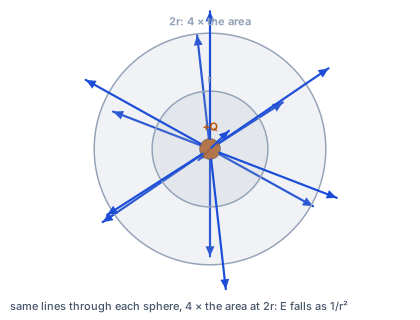
In three dimensions the equipotential circles are spheres, as in the figure, and the field lines leave the charge straight outward, crossing every sphere at right angles.
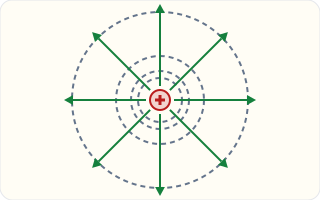
The figure shows a positive point charge with its field lines pointing outward and dashed circles of equal potential around it. The circles are drawn at equal steps of potential, so they crowd close to the charge, where the potential changes fastest, and spread apart farther out.
Every field line crosses every circle at a right angle. That must be so: moving along an equipotential changes no potential energy, so the field can do no work there, which means it has no component along the surface.
Fields are vectors: to combine the fields of several charges you must add arrows. Potentials are numbers: you just add them with their signs. Near a $+5$ nC charge at $10$ cm and a $-2$ nC charge at $20$ cm, the potential is $450 - 90 = 360$ V, with no geometry needed.
Potential also connects directly to energy. A charge $q$ moving through a potential difference $\Delta V$ changes its potential energy by $q\Delta V$, and if no other forces act, its kinetic energy changes by the opposite amount. The next lesson develops this.
Between two parallel plates connected to a battery, the field is uniform and the potential rises steadily from the negative plate to the positive one. The field equals the voltage divided by the gap: $E = \Delta V/d$. A $12$ V battery across plates $4$ mm apart makes $3000$ V/m.
This is why field strength is often quoted in volts per meter, the same unit as newtons per coulomb. It also shows how to make strong fields cheaply: put a modest voltage across a tiny gap. Transistors in computer chips have fields of millions of volts per meter across gaps of a few nanometers.
Potential can be zero where the field is not. Midway between equal and opposite charges, the positive charge's potential cancels the negative one's, so $V = 0$. But the two fields both point from the positive toward the negative charge, so they add, and the field there is strong.
Conversely, inside a charged metal sphere the field is zero, but the potential is not: it equals the potential at the surface, the same everywhere inside. The field measures how fast potential changes, not how large it is.
Checking an answer. A positive charge's potential must be positive and fall as $1/r$. The field must point toward lower potential. Equipotentials must cross field lines at right angles.
The electric force is conservative: the work it does moving a charge between two points does not depend on the path. That is what allows a potential energy, and hence a potential, to be defined at each point. Gravity shares this property; friction does not.
The formula $V = kQ/r$ comes from adding up the work to bring a test charge in from infinity against Coulomb's force, which requires integrating $1/r^2$ and gives $1/r$. Only differences in potential matter physically, so the choice of zero is ours.
Every battery and outlet is labeled by potential difference. A AA cell holds its positive terminal $1.5$ V above its negative one: each coulomb passing through a circuit delivers $1.5$ J. American wall outlets supply $120$ V, and electric dryers and ranges use $240$ V.
Birds perch safely on a single high-voltage line because both feet are at nearly the same potential: no potential difference, no current. Touch the line while grounded, and the full voltage appears across your body. Line workers use insulated trucks and bond themselves to the line to stay at its potential.
Atomic and nuclear physicists measure energy in electron-volts: the energy an electron gains crossing a potential difference of one volt, $1.602 \times 10^{-19}$ J. It is a natural unit because it links energy directly to voltage.
Visible light photons carry about $2$ eV, chemical bonds a few eV, X-rays thousands, and the protons in Fermilab's accelerator were brought to a trillion electron-volts. An electron accelerated through the $25{,}000$ V of an old color television tube hit the screen with $25$ keV.
On a charged conductor, the charge crowds onto sharp points, where the surface curves most. The potential is the same over the whole conductor, but near a sharp point the equipotentials bunch tightly, so the field there is very strong.
Benjamin Franklin used this in 1752 when he proposed lightning rods: pointed metal rods on rooftops connected to the ground. The strong field at the tip ionizes the air and gives lightning a preferred path to ground, away from the building. Franklin rods still protect barns and church steeples across America.
Each heartbeat begins with a wave of electrical activity that spreads through the heart muscle, making parts of the body's surface slightly positive or negative relative to others. An electrocardiogram records the potential differences between electrodes on the chest, arms and legs, about a millivolt.
The shape of the trace tells cardiologists how the wave travels through the heart, revealing blocked arteries, damaged muscle or irregular rhythms. Willem Einthoven invented the method in 1903 and won a Nobel Prize for it; today smartwatches can record a single-lead ECG from a fingertip, measuring the potential difference between the wrist and the opposite hand.
In a conductor at rest, charges move until the field inside is zero. With no field, no work is done moving a charge anywhere within it, so every point of a conductor, inside and on its surface, sits at the same potential. A metal object is one big equipotential.
That is why a wire can be treated as a single point in a circuit diagram: every part of an ideal wire has the same potential, and all the voltage drops happen across the components. It is also why touching a charged metal object at any point gives the same shock. Engineers exploit this with ground planes in circuit boards, large sheets of copper that hold a whole region at one reference potential.
Every nerve cell in your body keeps its inside about $70$ mV negative relative to the outside, by pumping sodium ions out and potassium ions in. The cell membrane that holds this voltage is only about $7$ nm thick, so the field across it is about $10$ million volts per meter, stronger than the field that makes lightning in air.
When a nerve fires, channels in the membrane open, ions rush through, and the potential briefly flips to about $+30$ mV. This pulse travels along the nerve at up to $100$ m/s. Neuroscientists measure these potentials with glass microelectrodes, a technique developed in the 1940s and 1950s that earned several Nobel Prizes.
Utility crews in the United States work on distribution lines carrying $7200$ V or more. The danger is not the voltage of the line itself but the potential difference across a body. A squirrel on a single wire is safe; a squirrel touching the wire and a grounded pole is not, which is why squirrels cause many local outages.
When a line falls to the ground, the potential spreads out through the soil, falling with distance from the contact point. Someone walking nearby can have hundreds of volts between their feet. Utilities advise shuffling away with feet together, keeping both feet on nearly the same equipotential, and staying at least ten meters from downed lines.
A common mistake is to think that where the potential is zero, the field must be zero too. Midway between equal and opposite charges the potential is zero while the field is strong. The field depends on how quickly the potential changes, not on its value.
A related error is to use $1/r^2$ for potential. The field of a point charge falls as $1/r^2$, but the potential falls only as $1/r$, so potential decreases more slowly with distance than field does.
A sphere carries $+3.0$ nC. Find the potential $15$ cm away.
$V = \dfrac{9.0 \times 10^9 \times 3.0 \times 10^{-9}}{0.15}$
Point-charge potential.
Evaluate the potential.
$V = 180\ \text{V}$
Positive.
Find the potential at $45$ cm.
$V = \dfrac{27}{0.45} = 60\ \text{V}$
A third, at three times the distance.
Find the difference.
$\Delta V = 180 - 60 = 120\ \text{V}$
Between the two spheres.
Find the work to push a $+2.0$ nC charge inward from $45$ cm to $15$ cm.
$W = 2.0 \times 10^{-9} \times 120 = 2.4 \times 10^{-7}\ \text{J}$
Uphill for a positive charge.
Charges of $+4.0$ nC and $-4.0$ nC are $20$ cm apart. Find the potential at the midpoint from the positive one.
$V_+ = \dfrac{9.0 \times 10^9 \times 4.0 \times 10^{-9}}{0.10} = 360\ \text{V}$
At $10$ cm.
Find the negative charge's potential there.
$V_- = -360\ \text{V}$
Same distance, opposite sign.
Add the two potentials.
$V = 360 - 360 = 0$
They cancel.
Find each field there.
$E = \dfrac{36}{0.10^2} = 3600\ \text{N/C}$
Same size from each.
Combine the fields.
$E = 3600 + 3600 = 7200\ \text{N/C}$
Both point toward the negative charge.
Draw the lesson.
$V = 0 \text{ but } E \neq 0$
Potential and field are different things.
Plates $2.0$ mm apart are held at $0$ V and $9.0$ V. Find the field.
$E = \dfrac{9.0}{2.0 \times 10^{-3}} = 4500\ \text{V/m}$
Voltage over gap.
Find the potential $0.50$ mm from the $0$ V plate.
$V = 4500 \times 0.50 \times 10^{-3} = 2.25\ \text{V}$
Linear rise.
Find where the potential is $6.0$ V.
$x = \dfrac{6.0}{4500} = 1.33 \times 10^{-3}\ \text{m}$
Solve $V = Ex$.
Describe the equipotentials.
$\text{flat planes parallel to the plates}$
At right angles to the field.
Find the work to carry $+1.0$ μC between plates.
$W = 1.0 \times 10^{-6} \times 9.0 = 9.0 \times 10^{-6}\ \text{J}$
From low to high potential.
Double the gap with the same battery. Find the new field.
$E = \dfrac{9.0}{4.0 \times 10^{-3}} = 2250\ \text{V/m}$
Halved.
Write the potential formula.
$V = \dfrac{kQ}{r}$
Keep the sign.
Substitute the values.
$V = \dfrac{9.0 \times 10^9 \times (-6.0 \times 10^{-9})}{0.30}$
SI units.
Evaluate the potential.
A small sphere carries $+8$ nC. Taking the potential far away as zero, what is the electric potential $40$ cm from it? Use $k = 9.0 \times 10^9$ N·m²/C².
Complete the worked solution: a $+9$ nC point charge sits alone. With $k = 9.0 \times 10^9$ N·m²/C², find the potential on the equipotential sphere $30$ cm from it, on the one $60$ cm from it, and the potential difference between them, all in volts.
Find the inner sphere's potential.
$V_1 = \dfrac{kQ}{r_1} =$ x
Closer, higher potential.
Find the outer sphere's potential.
$V_2 = \dfrac{kQ}{r_2} =$ y
Farther, lower potential.
Subtract for the difference.
$V_1 - V_2 =$ z
The voltage between the spheres.
Relate to moving a charge.
$W = q(V_1 - V_2)$
Work done by the field from inner to outer.
Match each term to its meaning.
| potential energy per unit charge | a surface on which the potential is the same everywhere | from higher potential toward lower potential | one joule per coulomb | |
|---|---|---|---|---|
| electric potential | ||||
| equipotential surface | ||||
| direction of the field | ||||
| one volt |
Two parallel plates $4$ mm apart are connected to a $12$ V battery, the negative plate at $0$ V. Fill in the field between them in V/m, the potential $1$ mm from the negative plate in V, and the work in nJ needed to carry a $2.0$ nC charge from the negative plate to the positive one.
| value | |
|---|---|
| field (V/m) | |
| potential at the point (V) | |
| work to cross (nJ) |
Two parallel plates $4$ mm apart are held at $0$ V and $12$ V. Write the potential in volts between them as a function of the distance $x$, in meters, measured from the $0$ V plate.
Answer:
A point P is $20$ cm from a $-6$ nC charge and $40$ cm from a $8$ nC charge. What is the electric potential at P, in volts? Use $k = 9.0 \times 10^9$ N·m²/C².
Answer: V
A resting nerve cell holds its inside $65$ mV below its outside, across a membrane $6$ nm thick. Treating the field in the membrane as uniform, how strong is it, in MV/m?
Answer: MV/m
Lesson test: one question per skill, one attempt each, no hints. Your answers are checked when you submit.
Two parallel plates $20$ mm apart are held at $0$ V and $100$ V. Write the potential in volts between them as a function of the distance $x$, in meters, measured from the $0$ V plate.
Answer:
You can work with electric potential. Explain to someone how the potential can be zero at a point where the field is strong.
22. Your turn: what is the potential $30$ cm from a $-6.0$ nC charge?, step 3
$V = -180\ \text{V}$
Negative near a negative charge.