Back to the on-screen lesson ·
Converging and diverging lenses, the thin-lens equation, magnification, lens power in diopters, and cameras, magnifiers and eyeglasses.
Paper packet. Every task here also exists on screen, where it is checked automatically; answers written on paper are not assessed by Nydus. When you are back at a device, enter your answers there.
By the end of this lesson you will be able to locate and describe lens images and use lens power to design simple corrections.
From the last two lessons you know the mirror equation, $1/d_o + 1/d_i = 1/f$, and Snell's law of refraction. A lens is a piece of glass with curved faces that refracts light twice, and it turns out to obey the same equation as a mirror, with images now forming on the far side.
| Term | What it means |
|---|---|
| Converging lens | Thicker in the middle; brings parallel rays to a real focus; $f > 0$. |
| Diverging lens | Thinner in the middle; spreads rays as if from a focus; $f < 0$. |
| Thin-lens equation | $1/d_o + 1/d_i = 1/f$. |
| Magnification | $m = -d_i/d_o$. |
| Power | $P = 1/f$ in diopters (D), with $f$ in meters. |
| Real and virtual images | Real images form on the far side ($d_i > 0$); virtual ones on the object's side. |
A converging lens, thicker in the middle, refracts each ray a little toward the axis, so parallel rays meet at a focal point a distance $f$ beyond the lens. A diverging lens, thinner in the middle, spreads parallel rays so they seem to come from a focal point in front of it; its $f$ is negative. For a thin lens, image locations follow
$$\frac{1}{d_o} + \frac{1}{d_i} = \frac{1}{f}, \qquad m = -\frac{d_i}{d_o},$$
with $d_i$ positive for a real image on the far side and negative for a virtual image on the object's side. Opticians describe lenses by their power, $P = 1/f$ in diopters.
Another way: picture
Picture a converging lens as a stack of prisms, thick ones at the edges pointed inward and none at the center. Each ray is bent toward the middle by the prism it passes through, and edge rays, passing through the steepest prisms, bend the most, so they all meet at one point. Turn the prisms around and you have a diverging lens.
Another way: steps
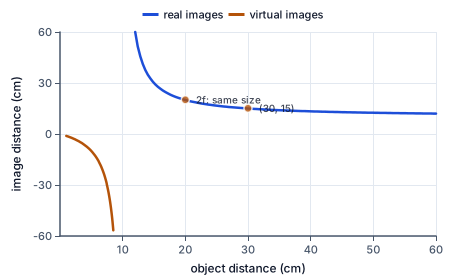
The chart shows image distance against object distance for a converging lens of focal length $10$ cm; it is the same chart as for a concave mirror. A distant object images near $10$ cm, small and inverted: this is how a camera or your eye works. Bring the object to $20$ cm, twice the focal length, and the image is also at $20$ cm and the same size.
Between $10$ and $20$ cm, the image lies beyond $20$ cm and is enlarged, as in a projector. Inside $10$ cm the image distance turns negative: a virtual, upright, enlarged image on the object's side, seen through a magnifying glass.
Three rays locate a lens image. A ray parallel to the axis bends through the far focal point. A ray through the center of the lens passes straight through, undeflected. A ray through the near focal point emerges parallel to the axis. Where they cross is the image.
For a diverging lens, the parallel ray bends away as if coming from the near focal point, and the ray aimed at the far focal point emerges parallel. The rays never cross on the far side; traced backward, they meet on the object's side, making a virtual image.
A real image is made by light actually converging, so it can be caught on a screen, a film or a sensor. Every camera, projector and eye forms real images, inverted and usually smaller than the object. The brain simply learns to read the upside-down image on the retina.
A virtual image cannot be caught on a screen; the light only seems to come from it. The magnified print you see through a magnifying glass and the smaller world seen through a nearsighted person's glasses are both virtual images, which the eye's own lens then turns into real images on the retina.
Opticians use power, $P = 1/f$ with $f$ in meters, measured in diopters. A lens with $f = 50$ cm has $P = +2$ D; one with $f = -25$ cm has $P = -4$ D. Stronger lenses have shorter focal lengths and larger powers.
Power is convenient because for thin lenses in contact, powers simply add. The eye's cornea and lens together have about $60$ D. An eyeglass prescription lists the extra power needed: negative for nearsighted eyes, positive for farsighted ones and for reading glasses.
Checking an answer. A diverging lens must always give a virtual, upright, smaller image. An object at $2f$ must give $m = -1$. A magnifier's object must be inside $f$.
The thin-lens equation comes from applying Snell's law at both surfaces, for rays close to the axis, with the lens thin compared with the distances involved. The focal length depends on the glass's index and the curvatures of the faces, through the lensmaker's equation.
Real lenses have aberrations. Spherical surfaces focus edge rays short of central ones, and because the index depends on color, different colors focus at slightly different distances. Camera lenses combine several elements of different glasses to cancel these errors.
The eye's cornea does most of the focusing; the lens behind it fine-tunes, changing shape to focus on near or far objects, which is called accommodation. A relaxed normal eye focuses on distant objects; tightening the ciliary muscle rounds the lens to focus as close as about $25$ cm in young adults.
A nearsighted eye focuses too strongly, so distant objects blur; diverging glasses correct it. A farsighted eye focuses too weakly. After about age forty-five the lens stiffens and the near point recedes, presbyopia, which is why reading glasses are so common.
A camera lens forms a real, inverted image on a sensor. To focus on near objects, the lens moves away from the sensor, since closer objects image farther from the lens. A phone camera's tiny lens, with a focal length of a few millimeters, moves by only a fraction of a millimeter.
Zoom lenses change their effective focal length by moving groups of lenses, changing the magnification. A telephoto lens has a long focal length and a narrow view; a wide-angle lens has a short focal length. Sports photographers at NFL games use lenses with focal lengths of $400$ mm or more.
A magnifying glass is a converging lens held so the object is just inside its focal point, giving an upright, enlarged virtual image. A lens of power $+10$ D, focal length $10$ cm, lets you see detail about two and a half times larger than with the naked eye at $25$ cm.
A compound microscope uses two lenses: the objective forms a real, magnified image inside the tube, and the eyepiece acts as a magnifier on that image. Their magnifications multiply, reaching a thousand times, enough to see bacteria. Anton van Leeuwenhoek saw them first in the 1670s with a single tiny, powerful lens.
When two thin lenses touch, their powers add. A $+5$ D lens and a $-2$ D lens together act as a $+3$ D lens. Eyeglass wearers are, in effect, adding a lens to the eye's own: a nearsighted eye with too much power gets a negative lens to bring the total back to what the eye's length needs.
Contact lenses sit directly on the cornea, so their powers add almost exactly. Laser eye surgery reshapes the cornea itself to change its power, removing a thin layer with an ultraviolet laser, an operation performed hundreds of thousands of times a year in the United States.
A movie projector puts the film or digital chip just outside the focal length of its lens, between $f$ and $2f$, so the lens forms a large, real, inverted image on a distant screen. The frame is loaded upside down so the picture appears upright.
Because the screen is far away compared with the focal length, the image distance is huge and the magnification is hundreds of times. Small changes in the chip's distance from the lens make large changes in where the image focuses, which is why projectors need careful focusing whenever they are moved.
Walk into any American pharmacy and you will find racks of reading glasses from $+1.00$ to $+3.50$ diopters. They serve people with presbyopia: after about age forty-five, the eye's lens stiffens and the near point drifts out, to $50$ cm, then $1$ m or more.
Readers form a virtual image of a page held at $25$ cm at the person's near point. For a near point of $1$ m, the power needed is $1/0.25 - 1/1.0 = 3.0$ D; for $50$ cm, $2.0$ D. Optometrists recommend an eye exam rather than guessing, since presbyopia can hide other problems, but the physics of the rack is just the thin-lens equation. The Food and Drug Administration regulates readers as medical devices, requiring impact-resistant lenses.
A smartphone's main camera has a lens with a focal length of only about $4$ to $7$ mm, forming a real image on a sensor smaller than a fingernail. To focus on a subject at $2$ m instead of at infinity, the lens must move out by only about $0.02$ mm, which a tiny voice-coil motor does in milliseconds.
Because the lens is so small, designers stack five to eight plastic elements of carefully shaped aspheric surfaces to cancel aberrations. Phones add separate telephoto and ultra-wide cameras with different focal lengths rather than one zoom lens, since there is no room to move lens groups far. Some telephoto cameras fold the light sideways with a prism to fit a longer focal length inside the phone.
It is natural to think that covering the top half of a lens removes the top half of the image. Each point of the lens receives light from every point of the object and sends it to the matching image point, so any part of the lens forms the whole image. Covering half the lens only makes the image dimmer.
A related error is to think a real image is always upright or that a lens always magnifies. A converging lens can make images smaller or larger, upright or inverted, depending on where the object is relative to the focal point.
A camera lens of focal length $50$ mm photographs a person $2.0$ m away. Convert units.
$f = 0.050\ \text{m}, \quad d_o = 2.0\ \text{m}$
Meters throughout.
Find the image distance.
$d_i = \dfrac{0.050 \times 2.0}{2.0 - 0.050} = 0.0513\ \text{m}$
Just beyond $f$.
Find the magnification.
$m = -\dfrac{0.0513}{2.0} = -0.0256$
Tiny and inverted.
Find the image of a $1.8$ m person.
$h_i = -0.0256 \times 1.8 = -0.046\ \text{m}$
Fits a sensor a few centimeters tall.
Find how far the lens moves from infinity focus.
$51.3 - 50.0 = 1.3\ \text{mm}$
Focusing motion.
A stamp is $8.0$ cm from a converging lens of focal length $10$ cm. Write the lens equation.
$\dfrac{1}{d_i} = \dfrac{1}{10} - \dfrac{1}{8.0}$
Inside the focal point.
Combine the fractions.
$\dfrac{1}{d_i} = \dfrac{4 - 5}{40} = -\dfrac{1}{40}$
Negative.
Invert for the image distance.
$d_i = -40\ \text{cm}$
Virtual, on the stamp's side.
Find the magnification.
$m = -\dfrac{-40}{8.0} = 5.0$
Upright, five times larger.
Find the lens's power.
$P = \dfrac{1}{0.10} = 10\ \text{D}$
A strong reading magnifier.
Explain why it must be held close.
$d_o > f \text{ would invert the image}$
Keep the object inside $f$.
A nearsighted student sees clearly only out to $50$ cm, their far point. Distant objects must be imaged there. Set the object distance.
$d_o = \infty$
A distant object.
Set the image distance.
$d_i = -0.50\ \text{m}$
A virtual image at the far point.
Find the power.
$P = \dfrac{1}{\infty} + \dfrac{1}{-0.50} = -2.0\ \text{D}$
Diverging.
Find the focal length.
$f = -0.50\ \text{m}$
Equal to minus the far point.
Test with a sign $5.0$ m away.
$\dfrac{1}{d_i} = -2.0 - 0.20 \Rightarrow d_i = -0.45\ \text{m}$
Inside the far point: seen clearly.
Read the prescription.
$-2.00\ \text{D}$
As written on the order.
Write the thin-lens equation.
$\dfrac{1}{d_i} = \dfrac{1}{10} - \dfrac{1}{30}$
Subtract.
Combine the fractions.
$\dfrac{1}{d_i} = \dfrac{2}{30}$
Common denominator.
Evaluate the image distance.
A lens has a focal length of $50$ cm. What is its power, in diopters?
Complete the worked solution: thin lenses of focal lengths $20$ cm and $20$ cm are placed in contact, and an object stands $30$ cm from the pair. Find the combined power in diopters, the combined focal length in cm, and the image distance in cm.
Add the powers.
$P = \dfrac{1}{f_1} + \dfrac{1}{f_2} =$ p
Focal lengths in meters.
Find the combined focal length.
$f = \dfrac{1}{P} =$ f
Converted to centimeters.
Locate the image.
$d_i = \dfrac{fd_o}{d_o - f} =$ i
Thin-lens equation.
Relate this to camera lenses.
$\text{several elements act as one lens}$
Combining corrects color errors.
Match each lens setup to the image it forms.
| real, inverted and smaller, as in a camera | real, inverted and larger, as in a projector | virtual, upright and larger, as in a magnifier | virtual, upright and smaller | |
|---|---|---|---|---|
| converging lens, object beyond 2f | ||||
| converging lens, object between f and 2f | ||||
| converging lens, object inside f | ||||
| diverging lens, any object |
A $1$ cm tall object stands $5$ cm from a converging lens of focal length $10$ cm. Fill in the image distance in cm, the magnification, and the image height in cm, with signs.
| value | |
|---|---|
| image distance (cm) | |
| magnification | |
| image height (cm) |
A converging lens has a focal length of $5$ cm. Write the magnification as a function of the object distance $d$, in cm.
Answer:
An object is $40$ cm from a diverging lens of focal length $-10$ cm. What is the image distance, in cm, with its sign?
Answer: cm
A person over fifty can no longer focus closer than $100$ cm, their near point. Drugstore reading glasses should let them read a page held $25$ cm away by forming its image at their near point. What power, in diopters, should they buy?
Answer: D
Lesson test: one question per skill, one attempt each, no hints. Your answers are checked when you submit.
A converging lens has a focal length of $10$ cm. Write the magnification as a function of the object distance $d$, in cm.
Answer:
You can work with thin lenses. Explain to someone why covering half a lens dims the image instead of cutting it in half.
22. Your turn: an object is $30$ cm from a converging lens of focal length $10$ cm. Where is the image?, step 3
$d_i = 15\ \text{cm}$
Real, on the far side.