Back to the on-screen lesson ·
Fields of straight wires, loops and solenoids, the right-hand grip rule, forces between parallel currents, and electromagnets.
Paper packet. Every task here also exists on screen, where it is checked automatically; answers written on paper are not assessed by Nydus. When you are back at a device, enter your answers there.
By the end of this lesson you will be able to find the magnetic fields of currents and the forces between parallel wires.
From the last lesson you know that magnetic fields push on moving charges and currents, with $F = qvB\sin\theta$ and $F = ILB\sin\theta$. You have used compasses and magnets. This lesson asks where magnetic fields come from: every one is made by moving charge.
| Term | What it means |
|---|---|
| Permeability of free space | $\mu_0 = 4\pi \times 10^{-7}$ T·m/A. |
| Field of a long wire | $B = \mu_0I/(2\pi r)$, in circles around the wire. |
| Right-hand grip rule | Thumb along the current; fingers curl in the field's direction. |
| Field at a loop's center | $B = \mu_0I/(2R)$. |
| Solenoid | A long coil; inside, $B = \mu_0nI$ with $n$ turns per meter. |
| Electromagnet | A solenoid, often around iron, whose field can be switched on and off. |
In 1820 Hans Christian Ørsted noticed a compass needle swing when a nearby wire carried current. Every current makes a magnetic field. Around a long straight wire the field forms circles centered on the wire, with strength
$$B = \frac{\mu_0 I}{2\pi r}, \qquad \mu_0 = 4\pi \times 10^{-7}\ \text{T·m/A},$$
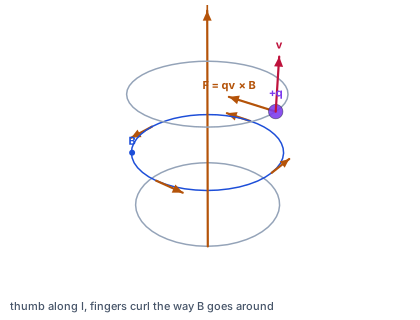
falling as one over the distance. The direction follows the right-hand grip rule: thumb along the current, fingers curling in the field's direction. Bending the wire into a loop concentrates the field at the center, $\mu_0I/(2R)$; stacking many loops into a solenoid makes a uniform field inside, $\mu_0nI$.
Another way: picture
Picture water swirling around a drain, circling the center and slower farther out. A current's magnetic field swirls around the wire the same way, circling it and weakening with distance. Wind the wire into a coil, and the swirls from every turn add up inside, like many drains in a row making one strong current through the middle.
Another way: steps
The scene shows a long wire carrying current upward, with the magnetic field circling it in rings, counterclockwise seen from above. A positive charge on one ring, moving upward alongside the current, feels a force pointing straight at the wire, perpendicular to both its velocity and the field.
That force explains why parallel currents attract: each moving charge in one wire sits in the other wire's field and is pushed toward it. Reverse one current and the force reverses, pushing the wires apart.
A wire's field falls as $1/r$, not $1/r^2$ like a point charge's field. The field lines are circles around the wire, and a circle's circumference grows only in proportion to its radius. Spread over a circumference $2\pi r$, the field weakens as $1/r$.
Doubling the distance halves the field. Standing $20$ m from a line carrying $1000$ A, you are in a field of $10$ μT, a fifth of Earth's. The field of a loop or a bar magnet, seen from far away, falls much faster, as $1/r^3$, because its opposite sides partly cancel.
Bend a wire into a circle and all the pieces of the loop make fields pointing the same way through the center, adding up to $\mu_0I/(2R)$. A loop's field resembles a bar magnet's, with a north face and a south face.
Wind many loops into a long coil, a solenoid, and their fields add inside to a uniform field $\mu_0nI$, where $n$ is the number of turns per meter, while outside they nearly cancel. Put an iron core inside and the field grows hundreds of times: an electromagnet, which can be switched on and off.
Two parallel wires carrying $I_1$ and $I_2$ a distance $d$ apart exert forces on each other of $F/L = \mu_0I_1I_2/(2\pi d)$ per meter of length. Same-direction currents attract; opposite currents repel.
This force once defined the ampere: the current that, in two parallel wires one meter apart, produces a force of $2 \times 10^{-7}$ N per meter. Since 2019 the ampere has been defined by fixing the electron's charge, but the force between currents remains how laboratories like NIST check their standards.
Checking an answer. Fields from household currents are microtesla; from lab solenoids, millitesla. A wire's field must halve at twice the distance. A solenoid's field must not depend on its diameter.
The formulas come from the Biot-Savart law, which adds up the field of every small piece of current, or from Ampère's law, which relates the field around a closed path to the current through it. Physics C derives them with calculus.
The straight-wire formula assumes a wire long compared with the distance; the solenoid formula assumes a coil long compared with its width, far from its ends. Fields from several currents add as vectors, the same superposition as for electric fields.
Scrapyard cranes lift cars with electromagnets and drop them by switching off the current. Doorbells, relays and the locks on hotel doors use small electromagnets. MRI scanners use superconducting solenoids carrying hundreds of amperes to make fields of $1.5$ to $3$ T.
The world's strongest steady magnetic fields, $45$ T, are made at the National High Magnetic Field Laboratory in Tallahassee, Florida, by a hybrid of a superconducting solenoid and a resistive one inside it, cooled by thousands of gallons of water a minute.
If every magnetic field comes from moving charge, where are the currents in a refrigerator magnet? They are inside the atoms: electrons orbit and, more importantly, spin, each acting as a tiny current loop. In most materials these atomic magnets point randomly and cancel.
In iron, nickel, cobalt and some alloys, neighboring atoms line up in domains, and in a permanent magnet the domains line up too. Heat a magnet past its Curie temperature, $770$ °C for iron, and the alignment is lost. Rare-earth magnets of neodymium, iron and boron, found in earbuds and wind turbines, are the strongest permanent magnets.
Earth's field, about $50$ μT at the surface, comes from electric currents in its molten iron outer core, stirred by convection and Earth's rotation: a geodynamo. The field looks roughly like a giant bar magnet's, tilted about $10°$ from the rotation axis.
Compasses point along it, which is why navigators must correct for the difference between magnetic and true north. The field wanders slowly, and it has reversed hundreds of times in Earth's history, recorded in the magnetized rocks of the seafloor spreading from the Mid-Atlantic Ridge. Migrating sea turtles, salmon and some birds sense this field and use it to find their way across oceans, returning to the beaches and rivers where they were born.
The wires in a house carry current out on one conductor and back on the other, a few millimeters apart. Their fields almost cancel, so even a few centimeters from a cable the field is tiny. Appliances with motors or transformers make stronger fields right at their surfaces, but these fall off quickly.
Large studies by the National Cancer Institute and others have looked for health effects of the weak, low-frequency fields from power lines and appliances, and have not found convincing evidence of harm at the levels found in homes. Utilities still route new lines with their fields in mind.
Sprinkle iron filings on a card threaded by a current-carrying wire and tap the card: the filings line up in circles around the wire, each tiny filing becoming a little magnet aligned with the field. Around a bar magnet, the filings trace curves running from one pole to the other; around a solenoid, they run straight through the inside and loop around the outside, the same pattern as a bar magnet.
A small compass moved step by step around a wire traces the same circles and shows their direction, which is how Ørsted and Ampère first mapped fields in 1820. Today a Hall probe does the job electronically, measuring the tiny voltage the field produces across a current-carrying chip, and every smartphone contains one so its compass app can find north.
A transmission line carrying $1000$ A, $20$ m above a backyard, produces a field at the ground of about $10$ μT by the straight-wire formula, a fifth of Earth's steady field. Real lines carry three phases whose currents partly cancel, so measured fields are usually a few microtesla.
The line's field alternates sixty times a second, unlike Earth's steady one. Utilities and state regulators in places like California and New York publish guidelines for fields at the edge of rights-of-way, and engineers arrange conductors to maximize cancellation when building new lines near homes and schools. Measuring it yourself is easy: a phone's magnetometer app, standing under a line and then walking away, shows the field falling roughly as one over the distance.
At the National High Magnetic Field Laboratory in Tallahassee, Florida, scientists study materials in fields up to $45$ T, nearly a million times Earth's. The key is the solenoid formula, $\mu_0nI$: pack in many turns and drive enormous currents.
The resistive magnets there draw tens of megawatts, and the heat from $I^2R$ is carried away by chilled water. The parallel-wire forces are so great that the coils would burst without careful design: the windings push outward like a pressurized tank. Researchers use the fields to probe superconductors, map proteins and discover new states of matter.
It is natural to imagine a wire's magnetic field pointing along the wire, or out from it like an electric field from a charged rod. It does neither: it circles the wire, as iron filings sprinkled around a current-carrying wire reveal. The right-hand grip rule gives its direction.
A related error is to think magnetism and electricity are unrelated, with magnets and currents as separate phenomena. Every magnetic field comes from moving charge, whether currents in wires or spinning electrons inside a permanent magnet.
A jumper cable carries $150$ A while starting a car. Find the field $2.0$ cm away.
$B = 2 \times 10^{-7} \times \dfrac{150}{0.020} = 1.5 \times 10^{-3}\ \text{T}$
Long straight wire.
Convert to microtesla.
$B = 1500\ \mu\text{T}$
Thirty times Earth's field.
Find the field at $10$ cm.
$B = 1500 \times \dfrac{2.0}{10} = 300\ \mu\text{T}$
One over the distance.
Predict a compass's behavior nearby.
$\text{it points around the cable}$
The cable's field dominates.
Find where the cable's field equals Earth's.
$r = 2 \times 10^{-7} \times \dfrac{150}{50 \times 10^{-6}} = 0.60\ \text{m}$
Beyond that, Earth wins.
A solenoid $30$ cm long has $600$ turns carrying $2.0$ A. Find the turns per meter.
$n = \dfrac{600}{0.30} = 2000\ \text{m}^{-1}$
Turns over length.
Find the field inside.
$B = 4\pi \times 10^{-7} \times 2000 \times 2.0 = 5.0 \times 10^{-3}\ \text{T}$
$\mu_0nI$.
Express it in millitesla.
$B = 5.0\ \text{mT}$
A hundred times Earth's field.
Stretch the coil to $60$ cm with the same turns. Find the new field.
$B = 2.5\ \text{mT}$
Half the turns per meter.
Insert an iron core multiplying the field by $500$. Find the field.
$B = 500 \times 5.0 = 2500\ \text{mT}$
Near iron's saturation limit.
Explain why the field is uniform.
$\text{outside fields cancel; inside they add}$
Many loops stacked.
Two parallel bus bars $30$ cm apart each carry $2000$ A in opposite directions. Find the force per meter.
$\dfrac{F}{L} = 2 \times 10^{-7} \times \dfrac{2000 \times 2000}{0.30} = 2.67\ \text{N/m}$
Parallel-wire force.
Give its direction.
$\text{repulsion}$
Opposite currents.
A fault raises the current to $40{,}000$ A. Scale the force.
$\dfrac{F}{L} = 2.67 \times 20^2 = 1067\ \text{N/m}$
Force goes as the product of currents.
Find the force on a $5.0$ m length.
$F = 1067 \times 5.0 = 5330\ \text{N}$
Over half a ton.
Explain the design response.
$\text{bars are braced on insulators}$
So faults do not bend them.
Find the force if the bars were $60$ cm apart.
$\dfrac{F}{L} = 533\ \text{N/m}$
Halved: one over the distance.
Write the wire's field.
$B = 2 \times 10^{-7}\dfrac{I}{r}$
Long straight wire.
Substitute the values.
$B = 2 \times 10^{-7} \times \dfrac{20}{0.040}$
Distance in meters.
Evaluate the field.
A long straight wire carries $20$ A. What is the magnetic field $5$ cm from it, in μT? Use $\mu_0 = 4\pi \times 10^{-7}$ T·m/A.
Complete the worked solution: two long parallel wires $10$ cm apart carry $5$ A and $5$ A in opposite directions. A point between them lies $5$ cm from the first and $5$ cm from the second. Find the first wire's field there, the second wire's field there, and the net field, all in μT.
Find the first wire's field.
$B_1 = 2 \times 10^{-7}\dfrac{I_1}{r_1} =$ p
In microtesla.
Find the second wire's field.
$B_2 = 2 \times 10^{-7}\dfrac{I_2}{r_2} =$ q
In microtesla.
Add the aligned fields.
$B = B_1 + B_2 =$ n
Opposite currents, same direction between.
Contrast same-direction currents.
$B = |B_1 - B_2|$
The fields would oppose between the wires.
Match each current arrangement to its magnetic field or effect.
| field circles the wire, falling as one over the distance | field equal to μ₀I over 2R | a uniform field equal to μ₀nI | the wires attract each other | |
|---|---|---|---|---|
| a long straight wire | ||||
| the center of a circular loop | ||||
| inside a long solenoid | ||||
| two parallel wires with currents the same way |
A solenoid $10$ cm long has $300$ turns and carries $1.5$ A. With $\mu_0 = 4\pi \times 10^{-7}$ T·m/A, fill in its turns per meter, the field inside in mT, and the field inside in mT if the current were doubled.
| value | |
|---|---|
| turns per meter | |
| field inside (mT) | |
| field with double current (mT) |
A long straight wire carries $25$ A. With $\mu_0 = 4\pi \times 10^{-7}$ T·m/A, write the magnetic field it produces, in μT, as a function of the distance $r$ from the wire, in meters.
Answer:
Two long parallel wires $25$ cm apart carry $200$ A and $150$ A in the same direction. What is the force per meter of length between them, in mN/m?
Answer: mN/m
A transmission line carries $800$ A, $15$ m above a backyard. Treating it as a single long straight wire, what magnetic field does it produce at the ground, in μT?
Answer: μT
Lesson test: one question per skill, one attempt each, no hints. Your answers are checked when you submit.
A long straight wire carries $25$ A. With $\mu_0 = 4\pi \times 10^{-7}$ T·m/A, write the magnetic field it produces, in μT, as a function of the distance $r$ from the wire, in meters.
Answer:
You can find magnetic fields of currents. Explain to someone why two parallel currents in the same direction attract.
22. Your turn: what field does a $20$ A current make $4.0$ cm from a long wire?, step 3
$B = 1.0 \times 10^{-4}\ \text{T} = 100\ \mu\text{T}$
Twice Earth's field.