Back to the on-screen lesson ·
Flux as field through an area, $\Phi = BA\cos\theta$, flux linkage of coils, signs as loops turn, and Earth's dipping field.
Paper packet. Every task here also exists on screen, where it is checked automatically; answers written on paper are not assessed by Nydus. When you are back at a device, enter your answers there.
By the end of this lesson you will be able to find the magnetic flux through loops and coils and how it changes as they turn.
From the last lessons you know how currents make magnetic fields and how fields push on currents. You know that a surface has an area and that the cosine of an angle picks out the part of a vector along a direction. This lesson measures how much magnetic field passes through a loop, the quantity induction depends on.
| Term | What it means |
|---|---|
| Magnetic flux | $\Phi = BA\cos\theta$, the field passing through a surface, in webers (Wb). |
| Normal | A line perpendicular to a surface; $\theta$ is measured from it. |
| Weber | $1$ Wb $= 1$ T·m². |
| Flux linkage | $N\Phi$ for a coil of $N$ turns. |
| Dip angle | The angle Earth's field makes below the horizontal. |
| Gauss's law for magnetism | The net magnetic flux out of any closed surface is zero. |
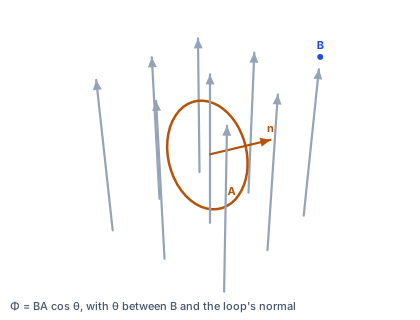
Hold a hoop in a magnetic field. How much field passes through it depends on three things: the field's strength, the hoop's area, and how squarely it faces the field. Magnetic flux combines them:
$$\Phi = BA\cos\theta,$$
where $\theta$ is the angle between the field and the loop's normal, the line perpendicular to its face. Facing the field, $\theta = 0$ and $\Phi = BA$; edge-on, $\theta = 90°$ and $\Phi = 0$; turned over, $\theta = 180°$ and $\Phi = -BA$. Flux is measured in webers, tesla-square-meters. For a coil of $N$ turns, the flux linkage is $N\Phi$.
Another way: picture
Picture holding a butterfly net in a steady wind. Face it into the wind and it catches the most air; turn it edge-on and it catches none; tilt it partway and it catches a fraction. A bigger net catches more, and a stronger wind more still. Flux is the amount of field the loop catches.
Another way: steps
The scene shows a uniform field pointing straight up and a circular loop tilted so its normal makes $60°$ with the field. Fewer field lines pass through the tilted loop than would pass through it lying flat. The flux is $BA\cos 60°$, exactly half the maximum.
Another way to see it: the flux equals the field times the loop's shadow, the area it presents to the field. A loop tilted to $60°$ casts a shadow half its size. Rotate it to edge-on and the shadow, and the flux, vanish.
A surface's direction is defined by its normal, the line sticking straight out of it. Measuring from the normal makes the formula use cosine: $\cos 0° = 1$ for a loop facing the field. If the angle is given between the field and the plane of the loop instead, use the sine, since the two angles add to $90°$.
Checking the two extremes guards against mixing them up: a loop whose plane contains the field must have zero flux, and a loop facing the field must have $BA$.
Flux has a sign that depends on which way the field crosses the loop. Choose a normal direction; flux is positive when the field goes through that way, negative the other. Turning a loop half over changes its flux from $+BA$ to $-BA$, a change of $2BA$.
A coil spinning in a field has a flux that swings smoothly between these values, following $BA\cos\omega t$. That continually changing flux is exactly what the next lesson turns into an induced voltage, the working principle of every generator.
Magnetic field lines never begin or end; they form closed loops. So any field line that enters a closed surface, such as a sphere or a box, must also leave it, and the net magnetic flux through any closed surface is zero. This is Gauss's law for magnetism.
It is another way of saying there are no magnetic monopoles, no isolated north or south poles. Cut a bar magnet in half and each half has both poles. Physicists have searched for monopoles for decades, including with detectors deep in mines and in the ice at the South Pole, and none has been found. If one turned up, this law would need changing.
Checking an answer. Flux must be largest when the loop faces the field and zero when edge-on. Doubling the area or field must double the flux. Turning a loop over must reverse the sign.
For a flat loop in a uniform field, the flux is simply the field's component along the normal times the area. In a non-uniform field, or for a curved surface, the flux is the sum of $B\cos\theta\,dA$ over tiny pieces, an integral in Physics C.
Flux linkage multiplies by $N$ because each turn of a coil encloses the same flux, and in the next lesson each turn contributes its own induced voltage, which add in series.
Earth's magnetic field is not horizontal. In most of the United States it dips steeply into the ground, about $60°$ to $70°$ below the horizontal, because the field lines curve down toward the magnetic pole in northern Canada. A compass needle free to tilt points down at that angle.
Only the horizontal part turns an ordinary compass, and only the vertical part crosses level ground. Geologists and archaeologists measure tiny variations in Earth's field with magnetometers to find buried rock, ore bodies and even ancient hearths, whose baked clay recorded the field when it cooled.
A transformer is two coils wound on one iron core. The core guides nearly all the flux made by the first coil through the second, so the two share the same flux. Changing that flux induces voltages in both, in proportion to their turns.
Iron is used because it concentrates flux: the same current makes hundreds of times more flux in iron than in air. The gray boxes on utility poles and the chargers for laptops are built around this shared flux, and their designers track flux carefully so the iron does not saturate.
When you tap a transit card or a credit card on a reader, a coil in the reader makes an alternating field. The card contains a flat coil of a few turns; the changing flux through it powers the card's chip, which answers by modulating the field.
Wireless phone chargers work the same way at higher power: a coil in the pad and a coil in the phone share an alternating flux, and the phone must be centered so that as much of the pad's flux as possible passes through its coil. Misalign it and the flux, and the charging, drop.
A fluxmeter measures flux directly: connect a search coil of known turns to it, pull the coil out of a field, and it records the total change in flux linkage. Magnet manufacturers use fluxmeters to check that each magnet is as strong as specified.
Magnetometers on satellites and in phones measure the field itself, often with Hall sensors. NASA's missions to study Earth's magnetosphere, such as the Magnetospheric Multiscale mission, carry magnetometers so sensitive they detect fields a millionth of Earth's.
Because flux is field times area, the field itself can be thought of as flux per unit area: one tesla is one weber per square meter. Older books call $B$ the magnetic flux density for exactly this reason. Picturing field lines drawn so that their number through an area measures the flux, the field is how densely the lines are packed.
That picture explains why iron cores make strong electromagnets and transformers work: iron gathers field lines from the surrounding space and funnels them through itself, packing more flux into the same cross section. It also explains why a small loop placed in a strong field can have little flux: few lines cross a small area, however dense they are. Engineers designing motors and generators think constantly about where the flux goes and how much of it threads each coil.
Wireless chargers follow the Qi standard used by most phones sold in the United States. The pad's coil makes a field alternating at about $100$ to $200$ kHz; the phone's coil, typically $10$ to $20$ turns of radius about $2$ cm, sits just above it. With a peak field of $0.5$ mT through a $10$-turn coil, the flux linkage peaks at about $6$ μWb.
That linkage reverses hundreds of thousands of times a second, and the rapid change induces the voltage that charges the battery. Because flux depends on how much of the pad's field passes through the phone's coil, a phone placed off-center charges slowly, which is why some pads use magnets to snap the phone into alignment.
In Minneapolis, Earth's field dips about $73°$ below the horizontal; in Miami, about $55°$. A compass needle must be balanced to stay level, and compasses made for the Northern Hemisphere are weighted differently from those sold in Australia.
The dip matters for flux too. Through a level parking lot of $2$ m² in a $50$ μT field dipping $65°$, the flux is about $91$ μWb, from the vertical part alone. Vehicle detectors buried under traffic lights sense the change in this flux when a car's steel body passes overhead, which is how the light knows a car is waiting.
It is natural to equate flux with the strength of the field. A strong field through a loop turned edge-on gives zero flux, and a weak field through a large loop facing it can give a lot. Flux depends on field, area and angle together.
A related error is to measure the angle from the loop's plane and still use cosine. The standard formula measures from the normal; from the plane, the sine is needed. Checking that an edge-on loop gives zero flux catches the mistake.
A $1.2$ m by $0.80$ m window faces north. Find its area.
$A = 1.2 \times 0.80 = 0.96\ \text{m}^2$
Length times width.
Earth's $50$ μT field dips $65°$ below the horizontal, pointing north. Find the angle between the field and the window's normal.
$\theta = 65°$
The normal points horizontally north.
Find the flux through the window.
$\Phi = 50 \times 10^{-6} \times 0.96 \times \cos 65° = 2.03 \times 10^{-5}\ \text{Wb}$
$\Phi = BA\cos\theta$.
Express it in microwebers.
$\Phi = 20.3\ \mu\text{Wb}$
Small but not zero.
Find the flux if the window faced east.
$\Phi = 0$
The field has no east component.
A $50$-turn coil of area $80$ cm² faces a $0.30$ T field. Find the flux per turn.
$\Phi = 0.30 \times 80 \times 10^{-4} = 2.4 \times 10^{-3}\ \text{Wb}$
Facing the field.
Find the flux linkage.
$N\Phi = 50 \times 2.4 \times 10^{-3} = 0.12\ \text{Wb}$
Fifty turns.
Turn it to $60°$. Find the new linkage.
$0.12 \times \cos 60° = 0.060\ \text{Wb}$
Half.
Turn it to $180°$. Find the linkage.
$-0.12\ \text{Wb}$
Reversed.
Find the change over the half turn.
$\Delta(N\Phi) = -0.12 - 0.12 = -0.24\ \text{Wb}$
Twice the maximum.
Relate it to a generator.
$\text{repeated each half turn}$
The source of alternating voltage.
A loop of area $0.050$ m² faces a field that grows from $0.20$ T to $0.50$ T. Find the starting flux.
$\Phi_1 = 0.20 \times 0.050 = 0.010\ \text{Wb}$
Facing the field.
Find the final flux.
$\Phi_2 = 0.50 \times 0.050 = 0.025\ \text{Wb}$
Same area and angle.
Find the change.
$\Delta\Phi = 0.025 - 0.010 = 0.015\ \text{Wb}$
Increase.
Shrink the loop to half its area at $0.50$ T. Find the flux.
$\Phi = 0.50 \times 0.025 = 0.0125\ \text{Wb}$
Area matters too.
Tilt the half-size loop to $60°$. Find the flux.
$0.0125 \times 0.5 = 0.00625\ \text{Wb}$
Angle matters too.
List the three ways to change flux.
$\text{change } B, \ A, \text{ or } \theta$
Each will induce a voltage.
Write the flux formula.
$\Phi = BA\cos\theta$
Field times area.
Substitute the values.
$\Phi = 0.40 \times 0.020 \times \cos 0°$
Facing the field.
Evaluate the flux.
A flat loop of area $400$ cm² sits in a uniform $0.3$ T field. Its normal makes $70°$ with the field. What magnetic flux passes through it, in mWb?
Complete the worked solution: Earth's $50$ μT field dips $65°$ below the horizontal where you stand. Find its vertical part and horizontal part in μT, and the flux in μWb through a level patch of ground of area $2$ m².
Find the vertical part.
$B_v = 50\sin\delta =$ v
Pointing into the ground.
Find the horizontal part.
$B_h = 50\cos\delta =$ h
What turns a compass.
Find the flux through level ground.
$\Phi = B_vA =$ f
Only the vertical part crosses a level surface.
Explain the steep dip.
$\text{field lines dive toward the magnetic pole}$
Steeper at higher latitudes.
Match each situation to its flux.
| the greatest possible flux, BA | zero flux | one tesla times one square meter | zero net flux, since field lines entering also leave | |
|---|---|---|---|---|
| a loop whose face is perpendicular to the field | ||||
| a loop whose plane is parallel to the field | ||||
| one weber | ||||
| any closed surface |
A $250$ cm² loop turns in a uniform $0.4$ T field. Fill in the flux through it, in mWb, when its normal makes $0°$, $60°$ and $180°$ with the field.
| value | |
|---|---|
| flux at 0° (mWb) | |
| flux at 60° (mWb) | |
| flux at 180° (mWb) |
A loop of area $300$ cm² is held with its normal at $60°$ to a uniform field of strength $B$, in tesla. Write the flux through it, in mWb, as a function of $B$.
Answer:
A coil of $150$ turns, each of area $30$ cm², faces a $0.6$ T field squarely and is then turned until it is edge-on. By how much does its flux linkage $N\Phi$ change, in Wb?
Answer: Wb
A phone's wireless charging coil has $10$ turns of radius $2.0$ cm. At its peak, the charging pad's field through the coil is $0.5$ mT, perpendicular to the coil. What is the peak flux linkage, in μWb?
Answer: μWb
Lesson test: one question per skill, one attempt each, no hints. Your answers are checked when you submit.
A loop of area $1000$ cm² is held with its normal at $60°$ to a uniform field of strength $B$, in tesla. Write the flux through it, in mWb, as a function of $B$.
Answer:
You can find magnetic flux. Explain to someone why a loop in a strong field can have no flux through it.
22. Your turn: a $0.020$ m² loop faces a $0.40$ T field squarely. What flux passes through it?, step 3
$\Phi = 8.0 \times 10^{-3}\ \text{Wb}$
Eight milliwebers.