Back to the on-screen lesson ·
The sideways force on moving charges and currents, the right-hand rule, circular orbits, mass spectrometers and motors.
Paper packet. Every task here also exists on screen, where it is checked automatically; answers written on paper are not assessed by Nydus. When you are back at a device, enter your answers there.
By the end of this lesson you will be able to find the size and direction of magnetic forces on charges and wires and the orbits they cause.
From the electric lessons you know fields and forces on charges, and from Physics 1 you know circular motion, where a force perpendicular to the velocity supplies $mv^2/r$. You have met magnets and compasses. This lesson describes how magnetic fields push on moving charges and on currents.
| Term | What it means |
|---|---|
| Magnetic field, B | Measured in teslas (T); Earth's is about $50$ μT. |
| Force on a moving charge | $F = qvB\sin\theta$, perpendicular to both $\vec{v}$ and $\vec{B}$. |
| Right-hand rule | Fingers along $\vec{v}$, curl toward $\vec{B}$: the thumb gives $\vec{F}$ on a positive charge. |
| Force on a wire | $F = ILB\sin\theta$ for a straight wire of length $L$. |
| Cyclotron motion | Circular motion in a field with $r = mv/(qB)$ and period $2\pi m/(qB)$. |
| Torque on a coil | $\tau = NIAB\sin\theta$, the principle of the electric motor. |
A magnetic field exerts no force on a charge at rest. On a moving charge it exerts
$$F = qvB\sin\theta,$$
where $\theta$ is the angle between the velocity and the field. The force is perpendicular to both $\vec{v}$ and $\vec{B}$, found by the right-hand rule: point your fingers along $\vec{v}$, curl them toward $\vec{B}$, and your thumb gives the force on a positive charge; reverse it for a negative one. Because the force is always sideways to the motion, it does no work: it changes direction, never speed. A current is many moving charges, so a wire feels $F = ILB\sin\theta$.
Another way: picture
Picture a car driving on an ice rink while someone pushes it sideways, always at right angles to its motion. The push never speeds the car up or slows it down, only turns it, and if the push stays the same size the car goes around in a circle. That is how a magnetic field steers a moving charge.
Another way: steps
The magnetic force's direction is the strangest thing about it: neither along the velocity nor along the field, but perpendicular to both. With your right hand, point your fingers in the direction of the velocity, then bend them toward the field; your extended thumb points along the force on a positive charge.
For an electron, the force points the opposite way. Practice with a proton moving east in a field pointing north: the force points up, out of the ground. An electron moving the same way is pushed down.
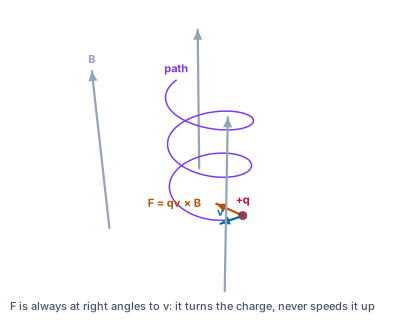
In the figure the force points to the center of the turn at every moment. With no velocity along B, the helix flattens into the circle this section describes.
A charge moving at right angles to a uniform field feels a constant-size force always perpendicular to its velocity: exactly the condition for uniform circular motion. Setting $qvB = mv^2/r$ gives $r = mv/(qB)$. Faster or heavier particles make bigger circles; stronger fields make smaller ones.
Remarkably, the time for one orbit, $T = 2\pi m/(qB)$, does not depend on speed: faster particles travel bigger circles in the same time. Ernest Lawrence used this at Berkeley in 1931 to build the cyclotron, which kicks particles with an alternating voltage in step with their orbits.
Current in a wire is charge in motion, so a wire in a magnetic field feels a force. Adding up the forces on all the moving charges in a length $L$ gives $F = ILB\sin\theta$, where $\theta$ is the angle between the wire and the field.
Place a loop of wire in a field and the forces on opposite sides point opposite ways, twisting the loop. That torque, $NIAB\sin\theta$ for a coil of $N$ turns and area $A$, drives every electric motor, from a phone's vibration motor to a subway train's traction motors.
Since the magnetic force on a charge is always perpendicular to its velocity, it never has a component along the motion, and so it does no work. A charged particle in a purely magnetic field keeps its speed and kinetic energy forever; only its direction changes.
To speed up a particle, an electric field is needed. Accelerators use electric fields to add energy and magnetic fields to steer. In a motor, the magnetic force on the wire does work on the rotor, but the energy comes from the battery maintaining the current, not from the field itself.
Checking an answer. Motion along the field must give zero force. The force must be perpendicular to both $v$ and $B$. A charge's speed in a magnetic field must not change.
The magnetic force law is an experimental fact, tested in countless accelerators and mass spectrometers. Its perpendicular direction is what the cross product in $\vec{F} = q\vec{v} \times \vec{B}$ expresses. Relativity shows that electric and magnetic forces are two aspects of one electromagnetic force, seen differently by observers in relative motion.
The circular-orbit result needs a uniform field and motion perpendicular to it. With some velocity along the field, the particle spirals, moving in a circle across the field while drifting along it at constant speed.
A mass spectrometer sends ions of the same speed and charge into a magnetic field. Heavier ions curve in larger circles, so they land at different places on a detector. Carbon-12 and carbon-14 at the same speed separate by a sixth of their radius.
Mass spectrometers weigh molecules in drug testing, identify pollutants for the Environmental Protection Agency, date rocks, and count carbon-14 atoms for radiocarbon dating. Airport security screens bags with ion-mobility spectrometers, close cousins that sort ions by how fast they drift.
The Sun streams out charged particles, the solar wind. Earth's magnetic field deflects most of them, bending their paths into spirals along the field lines. Near the poles, where field lines dive into the atmosphere, some particles spiral down and strike air molecules, making them glow: the aurora.
In Alaska and northern Canada, the northern lights are common; during strong solar storms they appear as far south as Texas. Without the magnetic field, the solar wind would strip away the atmosphere over time, as appears to have happened on Mars.
A direct-current motor puts a coil in a magnetic field. The forces on its two long sides make a torque that turns it. When the coil passes the point where the torque would reverse, a split ring called a commutator switches the current direction, so the torque keeps turning it the same way.
Electric motors use about half of all electricity in the United States, running fans, pumps, compressors, conveyor belts and, increasingly, cars. A modern electric car's motor converts over ninety percent of its electrical energy into motion, far better than any gasoline engine.
A loudspeaker is a motor that shakes back and forth. A coil of wire attached to a paper or plastic cone sits in the gap of a permanent magnet. The amplifier sends an alternating current that follows the sound wave; the force $ILB$ on the coil pushes the cone in and out in step, pushing the air to make sound.
Bigger currents give bigger forces and louder sound. Headphones, earbuds and the tiny speakers in phones work the same way, and so, in reverse, do many microphones, which the induction lessons explain.
An MRI scanner holds the patient in a field of $1.5$ to $3$ T, tens of thousands of times Earth's. Hydrogen nuclei in the body behave like tiny spinning magnets, and in the strong field they precess at a frequency proportional to the field, about $64$ MHz at $1.5$ T.
Radio pulses at that frequency tip the nuclei, and as they relax they emit signals that reveal the tissue around them. Gradient coils vary the field across the body, so each location has its own frequency, which is how the scanner builds a three-dimensional image. The field is so strong that loose steel objects become dangerous projectiles, which is why MRI rooms are strictly controlled. Technicians screen every patient for pacemakers, implants and metal fragments before the scan, and the magnet stays on day and night.
When a charge moves through an electric field and a magnetic field at right angles to each other, the two forces can point in opposite directions. The electric force $qE$ does not depend on speed, while the magnetic force $qvB$ does, so at exactly one speed, $v = E/B$, they cancel and the particle flies straight through. Slower particles are bent one way, faster ones the other.
This arrangement, a velocity selector, picks out particles of a single speed before they enter a mass spectrometer, so that differences in radius reflect differences in mass alone. J.J. Thomson used crossed fields in 1897 to measure the charge-to-mass ratio of the electron, the experiment that revealed the electron as a particle.
The Pacific DC Intertie carries direct current from the Columbia River's hydroelectric dams in Oregon to Los Angeles, over $1300$ km. At full load it carries about $3100$ A. Earth's magnetic field, about $50$ μT, exerts a force on every span of the line.
For a $300$ m span at $60°$ to the field, $F = ILB\sin\theta$ is about $40$ N, the weight of a four-kilogram bag of groceries. Compared with the thousands of newtons each span weighs, it is tiny, and engineers can ignore it. The same law, with far stronger fields made by the wires themselves, matters in substations, where short-circuit currents make parallel bus bars slam together unless they are braced.
Many American hospitals have a small cyclotron in the basement to make fluorine-18 for PET scans. Protons spiral outward in a field of about $1.5$ T, kicked by an alternating voltage each half turn. Because their period does not depend on speed, one fixed frequency keeps them in step as they gain energy.
At about $16$ MeV they are extracted and strike oxygen-18 water, converting it to fluorine-18, which chemists attach to a sugar molecule. With a half-life under two hours, the tracer must be made close to where it is used, and Ernest Lawrence's 1931 invention now runs in hundreds of hospitals nationwide.
It is natural to expect a magnetic field to push charges along its field lines, as an electric field does. The magnetic force is perpendicular to the field and to the velocity, and a charge moving along the field lines feels no magnetic force at all.
A related error is to think a magnetic field can speed up or slow down a charged particle. Because the force is always sideways to the motion, it only changes the direction; the particle's speed and kinetic energy stay constant.
An electron moves at $2.0 \times 10^7$ m/s perpendicular to a $0.010$ T field. Find the force.
$F = 1.602 \times 10^{-19} \times 2.0 \times 10^7 \times 0.010 = 3.2 \times 10^{-14}\ \text{N}$
$\sin 90° = 1$.
Find the radius of its path.
$r = \dfrac{9.109 \times 10^{-31} \times 2.0 \times 10^7}{1.602 \times 10^{-19} \times 0.010} = 0.0114\ \text{m}$
About $1.1$ cm.
Find its period.
$T = \dfrac{2\pi \times 9.109 \times 10^{-31}}{1.602 \times 10^{-19} \times 0.010} = 3.6 \times 10^{-9}\ \text{s}$
Independent of speed.
Find its kinetic energy change after one orbit.
$\Delta K = 0$
The force does no work.
Describe how a TV tube used this.
$\text{coils bent the beam across the screen}$
Magnetic steering.
A $0.20$ m wire carries $5.0$ A at right angles to a $0.60$ T field. Find the force.
$F = 5.0 \times 0.20 \times 0.60 = 0.60\ \text{N}$
$ILB$.
Tilt the wire to $30°$ from the field. Find the new force.
$F = 0.60 \times \sin 30° = 0.30\ \text{N}$
Only the part across the field.
Lay the wire along the field. Find the force.
$F = 0$
$\sin 0° = 0$.
A coil of $50$ turns, $0.20$ m by $0.10$ m, carries $5.0$ A in the $0.60$ T field. Find the maximum torque.
$\tau = NIAB = 50 \times 5.0 \times 0.020 \times 0.60 = 3.0\ \text{N·m}$
Coil plane along the field.
Find the torque with the coil's plane across the field.
$\tau = 0$
The forces line up and cancel.
Explain the need for a commutator.
$\text{reverse } I \text{ as the torque would reverse}$
Keeps the motor turning.
Singly charged uranium-235 ions move at $1.0 \times 10^5$ m/s in a $0.50$ T field. Find the mass.
$m = 235 \times 1.6605 \times 10^{-27} = 3.902 \times 10^{-25}\ \text{kg}$
Mass number times one u.
Find the radius.
$r = \dfrac{3.902 \times 10^{-25} \times 1.0 \times 10^5}{1.602 \times 10^{-19} \times 0.50} = 0.487\ \text{m}$
About half a meter.
Find the radius for uranium-238.
$r = 0.487 \times \dfrac{238}{235} = 0.493\ \text{m}$
Proportional to mass.
Find the separation after a half circle.
$2(0.493 - 0.487) = 0.012\ \text{m}$
About a centimeter.
Relate this to history.
$\text{the calutrons at Oak Ridge}$
Used for the first enriched uranium.
Explain why the method was abandoned.
$\text{too slow and costly per gram}$
Gas centrifuges replaced it.
Write the force on a wire.
$F = ILB\sin\theta$
Wire in a field.
Substitute the values.
$F = 3.0 \times 2.0 \times 0.050 \times 1$
At right angles.
Evaluate the force.
A proton moves at $6 \times 10^5$ m/s through a $0.1$ T magnetic field, its velocity at $37°$ to the field. What is the size of the magnetic force on it, in units of $10^{-14}$ N? Use $e = 1.602 \times 10^{-19}$ C.
Complete the worked solution: a rectangular motor coil has long sides $0.05$ m and width $0.03$ m, with $150$ turns carrying $4$ A in a $1.2$ T field. With the coil's plane along the field, find the force on one long side of one turn in N, the torque on one turn in N·m, and the torque on the whole coil in N·m.
Find the force on one long side.
$F = ILB =$ f
The side is perpendicular to the field.
Find the torque on one turn.
$\tau = 2F \times \dfrac{w}{2} = Fw =$ t
Two equal forces, opposite sides.
Multiply by the number of turns.
$\tau_{\text{coil}} = N\tau =$ m
Every turn adds its torque.
Explain how the motor keeps turning.
$\text{a commutator reverses the current each half turn}$
Keeping the torque in one direction.
Match each situation to the correct statement about the magnetic force.
| perpendicular to both the velocity and the field | feels no magnetic force | zero, so the speed stays the same | feels a force equal to ILB sin θ | |
|---|---|---|---|---|
| direction of the force on a moving charge | ||||
| a charge moving along the field lines | ||||
| work done by the magnetic force | ||||
| a wire carrying current across a field |
A proton ($m = 1.673 \times 10^{-27}$ kg, $q = 1.602 \times 10^{-19}$ C) moves at $2 \times 10^6$ m/s at right angles to a $1.5$ T field. Fill in the radius of its circle in cm, its period in ns, and its frequency in MHz.
| value | |
|---|---|
| radius (cm) | |
| period (ns) | |
| frequency (MHz) |
A straight wire $0.5$ m long lies at $90°$ to a uniform $0.4$ T magnetic field. Write the size of the magnetic force on it, in N, as a function of the current $I$ in amperes.
Answer:
In a mass spectrometer, singly charged ions of mass number $12$ enter a $0.5$ T field at $1.0 \times 10^5$ m/s, at right angles to it. What is the radius of their path, in cm? Use $1$ u $= 1.6605 \times 10^{-27}$ kg and $e = 1.602 \times 10^{-19}$ C.
Answer: cm
A high-voltage direct-current line like the Pacific DC Intertie carries $2000$ A. A $250$ m span between towers makes a $90°$ angle with Earth's $50$ μT magnetic field. What is the magnetic force on the span, in N?
Answer: N
Lesson test: one question per skill, one attempt each, no hints. Your answers are checked when you submit.
A straight wire $0.2$ m long lies at $90°$ to a uniform $1.5$ T magnetic field. Write the size of the magnetic force on it, in N, as a function of the current $I$ in amperes.
Answer:
You can work with magnetic forces. Explain to someone why a magnetic field can turn a charged particle but never speed it up.
23. Your turn: a $2.0$ m wire carries $3.0$ A perpendicular to a $0.050$ T field. What force acts on it?, step 3
$F = 0.30\ \text{N}$
Newtons.