Back to the on-screen lesson ·
The law of reflection, plane-mirror images, concave and convex mirrors, the mirror equation and magnification.
Paper packet. Every task here also exists on screen, where it is checked automatically; answers written on paper are not assessed by Nydus. When you are back at a device, enter your answers there.
By the end of this lesson you will be able to locate and describe the images formed by plane, concave and convex mirrors.
From the last lesson you know that light travels in straight rays and that we see an object by the rays that enter our eyes, tracing them back in straight lines. This lesson follows rays that bounce off mirrors and finds where the brain places the images they form.
| Term | What it means |
|---|---|
| Law of reflection | The angle of reflection equals the angle of incidence, both from the normal. |
| Virtual image | An image where rays only seem to come from; it cannot be caught on a screen. |
| Real image | An image where rays actually meet; it can be projected on a screen. |
| Focal point | Where a concave mirror brings parallel rays together; $f = R/2$. |
| Mirror equation | $1/d_o + 1/d_i = 1/f$. |
| Magnification | $m = -d_i/d_o$; negative means inverted. |
When a ray strikes a smooth surface, it reflects so that the angle of reflection equals the angle of incidence, both measured from the normal. A flat mirror sends rays from each point of an object back as if they came from a point just as far behind the mirror: a virtual image, upright and the same size.
A curved mirror bends the paths of many rays together. A concave mirror brings parallel rays to a focal point at $f = R/2$. Any image is located by the mirror equation
$$\frac{1}{d_o} + \frac{1}{d_i} = \frac{1}{f}, \qquad m = -\frac{d_i}{d_o},$$
with $d_i$ positive for a real image in front of the mirror and negative for a virtual one behind it. A convex mirror has a negative focal length.
Another way: picture
Picture a pool ball bouncing off a cushion: it leaves at the same angle it arrived. Light bounces off a mirror the same way. Now curve the cushion inward like a bowl, and balls rolled straight in from far away all bounce toward one spot: the focal point.
Another way: steps
Rays from a point on an object strike a flat mirror and reflect. Traced backward, the reflected rays all seem to come from a single point behind the mirror, exactly as far behind it as the object is in front. The brain sees the object there.
The image is virtual, since no light actually reaches the space behind the mirror; upright; the same size; and reversed front to back, which is why a mirror seems to swap left and right. To see your whole body in a flat mirror, the mirror needs to be only half your height, however far away you stand.
A concave mirror curves inward, like the inside of a spoon. Rays arriving parallel to its axis reflect through a single point, the focal point, halfway between the mirror and its center of curvature: $f = R/2$. Reversed, a light placed at the focal point sends out a parallel beam, which is how flashlights and car headlights work.
Where the image forms depends on the object's distance. Far objects make small, inverted, real images near the focal point; objects between $f$ and $2f$ make larger inverted images farther out; objects inside $f$ make upright, magnified, virtual images behind the mirror.
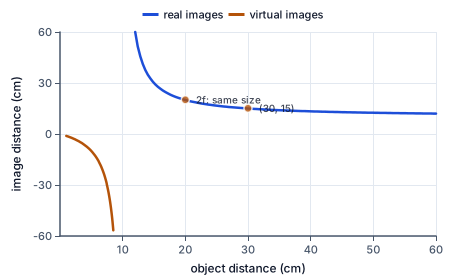
The chart plots image distance against object distance for a focal length of $10$ cm. Beyond $10$ cm the image distance is positive: real images. An object at $20$ cm, twice the focal length, images at $20$ cm, the same size and inverted. Move the object farther away and the image closes in on $10$ cm.
As the object approaches the focal point from outside, the image rushes off toward infinity. Inside the focal point the image distance is negative, a virtual image behind the mirror, which grows larger and farther as the object nears the focal point. The same chart describes a converging lens, as lesson 24 shows.
A convex mirror bulges outward. It spreads reflected rays apart, so they seem to come from a point behind the mirror, and its focal length is negative. Every image it forms is virtual, upright and smaller than the object.
That smallness buys a wide field of view. Convex mirrors watch store aisles, blind driveways and the passenger side of cars, where federal rules require the warning that objects are closer than they appear: the small image makes a car behind look farther away than it is.
Checking an answer. A convex mirror must always give a virtual, upright, smaller image. An object at $2f$ from a concave mirror must image at $2f$ with $m = -1$. Ray diagrams should agree with the numbers.
The law of reflection follows from the wave nature of light and holds for any smooth surface. The mirror equation, derived from the geometry of rays near the axis, assumes rays make small angles with it; rays far from the axis of a spherical mirror focus slightly short, an effect called spherical aberration.
Parabolic mirrors, used in telescopes and satellite dishes, bring all parallel rays to the same focus exactly. For small mirrors or rays near the axis, a sphere and a parabola are nearly the same, and the simple equation works.
Three easy rays locate any mirror image. A ray parallel to the axis reflects through the focal point. A ray through the focal point reflects parallel to the axis. A ray aimed at the center of curvature reflects straight back on itself. Where they meet, or seem to meet, is the image.
Drawing two of them carefully, from the top of the object, is enough. The diagram checks the mirror equation's signs: if the reflected rays actually cross in front of the mirror, the image is real; if they diverge and only their extensions meet behind it, the image is virtual.
Isaac Newton built the first practical reflecting telescope in 1668, using a concave mirror to gather and focus light. Mirrors can be made far larger than lenses, since they can be supported from behind, so every large research telescope is a reflector.
The $200$-inch Hale telescope on Palomar Mountain in California was the world's largest from 1948 to 1975. The twin $10$-meter Keck telescopes on Mauna Kea in Hawaii use mirrors of thirty-six hexagonal segments, and the James Webb Space Telescope's gold-coated $6.5$ m mirror unfolded in space.
Makeup and shaving mirrors are concave: held closer than the focal length, they give an upright, magnified virtual image. Dentists use small concave mirrors to see teeth enlarged. Headlight reflectors put the bulb at the focal point to send a strong parallel beam down the road.
Solar cookers and furnaces use large concave mirrors to concentrate sunlight at the focus. Solar power plants such as Ivanpah in California's Mojave Desert use thousands of flat mirrors aimed at a tower, together acting like one huge curved mirror, heating a boiler to drive a turbine.
Only smooth surfaces make images. A mirror or a calm lake reflects each ray at a definite angle, specular reflection. A sheet of paper or a painted wall is rough on the scale of light's wavelength, so parallel rays strike tiny facets at different angles and scatter in every direction: diffuse reflection.
Diffuse reflection is why we can see most objects from any direction, and why a movie screen can be seen from every seat. Road signs use tiny glass beads or prisms that send light straight back toward its source, retroreflection, so headlights make them glow for the driver.
Two flat mirrors at forty-five degrees make a periscope, letting a submarine crew or a crowd at a parade see over obstacles. Each reflection obeys the law of reflection, and the pair sends light out parallel to how it came in, shifted up or down.
Three mirrors meeting at right angles, like the inside corner of a box, form a corner reflector: any ray entering is sent straight back the way it came. The reflectors Apollo astronauts left on the Moon are arrays of such corners, which is why lasers fired from Earth come back to the telescope that sent them.
A telescope's primary mirror forms a real image of the sky at its focus. For an object as distant as the Moon, the image forms at the focal point, and its size is the focal length times the Moon's angular size, $3474$ km over $384{,}400$ km, about $0.009$.
The Hale telescope at Palomar, with a focal length of $16.8$ m, makes a Moon image about $15$ cm across; a backyard reflector with a $1.2$ m focal length makes one about a centimeter. Bigger mirrors gather more light, revealing fainter objects, and longer focal lengths spread the image over more of the camera, revealing finer detail. The Vera C. Rubin Observatory in Chile, funded by the National Science Foundation and the Department of Energy, uses a three-mirror design to image the whole southern sky every few nights.
Federal motor vehicle rules let the passenger-side mirror of an American car be convex, as long as it carries the warning that objects in the mirror are closer than they appear. With a focal length of about $-1$ m, a car $5$ m behind forms an image with a magnification of about $0.17$, upright but small.
The small image gives a wide field of view, covering the blind spot, but the brain judges distance partly by apparent size and so thinks the car is farther away. The driver's side mirror is flat so that distances there look true. Many newer cars add blind-spot sensors, since even a well-adjusted pair of mirrors leaves gaps.
It is natural to think a mirror's image lies on the glass, like a picture. The image in a plane mirror is as far behind the mirror as the object is in front; that is why you must refocus your eyes, or a camera, to the full distance to see it sharply.
A related error is to think a bigger mirror is needed to see yourself when you step back. A mirror half your height shows your whole body at any distance, because your image moves back as you do.
A $4.0$ cm object is $30$ cm from a concave mirror of radius $20$ cm. Find the focal length.
$f = \dfrac{R}{2} = 10\ \text{cm}$
Half the radius.
Find the image distance.
$\dfrac{1}{d_i} = \dfrac{1}{10} - \dfrac{1}{30} = \dfrac{2}{30} \Rightarrow d_i = 15\ \text{cm}$
Mirror equation.
Find the magnification.
$m = -\dfrac{15}{30} = -0.50$
Inverted, half size.
Find the image height.
$h_i = -0.50 \times 4.0 = -2.0\ \text{cm}$
Negative: upside down.
Classify the image.
$\text{real, inverted, smaller}$
It could be caught on a card.
A face is $15$ cm from a concave mirror of focal length $25$ cm. Write the mirror equation.
$\dfrac{1}{d_i} = \dfrac{1}{25} - \dfrac{1}{15}$
Inside the focal point.
Combine the fractions.
$\dfrac{1}{d_i} = \dfrac{3 - 5}{75} = -\dfrac{2}{75}$
Negative.
Invert for the image distance.
$d_i = -37.5\ \text{cm}$
Behind the mirror.
Find the magnification.
$m = -\dfrac{-37.5}{15} = 2.5$
Upright and magnified.
Classify the image.
$\text{virtual, upright, larger}$
Ideal for close work.
Move the face to $30$ cm. Find the new image.
$d_i = \dfrac{25 \times 30}{5} = 150\ \text{cm}, \ m = -5$
Now real and inverted: too far.
A convex mirror of radius $1.2$ m watches a shopper $4.0$ m away. Find the focal length.
$f = -0.60\ \text{m}$
Negative for convex.
Write the mirror equation.
$\dfrac{1}{d_i} = -\dfrac{1}{0.60} - \dfrac{1}{4.0}$
Both terms negative.
Evaluate the image distance.
$\dfrac{1}{d_i} = -1.917 \Rightarrow d_i = -0.52\ \text{m}$
Behind the mirror.
Find the magnification.
$m = -\dfrac{-0.52}{4.0} = 0.13$
Small and upright.
Find the image of a $1.7$ m shopper.
$h_i = 0.13 \times 1.7 = 0.22\ \text{m}$
Fits a wide view in a small mirror.
Explain the choice of convex.
$\text{a wide field of view}$
The whole aisle is visible.
Write the mirror equation.
$\dfrac{1}{d_i} = \dfrac{1}{20} - \dfrac{1}{40}$
Subtract.
Combine the fractions.
$\dfrac{1}{d_i} = \dfrac{1}{40}$
Common denominator.
Evaluate the image distance.
An object stands $30$ cm in front of a concave mirror of focal length $10$ cm. Where is its image, in cm from the mirror? Positive means in front of the mirror.
Complete the worked solution: a person $150$ cm tall, whose eyes are $9$ cm below the top of the head, wants to see their whole body in a flat wall mirror. Find the shortest mirror length in cm, the height of its top edge above the floor in cm, and the height of its bottom edge in cm.
Find the mirror's length.
$L = \dfrac{H}{2} =$ m
Half your height, whatever the distance.
Place the top edge.
$\text{top} = H - \dfrac{e}{2} =$ t
Halfway between eyes and the top of the head.
Place the bottom edge.
$\text{bottom} = \dfrac{H - e}{2} =$ b
Halfway between the floor and the eyes.
Explain why distance does not matter.
$\text{the image moves back as you do}$
The angles scale together.
Match each mirror setup to the image it forms.
| virtual, upright and the same size | real, inverted and smaller | virtual, upright and larger | virtual, upright and smaller | |
|---|---|---|---|---|
| a plane mirror | ||||
| a concave mirror, object beyond its center | ||||
| a concave mirror, object inside its focal point | ||||
| a convex mirror |
A $6$ cm tall candle stands $50$ cm from a concave mirror of focal length $25$ cm. Fill in the image distance in cm, the magnification, and the image height in cm, with signs (negative image height means inverted).
| value | |
|---|---|
| image distance (cm) | |
| magnification | |
| image height (cm) |
A concave mirror has a focal length of $12$ cm. Write the image distance, in cm, as a function of the object distance $d$ in cm.
Answer:
A car's passenger-side mirror is convex, with focal length $-1.2$ m. A car behind is $3$ m from the mirror. What is the magnification of its image?
Answer:
The primary mirror of the Hooker telescope at Mount Wilson has a focal length of $12.7$ m. The Moon, $3474$ km across, is $384{,}400$ km away. How large is the Moon's image at the mirror's focus, in cm?
Answer: cm
Lesson test: one question per skill, one attempt each, no hints. Your answers are checked when you submit.
A concave mirror has a focal length of $20$ cm. Write the image distance, in cm, as a function of the object distance $d$ in cm.
Answer:
You can work with mirrors. Explain to someone why a mirror half your height is enough to see your whole body.
22. Your turn: an object is $40$ cm from a concave mirror of focal length $20$ cm. Where is the image?, step 3
$d_i = 40\ \text{cm}$
At $2f$: same size, inverted.