Back to the on-screen lesson ·
Snell's law, bending toward and away from the normal, the critical angle and total internal reflection, dispersion, and apparent depth.
Paper packet. Every task here also exists on screen, where it is checked automatically; answers written on paper are not assessed by Nydus. When you are back at a device, enter your answers there.
By the end of this lesson you will be able to use Snell's law to trace light across boundaries and predict total internal reflection.
From lesson 21 you know that light travels more slowly in materials, at $v = c/n$, and that its frequency is unchanged. You know rays and the normal from the reflection lesson, and the sine function from trigonometry. This lesson explains why light bends when it crosses a boundary and how much.
| Term | What it means |
|---|---|
| Refraction | The bending of light as it crosses into a material where its speed differs. |
| Snell's law | $n_1\sin\theta_1 = n_2\sin\theta_2$, angles measured from the normal. |
| Critical angle | $\sin\theta_c = n_2/n_1$, beyond which light cannot leave the slower material. |
| Total internal reflection | Complete reflection at a boundary beyond the critical angle. |
| Dispersion | The spreading of colors because the index depends on wavelength. |
| Apparent depth | How deep an object under water looks: less than its true depth. |
When light crosses into a material where it travels more slowly, it bends toward the normal; into a faster material, away from it. Snell's law gives the exact amount:
$$n_1\sin\theta_1 = n_2\sin\theta_2,$$
with angles measured from the normal. Going from a slow material to a fast one, the refracted angle is larger than the incident angle and reaches $90°$ at the critical angle, $\sin\theta_c = n_2/n_1$. Beyond it no light gets out: total internal reflection. Because the index is slightly larger for violet than for red, different colors bend differently, which is dispersion.
Another way: picture
Picture a marching band crossing from pavement onto mud at an angle. The marchers who reach the mud first slow down while those still on pavement keep their pace, so the whole line swings around toward the direction straight into the mud. Light's wavefronts swing the same way when one side enters a slower material first.
Another way: steps
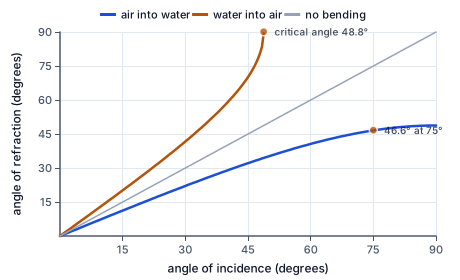
The chart plots the angle of refraction against the angle of incidence for a water surface. Going from air into water, every refracted angle is smaller than the incident one; even light skimming the surface at $90°$ enters the water at only $48.8°$.
Going from water into air, the curve rises faster than the gray no-bending line and reaches $90°$ when the angle in the water is $48.8°$, the critical angle. The curve stops there: at steeper angles no refracted ray exists, and all the light is reflected back into the water.
Think of light as a series of wavefronts. When a wavefront meets a surface at an angle, one edge enters the slower material first and slows down while the rest still travels at the old speed. The wavefront pivots, and the ray, which is perpendicular to it, bends toward the normal.
The geometry of that pivoting gives Snell's law: the sines of the angles are in the ratio of the speeds, $\sin\theta_1/\sin\theta_2 = v_1/v_2 = n_2/n_1$. Light arriving along the normal, straight on, enters the material without bending at all, though it still slows down.
Light trying to leave glass or water for air is bent away from the normal. As the angle inside increases, the ray outside tilts toward the surface, and at the critical angle it skims along it. At any steeper angle, the light cannot leave: every bit of it reflects back inside, more completely than from any silvered mirror.
For glass of index $1.5$ the critical angle is about $42°$; for diamond, $24°$. Diamond's small critical angle traps light inside a cut stone, bouncing it around until it exits through the top facets, which is why diamonds sparkle.
An optical fiber is a thin strand of very pure glass, its core surrounded by glass of slightly lower index. Light entering the core strikes the boundary at a shallow angle, beyond the critical angle, and is totally reflected, again and again, following the fiber around gentle bends for kilometers.
Charles Kao showed in the 1960s that pure enough glass could carry light over long distances, and Corning, in upstate New York, made the first low-loss fiber in 1970. Fibers now carry most of the world's internet traffic, and endoscopes use bundles of them to let doctors see inside the body.
Checking an answer. Light entering a denser material must bend toward the normal. The sine of any refracted angle must not exceed one. A ray through a slab with parallel faces must leave parallel to how it entered.
Snell's law follows from the wave nature of light and the requirement that wavefronts stay continuous across the boundary. It can also be derived from Fermat's principle: light takes the path of least time between two points, and bending at the boundary shortens the time spent in the slower material.
Using the sine is essential; the angles themselves are not proportional to the indices except for very small angles. At a real surface some light is always reflected as well as refracted, more so at steep angles.
Look down into a pool and the bottom seems closer than it is. Rays from the bottom bend away from the normal as they leave the water, and the eye traces them back in straight lines to a point above the true bottom. Looking straight down, the apparent depth is the true depth divided by $1.33$.
A $3$ m pool looks only about $2.3$ m deep. That is why the American Red Cross teaches swimmers never to dive into water whose depth they have not checked, and why a straw in a glass of water looks bent at the surface.
Glass bends violet light slightly more than red, because its index is slightly higher for shorter wavelengths. A prism, with its angled faces, spreads white light into a spectrum, as Isaac Newton showed in 1666.
Rainbows are dispersion in raindrops. Sunlight enters each drop, reflects once off the back, and leaves, with red emerging at about $42°$ from the direction opposite the Sun and violet at about $40°$. Each color comes from different drops, and the bow always forms a circle around the point directly opposite the Sun.
On a hot day, air just above a road is warmer and less dense than the air above it, with a slightly lower index. Light from the sky heading down at a shallow angle bends gradually upward as it passes into the thinner air, and it can curve back up to a driver's eye.
The driver sees sky apparently on the road ahead and interprets it as a shimmering pool of water. Desert travelers in the American Southwest see the same inferior mirages. Over cold water, the reverse happens, and distant ships can appear to float above the horizon.
Your eye focuses light mainly at the cornea, the curved front surface, because air and the cornea have very different indices. Underwater, the water's index is close to the cornea's, so little bending happens there and everything looks blurry.
A diving mask restores the air space in front of the eyes. Because light from underwater objects bends at the flat mask window, things look about a third larger and closer than they are, which divers learn to allow for when reaching for objects.
A diver looking up at a calm surface sees the whole sky compressed into a circle overhead. Light from the horizon, grazing the surface, enters at the critical angle, $48.8°$ from the vertical; light from higher in the sky arrives closer to straight up. Outside the circle, the surface acts as a mirror reflecting the dark depths.
The circle's radius on the surface is the depth times $\tan 48.8°$, about $1.14$ times the depth. Fish see the world above through this window, and anglers keep low on riverbanks so that they stay out of it.
Scuba divers in clear lakes and the Florida Keys see the sky above as a bright disk, ringed by a silvery mirror. Light from the entire sky above the water, horizon to horizon, crowds into a cone of half-angle $48.8°$, the critical angle for water.
At a depth of $5$ m, the disk's edge is $5 \times \tan 48.8°$, about $5.7$ m, from the point straight overhead, so the window is over eleven meters across. Beyond it, total internal reflection turns the surface into a mirror showing the lake bottom. Underwater photographers use the window to frame shots of the sky and shoreline, and anglers crouch on riverbanks to stay below the window's edge where a trout could see them.
Diamond's index, $2.42$, is among the highest of any clear material, giving a critical angle of only $24.4°$. Gem cutters shape a diamond's back facets at angles steeper than that, so light entering the top is totally reflected, bounced from facet to facet, and sent back out through the crown toward the viewer.
Diamond's strong dispersion splits that light into flashes of color, called fire. Marcel Tolkowsky, working in New York in 1919, calculated the proportions that return the most light, the round brilliant cut still standard today. A diamond cut too deep or too shallow lets light leak out the back and looks dull, however large it is.
It is tempting to divide the angle by the index: $30°$ into glass of index $1.5$ becoming $20°$. Snell's law relates the sines, and the true answer is $19.5°$; the difference grows at larger angles, and the shortcut can give impossible results near the critical angle.
A related error is to think light changes color when it enters water. The frequency, which sets the color we see, stays the same; only the speed and wavelength change. Objects underwater keep their colors except for the water's own absorption of red light at depth.
A ray in air strikes water, index $1.33$, at $50°$ from the normal. Write Snell's law.
$1.00 \sin 50° = 1.33 \sin\theta_2$
Air into water.
Solve for the sine.
$\sin\theta_2 = \dfrac{0.766}{1.33} = 0.576$
Divide by the index.
Take the inverse sine.
$\theta_2 = 35.2°$
Toward the normal.
Find how much the ray bent.
$50° - 35.2° = 14.8°$
The deviation.
Find the angle if the ray came straight in.
$\theta_2 = 0°$
No bending along the normal.
Light inside glass of index $1.50$ meets a glass-air surface. Find the critical angle.
$\sin\theta_c = \dfrac{1.00}{1.50} = 0.667 \Rightarrow \theta_c = 41.8°$
Slower to faster.
A ray inside strikes at $30°$. Find the exit angle.
$\sin\theta_2 = 1.50 \sin 30° = 0.75 \Rightarrow \theta_2 = 48.6°$
Bent away from the normal.
A ray strikes at $45°$. Test for escape.
$1.50 \sin 45° = 1.06 > 1$
No refracted angle exists.
State what happens.
$\text{total internal reflection}$
All light reflects inside.
Replace the air with water, index $1.33$. Find the new critical angle.
$\sin\theta_c = \dfrac{1.33}{1.50} \Rightarrow \theta_c = 62.5°$
Harder to trap light.
Explain why fibers need cladding of lower index.
$\text{it keeps } n_2 < n_1 \text{ at the boundary}$
So reflection stays total.
Crown glass has index $1.513$ for violet light and $1.502$ for red. Light enters from air at $45°$. Find the red ray's angle.
$\sin\theta_r = \dfrac{0.7071}{1.502} = 0.4708 \Rightarrow \theta_r = 28.09°$
Snell's law for red.
Find the violet ray's angle.
$\sin\theta_v = \dfrac{0.7071}{1.513} = 0.4673 \Rightarrow \theta_v = 27.86°$
Snell's law for violet.
Find the angle between them.
$28.09° - 27.86° = 0.23°$
A small spread.
Explain which bends more.
$\text{violet: larger index}$
Short wavelengths slow more.
Describe the second face of a prism.
$\text{the spread doubles as colors leave}$
Angled faces add the bends.
Relate this to a rainbow.
$\text{red at } 42°, \text{ violet at } 40°$
Raindrops as tiny prisms.
Write Snell's law.
$\sin\theta_2 = \dfrac{\sin 30°}{1.60}$
Air to glass.
Evaluate the sine.
$\sin\theta_2 = \dfrac{0.500}{1.60} = 0.3125$
Divide.
Take the inverse sine.
A ray in air strikes diamond, index $2.42$, at $25°$ from the normal. At what angle from the normal does it travel inside, in degrees?
Complete the worked solution: a ray in air strikes a glass slab of index $1.52$ at $60°$ from the normal. With $c = 3.00 \times 10^8$ m/s, find its angle inside the glass in degrees, its speed there in units of $10^8$ m/s, and the glass's critical angle for light trying to leave into air, in degrees.
Find the angle inside the glass.
$\theta_2 = \sin^{-1}\dfrac{\sin\theta_1}{n} =$ t
Bent toward the normal.
Find the speed in the glass.
$v = \dfrac{c}{n} =$ v
In units of $10^8$ m/s.
Find the critical angle.
$\theta_c = \sin^{-1}\dfrac{1}{n} =$ c
For light inside trying to leave.
Predict the exit.
$\text{the ray leaves parallel to how it entered}$
Parallel faces undo the bend.
Match each situation to what happens to the light.
| bends toward the normal | bends away from the normal | is totally reflected | spreads into colors, since the index depends on color | |
|---|---|---|---|---|
| light entering a material where it travels slower | ||||
| light entering a material where it travels faster | ||||
| light striking a faster material beyond the critical angle | ||||
| white light passing through a prism |
For sapphire, index $1.77$, fill in the critical angle for light trying to leave it into air (index $1.00$), in degrees; the speed of light in it, in units of $10^8$ m/s (take $c = 3.00 \times 10^8$ m/s); and the critical angle into water (index $1.33$), in degrees.
| value | |
|---|---|
| critical angle into air (degrees) | |
| speed of light (10⁸ m/s) | |
| critical angle into water (degrees) |
Light passes from a material of index $1.50$ into one of index $1.00$. Writing $x$ for the sine of the angle of incidence, write the sine of the angle of refraction as a function of $x$.
Answer:
You look straight down into a swimming pool $1.5$ m deep. Water's index is $1.33$. How deep does the bottom appear, in m?
Answer: m
A scuba diver $2$ m below a calm lake surface looks up and sees the sky squeezed into a bright circle, with the rest of the surface acting as a mirror. Water's index is $1.33$. What is the radius of that circle on the surface, in m?
Answer: m
Lesson test: one question per skill, one attempt each, no hints. Your answers are checked when you submit.
Light passes from a material of index $1.50$ into one of index $1.00$. Writing $x$ for the sine of the angle of incidence, write the sine of the angle of refraction as a function of $x$.
Answer:
You can apply Snell's law. Explain to someone why a swimming pool looks shallower than it really is.
22. Your turn: light in air strikes glass of index $1.60$ at $30°$. What is the angle inside?, step 3
$\theta_2 = 18.2°$
Toward the normal.