Back to the on-screen lesson ·
Resistance as voltage per ampere, Ohm's law, resistivity and wire size, power dissipated as heat, and components that are not ohmic.
Paper packet. Every task here also exists on screen, where it is checked automatically; answers written on paper are not assessed by Nydus. When you are back at a device, enter your answers there.
By the end of this lesson you will be able to use Ohm's law and resistivity to find currents, resistances and power in circuit components.
From the last lesson you know current, $I = \Delta Q/\Delta t$, and potential difference, energy per coulomb. You know power is $P = IV$. This lesson asks how much current a given voltage drives through a component, which depends on its resistance, and where the energy goes.
| Term | What it means |
|---|---|
| Resistance | $R = V/I$, volts per ampere, measured in ohms (Ω). |
| Ohm's law | For an ohmic conductor, $V = IR$ with $R$ constant. |
| Resistivity | $\rho$, a material's resistance to current, in Ω·m; $R = \rho L/A$. |
| Ohmic | Having constant resistance, so $I$ is proportional to $V$. |
| Power dissipated | $P = IV = I^2R = V^2/R$, turned to heat. |
| Wire gauge | The American wire size scale; a smaller number is a thicker wire. |
Apply a potential difference $V$ across a component and a current $I$ flows. The ratio is its resistance:
$$R = \frac{V}{I}.$$
For an ohmic conductor, such as a metal at steady temperature, $R$ stays constant: double the voltage and the current doubles. That is Ohm's law. A wire's resistance depends on its material and shape, $R = \rho L/A$: longer wires resist more, thicker ones less. The energy each coulomb loses in the resistance becomes heat, at a rate $P = I^2R = V^2/R$.
Another way: picture
Picture water flowing through pipes. The pressure difference is the voltage, the flow rate is the current, and a narrow or long pipe is a large resistance. Push harder and more water flows; make the pipe narrower and less does. The friction of water on the pipe walls warms it slightly, as resistance warms a wire.
Another way: steps
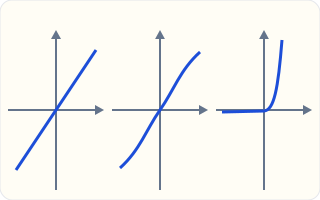
The figure shows three components' current against voltage. The resistor gives a straight line through the origin: its resistance is the same at every voltage, and reversing the voltage simply reverses the current. That is ohmic behavior.
The filament lamp's curve flattens at larger voltages: as it heats, its resistance rises, so each extra volt drives less extra current. The diode passes almost no current in one direction and very little below a small threshold in the other, then conducts freely. Only the first obeys Ohm's law.
Resistivity is a property of the material: copper's is $1.68 \times 10^{-8}$ Ω·m, aluminum's $2.65 \times 10^{-8}$, nichrome's $1.10 \times 10^{-6}$, sixty-five times copper's. Rubber and glass have resistivities around $10^{13}$ Ω·m or more, which is why they insulate.
Resistance adds shape: $R = \rho L/A$. Twice the length doubles it; twice the diameter quarters it, because the area grows as the square. American wire is sized by gauge: $12$-gauge copper, used for kitchen outlets, has about $1.6$ Ω per thousand feet; thin $22$-gauge hookup wire has sixteen.
Every coulomb crossing a resistance loses energy $V$ joules, turned into heat. The rate is $P = IV$, and using Ohm's law, $P = I^2R = V^2/R$. Which form helps depends on what stays fixed: in a wire carrying a set current, $I^2R$ shows that doubling the resistance doubles the heating; across a fixed voltage, $V^2/R$ shows the opposite.
That is why toasters, space heaters and hair dryers use elements of modest resistance on a fixed $120$ V supply, while power lines use thick wires to keep $I^2R$ losses small for the large currents they carry.
In metals, resistance rises with temperature: hotter atoms vibrate more and scatter the drifting electrons more often. A tungsten filament's resistance is about ten to fifteen times higher at its $2500$ °C operating temperature than at room temperature.
So an incandescent bulb draws a large surge when first switched on, which is when most burn out. Semiconductors behave oppositely: their resistance falls as they warm, freeing more charge carriers. Thermistors made of such materials serve as temperature sensors in thermostats, ovens and car engines.
Checking an answer. Household resistances are ohms to kilohms. A longer or thinner wire must have more resistance. The three power formulas must agree.
Ohm's law is not a law of nature like energy conservation; it is an empirical rule that holds for metals and many other materials at steady temperature. Georg Ohm found it in 1827. It fails for lamps, diodes, transistors and gases, and the definition $R = V/I$ still applies to them, but $R$ then changes with $V$.
The wire formula assumes current spreads evenly across the wire, which holds for direct current. The power formulas follow from $P = IV$ and the definition of resistance, and they hold for any component.
Some materials, cooled far enough, lose all resistance. Heike Kamerlingh Onnes discovered this in mercury at $4.2$ K in 1911. A current set flowing in a superconducting ring keeps flowing for years with no voltage to drive it.
The magnets in MRI scanners are superconducting coils cooled by liquid helium, carrying hundreds of amperes with no heating. In 1986, researchers found ceramics that superconduct at higher temperatures, and in 1987 Paul Chu at the University of Houston reported one above $77$ K, cold enough to use cheap liquid nitrogen.
Circuit designers use resistors to set currents and divide voltages. A resistor's value is printed in colored bands: brown-black-red means $1000$ Ω. They are rated for the power they can dissipate without overheating, from an eighth of a watt for tiny surface-mount parts to hundreds of watts for power resistors bolted to heat sinks.
A light-emitting diode needs a resistor in series to limit its current; without one, the LED's nearly vertical current-voltage curve would let the current soar and destroy it. Choosing the resistor is a direct application of Ohm's law.
The body's resistance depends mostly on the skin. Dry skin can present a hundred thousand ohms, limiting a $120$ V shock to about a milliampere, barely felt. Wet skin can drop to a thousand ohms, allowing a hundred times more current, enough to stop the heart.
That is why electrical codes demand special protection near water, and why electricians test that circuits are dead before touching them. Once current is inside the body, it follows the salty, low-resistance paths of blood and nerves, which is what makes it dangerous.
An ohmmeter measures resistance by sending a small known current through a component and reading the voltage across it: $R = V/I$. Digital multimeters do this on their resistance setting, which is why the component must be disconnected from any other source first.
For very small resistances, such as a length of thick copper bus bar, a four-wire method separates the current-carrying leads from the voltage-sensing leads, so the resistance of the test leads themselves does not spoil the reading. Electricians use these low-resistance ohmmeters to check that grounding connections are sound.
A power plant sends the same power down a line whether it uses high voltage and small current or low voltage and large current, since $P = IV$. But the line's own resistance wastes power as $I^2R$, which depends on the square of the current. Raising the voltage a hundredfold cuts the current a hundredfold and the losses ten-thousandfold.
That is why long-distance lines across the United States run at $345{,}000$ to $765{,}000$ volts, stepped up by transformers at the plant and stepped down again near towns. Even so, about five percent of the electricity generated in the country is lost as heat in transmission and distribution lines. Utilities weigh the cost of thicker conductors, which lower $R$, against the value of the energy they would save over decades of service.
Hardware stores sell extension cords labeled by gauge: $16$-gauge for lamps and small tools, $14$ or $12$-gauge for saws and air compressors. The reason is resistance. A $100$ ft $16$-gauge cord has $200$ ft of wire in its two conductors, about $0.8$ Ω, and at $12$ A it drops almost $10$ V before the power reaches the tool.
A motor starved of voltage draws more current trying to keep up, runs hot and can burn out, while the cord itself heats by $I^2R$. Manufacturers' charts recommend heavier gauges for longer runs and higher currents, and the National Electrical Code limits cords to uses where they will not overheat.
Look inside a toaster and you see glowing coils of nichrome, an alloy of nickel and chromium. Nichrome has sixty-five times copper's resistivity, so a few meters of it give the dozen ohms a $1200$ W toaster needs on a $120$ V outlet. Just as important, it forms a thin layer of chromium oxide that protects it from burning away when red-hot.
Albert Marsh patented nichrome in 1906 in Illinois, and it made the electric toaster, iron and heater practical. Engineers pick the wire's length and thickness with $R = \rho L/A$, trading off how hot it glows against how long it lasts.
It is natural to read $R = V/I$ as saying resistance depends on voltage. For an ohmic conductor, resistance is fixed by the material and shape; apply more voltage and more current flows, keeping the ratio constant. The formula measures resistance; it does not create it.
A related error is to think thicker wires have more resistance because there is more metal. A thicker wire gives charge more room to flow, so its resistance is lower, which is why heavy appliances need heavy wires.
A space heater draws $12.5$ A from a $120$ V outlet. Find its resistance.
$R = \dfrac{120}{12.5} = 9.6\ \Omega$
Definition of resistance.
Find its power.
$P = IV = 12.5 \times 120 = 1500\ \text{W}$
The rating on the label.
Check with the other forms.
$I^2R = 12.5^2 \times 9.6 = 1500, \quad \dfrac{V^2}{R} = \dfrac{14{,}400}{9.6} = 1500$
All agree.
Find the energy in an hour in kWh.
$1.5\ \text{kW} \times 1\ \text{h} = 1.5\ \text{kWh}$
What the utility bills.
Find the cost at $15$ cents per kWh.
$1.5 \times 0.15 = \$0.23$
Per hour of running.
A $30$ m run of $12$-gauge copper has cross section $3.31$ mm². Convert the area.
$A = 3.31 \times 10^{-6}\ \text{m}^2$
SI units.
Find the resistance of one conductor.
$R = \dfrac{1.68 \times 10^{-8} \times 30}{3.31 \times 10^{-6}} = 0.152\ \Omega$
$R = \rho L/A$.
Double it for the round trip.
$R = 0.305\ \Omega$
Out and back.
Find the voltage drop at $15$ A.
$\Delta V = 15 \times 0.305 = 4.6\ \text{V}$
Lost in the wiring.
Find the power wasted.
$P = 15^2 \times 0.305 = 69\ \text{W}$
Spread along the wires as heat.
Compare with $14$-gauge wire, area $2.08$ mm².
$R \propto \dfrac{1}{A}: \ 0.305 \times \dfrac{3.31}{2.08} = 0.485\ \Omega$
Thinner wire, more loss.
A lamp draws $0.20$ A at $3.0$ V and $0.30$ A at $9.0$ V. Find its resistance at $3.0$ V.
$R = \dfrac{3.0}{0.20} = 15\ \Omega$
Definition.
Find its resistance at $9.0$ V.
$R = \dfrac{9.0}{0.30} = 30\ \Omega$
Doubled.
Decide whether it is ohmic.
$\text{no: } R \text{ changes with } V$
The filament heats.
Predict the current at $9.0$ V if it were ohmic at $15$ Ω.
$I = \dfrac{9.0}{15} = 0.60\ \text{A}$
Twice the real value.
Find its power at $9.0$ V.
$P = 0.30 \times 9.0 = 2.7\ \text{W}$
Using measured values.
Explain the graph's shape.
$\text{slope } \tfrac{1}{R} \text{ falls as } R \text{ rises}$
The curve flattens.
Convert the current.
$I = 0.050\ \text{A}$
Milliamperes to amperes.
Apply Ohm's law.
$V = IR = 0.050 \times 220$
Voltage from current and resistance.
Evaluate the voltage.
A copper wire is replaced by one of the same metal that is $2$ times as long and $2$ times the diameter. By what factor does its resistance change?
Complete the worked solution: an incandescent bulb is rated $75$ W on a $120$ V circuit. Its tungsten filament's resistance when cold is $12$ times smaller than when hot. Find the hot resistance in Ω, the working current in A, and the current at the instant it is switched on, in A.
Find the hot resistance.
$R_{\text{hot}} = \dfrac{V^2}{P} =$ r
At its rated power.
Find the working current.
$I = \dfrac{P}{V} =$ i
Steady when hot.
Find the switch-on current.
$I_0 = \dfrac{V}{R_{\text{cold}}} =$ j
The filament has not heated yet.
Explain why bulbs fail at switch-on.
$\text{the surge heats weak spots fastest}$
Most burn out as they are turned on.
Match each current-voltage graph to what it shows.
| an ohmic resistor | a filament lamp | a diode | the smaller resistance | |
|---|---|---|---|---|
| straight line through the origin | ||||
| curve that flattens at higher voltage | ||||
| zero current, then a steep rise past a threshold | ||||
| the steeper of two straight lines |
A $4.7$ Ω resistor has $9.4$ V across it. Fill in the current in A, the power it dissipates in W, and the energy it turns to heat in one minute, in J.
| value | |
|---|---|
| current (A) | |
| power (W) | |
| energy in one minute (J) |
A nichrome wire, resistivity $110 \times 10^{-8}$ Ω·m, has a cross section of $0.25$ mm². Write its resistance, in ohms, as a function of its length $L$ in meters.
Answer:
A toaster's heating element should dissipate $1000$ W on a $120$ V outlet. It is made of nichrome wire, resistivity $1.10 \times 10^{-6}$ Ω·m, with a cross section of $0.20$ mm². Treating the resistance as constant, how long must the wire be, in meters?
Answer: m
A $50$ ft extension cord made of $14$-gauge copper wire, $2.525$ Ω per $1000$ ft, powers a table saw drawing $12$ A. How many volts are lost in the cord?
Answer: V
Lesson test: one question per skill, one attempt each, no hints. Your answers are checked when you submit.
A copper wire, resistivity $1.68 \times 10^{-8}$ Ω·m, has a cross section of $0.84$ mm². Write its resistance, in ohms, as a function of its length $L$ in meters.
Answer:
You can work with resistance. Explain to someone why a thicker wire has less resistance than a thin one of the same length.
22. Your turn: a $220$ Ω resistor carries $50$ mA. What voltage is across it?, step 3
$V = 11\ \text{V}$
Volts.