Back to the on-screen lesson ·
Adding the fields of several charges as vectors: along a line, at right angles and by components, with null points and dipoles.
Paper packet. Every task here also exists on screen, where it is checked automatically; answers written on paper are not assessed by Nydus. When you are back at a device, enter your answers there.
By the end of this lesson you will be able to find the net electric field of several point charges by vector addition.
From the last lessons you know the field of a point charge, $E = kQ/r^2$, pointing away from positive charges and toward negative ones. From Physics 1 you know how to add vectors by components and the Pythagorean theorem. This lesson combines the fields of several charges.
| Term | What it means |
|---|---|
| Superposition | Each charge contributes its field independently; the net field is the vector sum. |
| Net field | $\vec{E} = \vec{E}_1 + \vec{E}_2 + \ldots$ |
| Components | The x and y parts of a vector, added separately. |
| Null point | A place where the fields of several charges cancel to zero. |
| Electric dipole | Equal and opposite charges a small distance apart. |
When several charges are present, each produces its own field at every point, exactly as if the others were absent. The net field is the vector sum:
$$\vec{E} = \vec{E}_1 + \vec{E}_2 + \vec{E}_3 + \ldots$$
This is the superposition principle. To use it, find each field's size from $kq/r^2$ and its direction from the sign of the charge, then add the vectors: along a line by adding or subtracting, at right angles by the Pythagorean theorem, and in general by components. Potentials, being scalars, simply add as signed numbers.
Another way: picture
Picture two people pulling a sled with ropes. If they pull the same way, their pulls add; if they pull in opposite directions, they partly cancel; if they pull at right angles, the sled moves diagonally with a pull given by the Pythagorean theorem. Fields from several charges combine exactly like those ropes.
Another way: steps
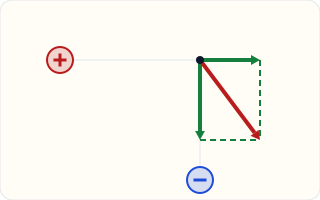
The figure shows a point with a positive charge to its left and a negative charge below it. The positive charge's field points right, away from it, three units long; the negative charge's field points down, toward it, four units long. Completing the rectangle gives the net field along the diagonal: five units, down and to the right.
That is the Pythagorean theorem: $\sqrt{3^2 + 4^2} = 5$. The net field is not seven units; perpendicular vectors add to less than the sum of their sizes. Its angle below the horizontal is $\tan^{-1}(4/3) = 53°$.
When all the charges and the point lie on a line, every field points along it, and vector addition becomes signed addition. Between two positive charges, their fields point in opposite directions and partly cancel; outside them, both point the same way and add.
Between a positive and a negative charge, both fields point toward the negative one and add. That is why the field between the plates of a capacitor is strong while the field outside nearly vanishes: inside, the fields of the two plates add; outside, they cancel.
Between two positive charges there is always a point where their fields cancel. If the charges are equal, it is the midpoint. If they differ, it lies closer to the smaller charge, where its weaker field is balanced by being nearer. Setting $kQ_1/x^2 = kQ_2/(d - x)^2$ and taking square roots finds it.
For a positive and a negative charge, no null point exists between them, since both fields point the same way there. A null point may exist outside, beyond the smaller charge. Ion traps and particle beam optics use such null points to hold charged particles in place.
When fields point at arbitrary angles, break each into x and y components: $E_x = E\cos\theta$ and $E_y = E\sin\theta$. Add all the x components together and all the y components together. The net field has size $\sqrt{E_x^2 + E_y^2}$ and direction $\tan^{-1}(E_y/E_x)$, adjusted for the quadrant.
Symmetry often saves work. On the perpendicular bisector of two equal charges, their components along the line joining them cancel, and only the perpendicular components survive. Spotting such cancellations first is a mark of skill.
Checking an answer. The net size must lie between the difference and the sum of the parts. Fields of equal like charges must cancel at their midpoint. Far from a group of charges, the field must look like that of their total charge.
Superposition is an experimental fact about electric forces: the force between two charges is unaffected by the presence of a third. It follows from the linearity of Maxwell's equations, and it has been tested from atomic scales to astronomical ones.
It is what makes electrostatics solvable: any charge distribution can be built from point charges, and its field is the sum of theirs. For continuous distributions the sum becomes an integral, as in Physics C.
Equal and opposite charges a small distance apart form a dipole. Far away, their fields almost cancel, since the charges are nearly at the same place. What remains falls off as $1/r^3$, faster than a single charge's $1/r^2$.
Water molecules are dipoles, with the oxygen end negative and the hydrogen end positive. Their dipole fields make water an excellent solvent for salts, pulling ions apart, and they are why microwave ovens heat food: the oven's field twists the dipoles back and forth billions of times a second.
Inside a closed metal shell, the charges on the surface arrange themselves so their fields exactly cancel any outside field. The interior field is zero by superposition: the outside field plus the field of the induced surface charges.
That is the Faraday cage principle, used for sensitive measurements and in the shielded cables that carry signals to televisions and computers. The braided outer conductor of a coaxial cable keeps outside fields from disturbing the signal on the center wire.
At Kennedy Space Center and Cape Canaveral, a network of dozens of field mills measures the electric field at the ground continuously. A field mill uses a rotating shutter to alternately expose and cover a metal plate, producing a current proportional to the field.
The field at the ground is the superposition of fields from every charge region in the clouds above. Forecasters use the network to map charge overhead and predict lightning. NASA's launch rules forbid launching when fields exceed about $1500$ V/m near the pad, since a rocket's exhaust plume can trigger a strike.
Real charged objects hold their charge spread out, not at points. Superposition still works: divide the object into tiny pieces, treat each as a point charge, and add their fields. A long straight wire, a flat sheet, a ring: each has a known field found this way.
A large flat sheet with charge per area $\sigma$ produces a uniform field $\sigma/2\varepsilon_0$ on each side, independent of distance. Two oppositely charged sheets make the uniform field of a parallel-plate capacitor, $\sigma/\varepsilon_0$ between them and zero outside, which is superposition in its simplest and most useful form.
Superposition applies to forces as well as fields. A charge surrounded by several others feels the vector sum of the forces each would exert alone. Multiplying the net field by the charge gives the same result, which is why it is usually simpler to find the field first and multiply once at the end.
Chemists and biologists use this constantly. The shape of a protein depends on the electric forces among thousands of charged and polar groups, each adding its push or pull. Computer programs that predict how a drug molecule will fit into a protein's pocket add up these forces for every pair of atoms, billions of calculations resting on the same principle you use for two or three charges. The rule is simple; only the bookkeeping grows.
The same principle underlies how engineers design the electrodes in an ion thruster, such as those on NASA's Dawn spacecraft, which shaped several grids of charge so that their combined field accelerated xenon ions out of the engine in a tight beam.
Before every launch from Florida's Space Coast, the 45th Weather Squadron checks a network of field mills around Kennedy Space Center. Each reads the net electric field at the ground, the superposition of fields from charge regions in the clouds overhead.
A storm with $+40$ C at $8$ km and $-40$ C at $4$ km directly above a pad produces a net upward field of about $17$ kN/C: the nearer negative charge dominates. In 1987 an Atlas-Centaur rocket launched into an electrified cloud triggered lightning and had to be destroyed. Since then, launch commit criteria forbid liftoff when the field mills show dangerous values, and launches are routinely delayed until fields relax.
A microwave oven fills its cooking chamber with an electric field oscillating $2.45$ billion times a second. Each water molecule, a small dipole, feels a torque that tries to align it with the field. As the field reverses, the molecules twist back and forth, jostling their neighbors and heating the food.
The field inside the oven is itself a superposition: waves reflecting off the metal walls add up to a standing pattern with hot spots and cold spots a few centimeters apart. That is why ovens have turntables, and why a chocolate bar left still inside melts in spots about six centimeters apart, a classic way to measure the wavelength.
It is tempting to add field strengths like ordinary numbers. Fields have direction, and two fields of $1000$ N/C can give anything from zero, if they point opposite ways, to $2000$ N/C, if they point the same way. At right angles they give $1414$ N/C.
A related error is to assume the midpoint of two charges is always a null point. It is only for equal like charges. For unequal charges the null point shifts toward the smaller one, and for unlike charges there is none between them.
Charges of $+8.0$ nC and $+2.0$ nC are $30$ cm apart. Find each field at the midpoint.
$E_1 = \dfrac{72}{0.15^2} = 3200, \quad E_2 = \dfrac{18}{0.15^2} = 800\ \text{N/C}$
At $15$ cm each.
Assign each field a direction.
$\vec{E}_1 \text{ toward the } 2\ \text{nC}, \ \vec{E}_2 \text{ toward the } 8\ \text{nC}$
Each points away from its source.
Subtract for the net field.
$E = 3200 - 800 = 2400\ \text{N/C}$
Toward the smaller charge.
Find the null point from the larger charge.
$x = \dfrac{30}{1 + \sqrt{2/8}} = \dfrac{30}{1.5} = 20\ \text{cm}$
Nearer the smaller charge.
Check the fields there.
$\dfrac{72}{0.20^2} = 1800 = \dfrac{18}{0.10^2}$
Equal and opposite.
A $+4.0$ nC charge is $20$ cm left of P; a $-2.0$ nC charge is $10$ cm below P. Find the first field.
$E_1 = \dfrac{36}{0.20^2} = 900\ \text{N/C}$
Pointing right, away.
Find the second field.
$E_2 = \dfrac{18}{0.10^2} = 1800\ \text{N/C}$
Pointing down, toward the negative charge.
Combine at right angles.
$E = \sqrt{900^2 + 1800^2} = 2012\ \text{N/C}$
Pythagorean theorem.
Find the angle below horizontal.
$\theta = \tan^{-1}\dfrac{1800}{900} = 63.4°$
Steeply downward.
Find the force on a $-1.0$ nC charge at P.
$F = 1.0 \times 10^{-9} \times 2012 = 2.0 \times 10^{-6}\ \text{N}$
Size.
Give its direction.
$\text{up and to the left}$
Opposite to the field for a negative charge.
Charges $+3.0$ nC and $-3.0$ nC are $8.0$ cm apart. Point P is $3.0$ cm from the midpoint along the perpendicular bisector. Find the distance to each charge.
$r = \sqrt{4.0^2 + 3.0^2} = 5.0\ \text{cm}$
Right triangle.
Find each field's size.
$E = \dfrac{27}{0.050^2} = 10{,}800\ \text{N/C}$
Equal distances, equal sizes.
Split into components along the line of charges.
$E_x = 10{,}800 \times \dfrac{4.0}{5.0} = 8640\ \text{N/C each}$
Both toward the negative side.
Find the perpendicular components.
$E_y = \pm 10{,}800 \times \dfrac{3.0}{5.0}$
One up, one down.
Add the components.
$E_x = 17{,}280, \quad E_y = 0$
The perpendicular parts cancel.
State the net field.
$E = 17{,}280\ \text{N/C, parallel to the dipole}$
From the positive side toward the negative.
Note the angle between them.
$90°$
East and north are perpendicular.
Apply the Pythagorean theorem.
$E = \sqrt{600^2 + 800^2}$
Right-angle vectors.
Evaluate the net field.
Charges of $+4$ nC and $+1$ nC are $20$ cm apart. What is the size of the net electric field at the point midway between them? Use $k = 9.0 \times 10^9$ N·m²/C².
Complete the worked solution: charges of $+25$ nC and $+4$ nC are $70$ cm apart. Find the square root of the smaller over the larger charge, the distance in cm from the larger charge to the point between them where the net field is zero, and that point's distance in cm from the smaller charge.
Set the fields equal.
$\dfrac{kQ_1}{x^2} = \dfrac{kQ_2}{(d - x)^2}$
Opposite directions between like charges.
Take square roots of the charge ratio.
$\sqrt{Q_2/Q_1} =$ r
So $d - x = x\sqrt{Q_2/Q_1}$.
Solve for the distance from the larger charge.
$x = \dfrac{d}{1 + \sqrt{Q_2/Q_1}} =$ x
In centimeters.
Find the distance from the smaller charge.
$d - x =$ y
Nearer the smaller charge.
Match each situation to the rule or result.
| add as vectors | add as signed numbers | the net field is zero | the net field is twice one charge's field | |
|---|---|---|---|---|
| fields from several charges | ||||
| potentials from several charges | ||||
| midpoint of two equal like charges | ||||
| midpoint of two equal unlike charges |
At a point P, one charge produces a field of $5000$ N/C pointing right and another produces $12000$ N/C pointing down. Fill in the size of the net field in N/C, its angle below the horizontal in degrees, and the size of the force on a $2.0$ nC charge placed at P, in μN.
| value | |
|---|---|
| net field (N/C) | |
| angle below horizontal (degrees) | |
| force on 2.0 nC (μN) |
Two $+5$ nC charges sit on the x-axis at $x = -0.2$ m and $x = +0.2$ m. With $k = 9.0 \times 10^9$ N·m²/C², write the size of the net field, in N/C, at a point on the axis at position $x$, for $x$ greater than $0.2$.
Answer:
A $+4$ nC charge sits $20$ cm to the left of point P, and a $+4$ nC charge sits $40$ cm directly below P. With $k = 9.0 \times 10^9$ N·m²/C², what is the size of the net field at P, in N/C?
Answer: N/C
Field mills at Kennedy Space Center watch a storm with $+40$ C of charge $9$ km above a launch pad and $-40$ C of charge $3$ km directly above it. Treating these as point charges with $k = 9.0 \times 10^9$ N·m²/C², what is the size of the net field at the pad, in kN/C?
Answer: kN/C
Lesson test: one question per skill, one attempt each, no hints. Your answers are checked when you submit.
Two $+2$ nC charges sit on the x-axis at $x = -0.1$ m and $x = +0.1$ m. With $k = 9.0 \times 10^9$ N·m²/C², write the size of the net field, in N/C, at a point on the axis at position $x$, for $x$ greater than $0.1$.
Answer:
You can superpose fields. Explain to someone why two strong fields can add up to zero.
22. Your turn: fields of $600$ N/C east and $800$ N/C north act at a point. What is the net field?, step 3
$E = 1000\ \text{N/C}$
Northeast, $53°$ north of east.