Back to the on-screen lesson ·
Transverse and longitudinal waves, $v = f\lambda$, wave speed on strings, standing waves and harmonics, and energy carried by waves.
Paper packet. Every task here also exists on screen, where it is checked automatically; answers written on paper are not assessed by Nydus. When you are back at a device, enter your answers there.
By the end of this lesson you will be able to relate wave speed, frequency and wavelength and find the harmonics of a string.
From Physics 1 you know simple harmonic motion: a mass on a spring oscillates with a period and frequency, and energy moves between kinetic and potential forms. This lesson links many oscillators together, so that a disturbance passes from one to the next: a wave.
| Term | What it means |
|---|---|
| Wave | A disturbance that carries energy through a medium, or through space, without carrying matter. |
| Transverse and longitudinal | Medium moving across, or along, the direction of travel. |
| Wavelength | $\lambda$, the distance between neighboring crests. |
| Wave relation | $v = f\lambda$. |
| Wave speed on a string | $v = \sqrt{T/\mu}$, with tension $T$ and mass per length $\mu$. |
| Standing wave | A pattern of fixed nodes and antinodes made by waves reflecting back and forth. |
| Harmonics | The standing-wave frequencies $f_n = nv/(2L)$ of a string fixed at both ends. |
Flick one end of a stretched rope and a pulse runs along it; each bit of rope moves up and down and returns, but the pulse travels to the far end. A wave carries energy and a pattern from place to place while the medium only oscillates in place. In a transverse wave the medium moves across the direction of travel; in a longitudinal wave, along it.
For a periodic wave, one wavelength passes each cycle, so
$$v = f\lambda.$$
The medium sets the speed, the source sets the frequency, and the wavelength follows. On a string, $v = \sqrt{T/\mu}$. A string fixed at both ends holds standing waves only at frequencies $f_n = nv/(2L)$.
Another way: picture
Picture a stadium wave. Fans stand and sit in turn, each staying in their seat, while the wave sweeps around the stadium. The fans are the medium; the wave is the pattern of motion traveling through them. How fast it goes depends on how quickly each fan reacts to their neighbor, not on how high they jump.
Another way: steps
Waves on a guitar string, ripples on a pond and light are transverse: the disturbance is perpendicular to the direction of travel. Sound in air is longitudinal: air molecules jostle back and forth along the direction the sound moves, making regions of compression and rarefaction.
Some waves are both. Earthquakes send out longitudinal P waves, which travel fastest, and transverse S waves, which cannot pass through liquids. That the S waves never reach the far side of the Earth told seismologists the outer core is molten.
A wave's speed depends on the medium: how stiffly its parts are connected and how much inertia they have. On a string, tension pulls neighboring bits back into line, and mass per length resists: $v = \sqrt{T/\mu}$. Tighten a guitar string and its waves travel faster; use a thicker string and they travel slower.
Sound travels at $343$ m/s in room-temperature air, about $1480$ m/s in water and nearly $6000$ m/s in steel, since stiffer materials pass on a push faster. The speed does not depend on the frequency or amplitude, which is why a band's high and low notes reach the back row together.
The source sets the frequency: a tuning fork vibrating $440$ times a second makes a $440$ Hz wave. Each vibration sends out one wavelength, so in one second $f$ wavelengths leave the source and travel a distance $v$: hence $v = f\lambda$. In air, $440$ Hz sound has a wavelength of about $78$ cm.
When a wave passes into a new medium, its frequency stays the same, set by the source, while its speed changes, so its wavelength changes too. Light entering water and sound entering a wall both behave this way.
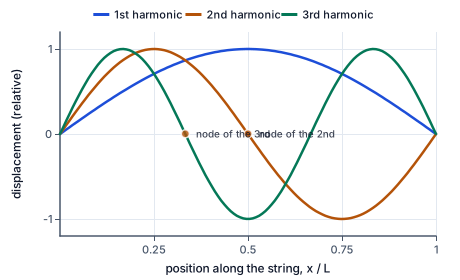
A wave on a string reflects at a fixed end and travels back, overlapping the incoming wave. At certain frequencies the two combine into a standing wave: a fixed pattern of nodes, which never move, and antinodes, which swing widest. The chart shows the first three.
Both ends must be nodes, so a whole number of half-wavelengths must fit on the string: $L = n\lambda/2$. The frequencies are $f_n = nv/(2L)$, whole-number multiples of the fundamental, called harmonics. A plucked string vibrates in many harmonics at once, and their mixture gives each instrument its tone.
Checking an answer. Higher frequencies must have shorter wavelengths in the same medium. Tighter strings must have faster waves and higher pitches. Harmonics must be whole-number multiples of the fundamental.
The relation $v = f\lambda$ is geometry: in one period the wave moves one wavelength. The string speed formula comes from applying Newton's second law to a small piece of string curved by the wave; the tension's pull on its curved ends accelerates it.
Standing waves follow from superposition: two identical waves traveling in opposite directions add to a pattern that oscillates in place. The boundary conditions, nodes at the fixed ends, select which wavelengths can exist, the same way they select the energy levels of a particle in a box.
A wave's amplitude is its largest displacement from rest. The energy a wave carries grows as the square of the amplitude: double the amplitude and four times the energy flows. That is why a loud sound, with a large pressure amplitude, can damage hearing, and why tsunamis, with enormous amplitudes near shore, are so destructive.
Amplitude does not change the speed or the wavelength. A gentle ripple and a large wave on the same pond travel at the same speed if they have the same wavelength. Mixing up amplitude with wavelength or frequency is a common error.
When a wave reaches the end of its medium, some or all of it reflects. A pulse reaching a fixed end, like a string tied to a wall, comes back inverted; at a free end, like a string on a frictionless ring, it comes back upright. Where two strings of different density join, part of the pulse passes through and part reflects.
Echoes are reflected sound; radar and sonar use reflected waves to find distant objects. The partial reflection of light at a window, which lets you see yourself at night, is the same effect at the boundary between air and glass.
The U.S. Geological Survey runs a network of seismometers across the country. An earthquake's fast P waves arrive first, then the slower S waves; the longer the lag, the farther the earthquake. With P waves at about $6$ km/s and S waves at about $3.5$ km/s, each second of lag means about $8.4$ km of distance.
Three stations give three distances, and the circles drawn around them cross at the epicenter. By timing waves that pass through the planet, seismologists have mapped Earth's crust, mantle, liquid outer core and solid inner core, which no one will ever visit.
Guitar, violin and piano strings are all standing-wave machines. Tuning changes the tension, and so the speed and pitch; fretting or fingering shortens the vibrating length, raising the pitch. Bass strings are thick or wound with wire to add mass, slowing their waves to reach low notes without being impractically long.
A piano's lowest string, the A at $27.5$ Hz, and its highest, the C at $4186$ Hz, differ in frequency by a factor of about $150$. Piano makers achieve that range with a combination of length, tension and mass per length, and a concert grand's strings together pull with a force of about twenty tons on its iron frame.
Water waves in the deep ocean travel at a speed set by the depth, about $\sqrt{gh}$ for waves much longer than the ocean is deep. In the Pacific, $4000$ m deep, a tsunami races at about $200$ m/s, the speed of a jetliner, with a wavelength of hundreds of kilometers and an amplitude of less than a meter, unnoticed by ships.
As it reaches shallow water it slows, its wavelength shortens, and its energy piles into a wall of water many meters high. NOAA's tsunami warning centers in Alaska and Hawaii track such waves with ocean-bottom pressure sensors and use their known speed to predict arrival times along the coast.
The U.S. Geological Survey's National Earthquake Information Center in Golden, Colorado, locates thousands of earthquakes a year from seismometer records. At each station, the P wave arrives first, traveling about $6.0$ km/s through the crust, followed by the S wave at about $3.5$ km/s.
Each second of lag between them adds about $8.4$ km of distance: a lag of $25$ s means the earthquake was about $210$ km away. With three or more stations, the circles of those radii meet at the epicenter. The same timing, run fast, powers the ShakeAlert early-warning system on the West Coast, which uses the fast P waves to send phone alerts seconds before the damaging S waves arrive.
An acoustic guitar's strings share a vibrating length of about $65$ cm but sound notes from $82$ Hz to $330$ Hz. The fundamental's wavelength is always twice the length, $1.3$ m, so the wave speeds must range from about $107$ to $429$ m/s. Since $v = \sqrt{T/\mu}$, manufacturers such as Martin and Taylor choose each string's mass per length so that all six sit at similar tensions, around $70$ to $80$ N each.
The low strings are wound with bronze wire to add mass without making them stiff. Pressing a string against a fret shortens its vibrating length, raising the pitch; the frets are spaced so that each one raises the frequency by the same ratio, a semitone, which is why they crowd closer together up the neck.
It is natural to think a wave carries the water or rope along with it. A floating duck bobs up and down as waves pass but stays in roughly the same place. The medium oscillates about its rest position; only the energy and the pattern travel.
A related error is to think a bigger wave travels faster. A wave's speed is set by the medium; its amplitude changes how much energy it carries, not how fast it goes, and its frequency changes its wavelength, not its speed.
An FM station broadcasts at $101.1$ MHz. Radio travels at $3.00 \times 10^8$ m/s. Find its wavelength.
$\lambda = \dfrac{3.00 \times 10^8}{101.1 \times 10^6} = 2.97\ \text{m}$
About three meters.
Find the period.
$T = \dfrac{1}{101.1 \times 10^6} = 9.9 \times 10^{-9}\ \text{s}$
Ten nanoseconds.
A tuba plays $58$ Hz in air at $343$ m/s. Find the wavelength.
$\lambda = \dfrac{343}{58} = 5.9\ \text{m}$
Longer than a room.
A piccolo plays $3500$ Hz. Find its wavelength.
$\lambda = \dfrac{343}{3500} = 0.098\ \text{m}$
Under ten centimeters.
Compare the two notes' arrival times at $50$ m.
$t = \dfrac{50}{343} = 0.146\ \text{s for both}$
Speed does not depend on frequency.
A violin's A string is $0.33$ m long with $\mu = 0.60$ g/m and must sound $440$ Hz. Find the needed wavelength.
$\lambda_1 = 2L = 0.66\ \text{m}$
Fundamental.
Find the needed wave speed.
$v = f\lambda = 440 \times 0.66 = 290.4\ \text{m/s}$
From $v = f\lambda$.
Solve the string formula for tension.
$T = \mu v^2$
Rearranged.
Evaluate the tension.
$T = 0.60 \times 10^{-3} \times 290.4^2 = 50.6\ \text{N}$
About eleven pounds.
Find the second harmonic.
$f_2 = 880\ \text{Hz}$
An octave up.
Find the tension for $442$ Hz.
$T = 50.6 \times \left(\dfrac{442}{440}\right)^2 = 51.1\ \text{N}$
Frequency goes as $\sqrt{T}$.
A tsunami crosses ocean $4000$ m deep. Find its speed.
$v = \sqrt{9.8 \times 4000} = 198\ \text{m/s}$
Deep-water tsunami speed.
Convert to km/h.
$198 \times 3.6 = 713\ \text{km/h}$
Jetliner speed.
Find the time to cross $3800$ km from Alaska to Hawaii.
$t = \dfrac{3.8 \times 10^6}{198} = 1.92 \times 10^4\ \text{s}$
Seconds.
Convert to hours.
$t = 5.3\ \text{h}$
Time to warn.
Its period is $15$ minutes. Find its wavelength.
$\lambda = 198 \times 900 = 178\ \text{km}$
Enormous.
Explain why ships do not notice it.
$\text{a small rise spread over } 178\ \text{km}$
The slope is tiny.
Write the wave relation.
$v = f\lambda$
Speed from frequency and wavelength.
Substitute the values.
$v = 50 \times 2.4$
Hertz times meters.
Evaluate the speed.
A wave of frequency $1000$ Hz travels at $1480$ m/s. What is its wavelength, in m?
Complete the worked solution: a guitar string of linear density $3$ g/m and vibrating length $0.9$ m is tuned to a tension of $120$ N. Find the wave speed in m/s, the fundamental frequency in Hz, and the fundamental's wavelength on the string in m.
Find the wave speed.
$v = \sqrt{\dfrac{T}{\mu}} =$ v
With $\mu$ in kg/m.
Find the fundamental frequency.
$f_1 = \dfrac{v}{2L} =$ f
Half a wavelength on the string.
Find the fundamental's wavelength.
$\lambda_1 = 2L =$ w
Twice the vibrating length.
Explain fretting.
$\text{shorter } L \Rightarrow \text{higher } f$
Pressing a fret shortens the string.
Match each term to its meaning.
| the medium moves across the direction the wave travels | the medium moves along the direction the wave travels | the largest displacement from the rest position | the number of cycles each second, set by the source | |
|---|---|---|---|---|
| transverse wave | ||||
| longitudinal wave | ||||
| amplitude | ||||
| frequency |
A string $0.5$ m long, fixed at both ends, carries waves at $200$ m/s. Fill in the frequencies, in Hz, of its first, second and third harmonics.
| value | |
|---|---|
| 1st harmonic (Hz) | |
| 2nd harmonic (Hz) | |
| 3rd harmonic (Hz) |
Sound travels at $5960$ m/s in steel. Write the wavelength, in meters, as a function of the frequency $f$ in hertz.
Answer:
A string with a linear density of $8$ g/m is stretched to a tension of $200$ N. How fast do waves travel along it, in m/s?
Answer: m/s
A U.S. Geological Survey seismometer records an earthquake's P waves, traveling at $6.0$ km/s, and then its S waves, at $3.5$ km/s, $40$ s later. How far away was the earthquake, in km?
Answer: km
Lesson test: one question per skill, one attempt each, no hints. Your answers are checked when you submit.
Sound travels at $331$ m/s in air at 0 °C. Write the wavelength, in meters, as a function of the frequency $f$ in hertz.
Answer:
You can describe waves. Explain to someone why a louder sound does not travel faster than a quiet one.
22. Your turn: a wave on a string has frequency $50$ Hz and wavelength $2.4$ m. What is its speed?, step 3
$v = 120\ \text{m/s}$
Meters per second.