Back to the on-screen lesson ·
$\oint \vec{B}\cdot d\vec{l} = \mu_0I_{\text{enc}}$ with symmetric loops: fields inside and outside wires, solenoids $\mu_0nI$, toroids, current sheets and coaxial cables.
Paper packet. Every task here also exists on screen, where it is checked automatically; answers written on paper are not assessed by Nydus. When you are back at a device, enter your answers there.
By the end of this lesson you will be able to use Ampère's law to find magnetic fields of symmetric current distributions.
From the last lesson you can find magnetic fields by integrating the Biot–Savart law. From Gauss's law you know how symmetry can turn an integral law into a one-line calculation. Ampère's law is the magnetic partner of Gauss's law: it relates the field around a closed path to the current passing through it.
| Term | What it means |
|---|---|
| Ampère's law | $\oint \vec{B}\cdot d\vec{l} = \mu_0I_{\text{enc}}$, for steady currents. |
| Amperian loop | An imaginary closed path chosen so that $B$ is constant along it or zero. |
| Enclosed current | The net current through any surface bounded by the loop, with signs. |
| Solenoid | A long helical coil; $B = \mu_0nI$ inside, nearly zero outside. |
| Turns per length | $n = N/\ell$, in turns per meter. |
| Toroid | A solenoid bent into a ring; its field is confined inside the windings. |
| Current density | $J$, current per unit area, in A/m². |
Walk around any closed loop and add up the component of $\vec{B}$ along your path. Ampère's law says the total is set by the current threading the loop:
$$\oint \vec{B}\cdot d\vec{l} = \mu_0I_{\text{enc}}.$$
Like Gauss's law, it is always true for steady currents, but it gives the field only when symmetry lets you pick a loop along which $B$ is constant and parallel to the path, or zero. For a long wire, a circle of radius $r$ gives $B \cdot 2\pi r = \mu_0I$, so $B = \mu_0I/2\pi r$ in one line. For a long solenoid with $n$ turns per meter,
$$B = \mu_0nI$$
inside, uniform, and nearly zero outside. A toroid's field is $\mu_0NI/2\pi r$ within its windings and zero outside.
Another way: picture
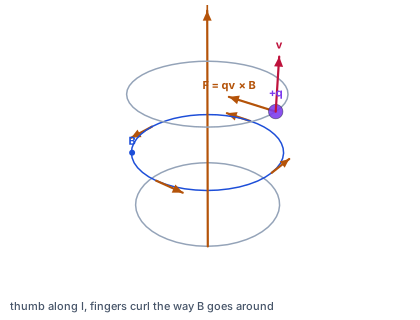
Picture the circular field lines around a wire as a whirlpool. Walk a circle around the wire and you are pushed along the whole way; the push adds up to $\mu_0I$ no matter how large the circle. Walk a loop that does not enclose the wire, and you are pushed forward on one side and back on the other, and the total is zero.
Another way: steps
The figure shows why a circle is the right Amperian loop outside a wire: the field runs along each ring with the same strength all the way round.
Outside a long wire of radius $R$, any circle of radius $r > R$ encloses the full current, so $B = \mu_0I/2\pi r$, matching the Biot–Savart result. Inside, a circle of radius $r < R$ encloses only part of the current. For a uniform current density, the fraction is the area ratio $r^2/R^2$, so $B \cdot 2\pi r = \mu_0Ir^2/R^2$, and $B = \mu_0Ir/2\pi R^2$.
The field grows linearly from zero on the axis to its greatest value at the surface, then falls off as $1/r$, just like the electric field of a uniformly charged cylinder. For a nonuniform current density, integrate $J$ over rings of area $2\pi r\,dr$ to find the enclosed current.
In a long, tightly wound solenoid, symmetry makes the field inside parallel to the axis and the same at every point, and the field outside nearly zero. Take a rectangular loop with one side of length $\ell$ inside the coil, one outside, and two crossing the windings. Only the inside side contributes: $B\ell$. The loop encloses $n\ell$ turns, each carrying $I$. So $B\ell = \mu_0n\ell I$, and $B = \mu_0nI$.
The field does not depend on the coil's radius or on the position inside. A coil with $1000$ turns per meter carrying $1$ A makes $1.26$ mT. Near the ends the field spreads out and falls to about half the central value at the very end.
Bend a solenoid into a ring and it becomes a toroid. A circle of radius $r$ inside the windings threads every turn once, so $B \cdot 2\pi r = \mu_0NI$ and $B = \mu_0NI/2\pi r$. A circle in the hole in the middle encloses no current; a circle outside the ring encloses each turn twice, once going up and once coming down, for a net of zero. The field is confined to the inside of the windings.
That confinement makes toroids useful for transformers and inductors that must not disturb nearby circuits, and it is the shape of the tokamak magnets that hold fusion plasmas.
The Biot–Savart law always works, but it requires an integral with vectors that can be difficult. Ampère's law is quick, but only with high symmetry: infinite straight wires, infinite sheets of current, long solenoids and toroids. For a finite wire or a single loop, Ampère's law is true but cannot be solved for $B$, because no path exists along which $B$ is constant.
The two laws agree wherever both can be used; each can be derived from the other for steady currents. Gauss's law and Coulomb's law have the same relationship.
Checking an answer. Units: $\mu_0I/\text{m}$ is tesla. The field must be continuous where there is no surface current. Outside a finite region of current, it must fall off. And it must agree with Biot–Savart results for the same arrangement.
Taking $B$ out of the integral needs two facts about the chosen path: $\vec{B}$ is parallel to it and has the same size everywhere on it. For a long straight wire, rotating about the wire or sliding along it changes nothing, so the field can depend only on $r$. That it cannot point radially follows from Gauss's law for magnetism, $\oint \vec{B}\cdot d\vec{A} = 0$: there are no magnetic charges for field lines to start on.
Ampère's law as stated holds only for steady currents. With a charging capacitor, current flows in the wire but not across the gap, and the law gives contradictory answers for different surfaces. Maxwell's fix, adding a displacement current, is the subject of a later lesson.
An infinite flat sheet carrying current $K$ per unit width makes a uniform field on each side, parallel to the sheet and perpendicular to the current, pointing opposite ways on the two sides. A rectangular loop straddling the sheet gives $2B\ell = \mu_0K\ell$, so $B = \mu_0K/2$.
Two such sheets with opposite currents make a field only between them, $\mu_0K$, just as two oppositely charged sheets make an electric field only between them. A solenoid is effectively this arrangement rolled into a cylinder, with $K = nI$, which is why its field is $\mu_0nI$ inside and zero outside.
Filling a solenoid with iron multiplies its field by a factor of hundreds or thousands, because the iron's atomic magnetic moments line up with the field and add their own. Electromagnets in scrap yards, relays, and the doorbells of American homes use soft iron cores that magnetize strongly when current flows and let go when it stops.
Iron saturates at about $2$ T, when nearly all its moments are aligned. Stronger fields, like those of MRI machines and particle accelerators, need air-core coils with very large currents, which in practice means superconducting wire cooled by liquid helium, carrying hundreds of amperes with no resistance at all.
Ampère's law needs a sign convention, and it is the right-hand rule again. Choose a direction to walk around the loop; curl the fingers of your right hand that way, and your thumb points in the positive direction for current through the loop. Currents along the thumb count as positive, currents against it as negative, and the enclosed current is their sum.
With two wires carrying $5$ A up and $3$ A down through the same loop, the enclosed current is $2$ A, and the circulation is $\mu_0 \times 2$ A, whatever the loop's shape. With a coil of $N$ turns passing through a loop, each turn counts once, which is how the toroid's $NI$ arises. A loop that threads no current, or equal currents both ways, has zero circulation, even though the field along it may be large: the field is pushed forward on some parts of the loop and backward on others.
This bookkeeping is also the check on any answer. If the computed field circles the wrong way for the current enclosed, a sign has slipped, and the right-hand grip rule applied to the original wire will show which. Drawing the loop, its direction, and every current's direction through it before writing any equation removes most such errors, just as drawing the Gaussian surface and the charges inside it does for Gauss's law.
The MRI scanners at hospitals such as the Mayo Clinic in Rochester, Minnesota, are built around a superconducting solenoid wide enough for a person, making a uniform field of $1.5$ or $3$ tesla, tens of thousands of times the Earth's. The field lines up the magnetic moments of hydrogen nuclei in the body, and radio pulses then tip them to reveal tissue structure.
The coil carries hundreds of amperes in niobium-titanium wire cooled to $4$ K by liquid helium, so it has no resistance, and once energized the current circulates for years without a power supply. The solenoid shape, with its uniform field inside, is exactly what the imaging needs.
Electricians measure large currents without cutting wires using a clamp meter: a hinged ring of iron that closes around a single wire. Ampère's law says the circulation of the field around the ring depends only on the current enclosed, wherever the wire sits inside it.
A sensor in the ring measures the field, and the meter converts it to amperes. Clamping around a whole power cord, with current going and returning, reads zero, since the enclosed current cancels, which is why the clamp must go around a single conductor. The same principle underlies ground-fault detectors that protect bathroom outlets.
It is natural to think a wider coil makes a weaker field, as a wider loop does at its center. For a long solenoid, though, Ampère's law gives $B = \mu_0nI$ with no radius in it, and the field is the same everywhere inside, not just on the axis.
A related error is to use the total number of turns instead of turns per length. A solenoid of $1000$ turns spread over two meters makes half the field of the same turns packed into one meter.
A solenoid $40$ cm long has $800$ turns carrying $3.0$ A. Find the turns per meter.
$n = \dfrac{800}{0.40} = 2000\ \text{m}^{-1}$
Turns over length.
Find the field inside.
$B = 4\pi \times 10^{-7} \times 2000 \times 3.0 = 7.5\ \text{mT}$
$\mu_0nI$.
Find the field outside.
$B \approx 0$
For a long, tightly wound coil.
Double the radius of the coil.
$B = 7.5\ \text{mT}$
The radius does not matter.
Find the energy stored per cubic meter.
$u = \dfrac{B^2}{2\mu_0} = \dfrac{(0.0075)^2}{2 \times 1.26 \times 10^{-6}} = 22\ \text{J/m}^3$
The magnetic energy density.
A wire of radius $2.0$ mm carries $10$ A uniformly. Find the field at its surface.
$B = \dfrac{2 \times 10^{-7} \times 10}{0.0020} = 1.0\ \text{mT}$
All the current enclosed.
Find the current enclosed at $1.0$ mm.
$I_{\text{enc}} = 10 \times \left(\dfrac{1.0}{2.0}\right)^2 = 2.5\ \text{A}$
Area fraction.
Find the field there.
$B = \dfrac{2 \times 10^{-7} \times 2.5}{0.0010} = 0.50\ \text{mT}$
Half the surface value.
Find the field at $4.0$ mm.
$B = \dfrac{2 \times 10^{-7} \times 10}{0.0040} = 0.50\ \text{mT}$
Outside, it falls as $1/r$.
Find the field on the axis.
$B = 0$
No current enclosed.
Describe the whole curve.
$\text{linear up to } R, \text{ then } 1/r$
Greatest at the surface.
A toroid has inner radius $10$ cm and outer radius $15$ cm, with $600$ turns carrying $2.0$ A. Find the field at $10$ cm.
$B = \dfrac{2 \times 10^{-7} \times 600 \times 2.0}{0.10} = 2.4\ \text{mT}$
$\mu_0NI/2\pi r$.
Find the field at $15$ cm.
$B = \dfrac{2.4 \times 10}{15} = 1.6\ \text{mT}$
Weaker toward the outside.
Find the field in the central hole.
$B = 0$
No current enclosed.
Find the field outside the ring.
$B = 0$
Each turn is enclosed twice, once each way.
Find the average field inside.
$\bar{B} \approx \dfrac{2 \times 10^{-7} \times 1200}{0.125} = 1.9\ \text{mT}$
At the mean radius.
Compare with a straight solenoid of the same length.
$n = \dfrac{600}{2\pi \times 0.125} = 764\ \text{m}^{-1}: \ \mu_0nI = 1.9\ \text{mT}$
The same at the mean radius.
Explain why toroids are preferred in sensitive circuits.
$\text{no field outside}$
They neither leak field nor pick it up.
Write the solenoid field.
$B = \mu_0nI$
Uniform inside.
Solve for the current.
$I = \dfrac{0.0030}{4\pi \times 10^{-7} \times 1500}$
Rearranged.
Evaluate the current.
A long solenoid makes a field of $6$ mT inside. Its coil is stretched to twice its length, keeping the same number of turns and the same current. What is the field inside now?
Complete the worked solution: a coaxial cable has a solid inner wire of radius $1.0$ mm carrying $6$ A spread uniformly, and a thin outer sheath carrying $6$ A back. With $\mu_0 = 4\pi \times 10^{-7}$ T·m/A, find the field in mT $4.0$ mm from the axis, between the conductors; $0.40$ mm from the axis, inside the wire; and at the wire's surface.
Enclose the whole inner wire.
$B = \dfrac{\mu_0I}{2\pi r} = \dfrac{2 \times 10^{-7} \times 6}{0.0040} =$ a
The sheath lies outside this circle.
Enclose part of the wire.
$B = \dfrac{\mu_0I}{2\pi r}\cdot\dfrac{r^2}{R^2} = \dfrac{\mu_0Ir}{2\pi R^2} =$ b
Only the fraction $r^2/R^2$ of the current is inside.
Evaluate at the wire's surface.
$B = \dfrac{2 \times 10^{-7} \times 6}{0.0010} =$ c
Both formulas agree there.
Check outside the sheath.
$I_{\text{enc}} = 6 - 6 = 0 \Rightarrow B = 0$
Why coaxial cables do not radiate or pick up fields.
Match each current arrangement to the field Ampère's law gives.
| $\mu_0I/2\pi r$ | $\mu_0Ir/2\pi R^2$ | $\mu_0nI$ | $\mu_0NI/2\pi r$ | |
|---|---|---|---|---|
| outside a wire | ||||
| inside a uniform wire | ||||
| long solenoid | ||||
| toroid |
A long solenoid has $16$ turns per centimeter and carries $4$ A. With $\mu_0 = 4\pi \times 10^{-7}$ T·m/A, fill in the field inside in mT, the field inside if the current is doubled in mT, and the energy density of the original field in J/m³.
| value | |
|---|---|
| field (mT) | |
| field at twice the current (mT) | |
| energy density (J/m³) |
A thick wire of radius $2$ mm carries a current whose density grows in proportion to the distance from its axis, $J = cr$. The field at its surface is $32$ mT. Write the field inside, in mT, as a formula in $r$ (mm).
Answer:
A toroid has $1000$ turns carrying $5$ A. With $\mu_0 = 4\pi \times 10^{-7}$ T·m/A, how strong is the field inside its windings $5$ cm from its central axis, in mT?
Answer: mT inside the toroid
An engineer at a hospital in Rochester, Minnesota, checks an MRI magnet: a long superconducting solenoid with $2500$ turns per meter that makes a $1.5$ T field. With $\mu_0 = 4\pi \times 10^{-7}$ T·m/A, what current does it carry, in A?
Answer: A in the windings
Lesson test: one question per skill, one attempt each, no hints. Your answers are checked when you submit.
A thick wire of radius $2$ mm carries a current whose density grows in proportion to the distance from its axis, $J = cr$. The field at its surface is $32$ mT. Write the field inside, in mT, as a formula in $r$ (mm).
Answer:
You can apply Ampère's law. Explain to someone why a toroid has no field outside its windings.
20. Your turn: a solenoid with $1500$ turns per meter must make $3.0$ mT. What current does it need?, step 3
$I = 1.6\ \text{A}$
A modest current.