Back to the on-screen lesson ·
$\vec{L} = \vec{r} \times \vec{p}$ and $L = I\omega$, $\vec{\tau} = d\vec{L}/dt$ and conservation, rotational kinetic energy, rolling, and rotational collisions.
Paper packet. Every task here also exists on screen, where it is checked automatically; answers written on paper are not assessed by Nydus. When you are back at a device, enter your answers there.
By the end of this lesson you will be able to use conservation of angular momentum in spins and rotational collisions, and include rotational kinetic energy in rolling and energy problems.
The last lesson gave torque, rotational inertia and $\tau = I\alpha$. The momentum lessons showed that force changes linear momentum and that momentum is conserved without external force. This lesson builds the rotational counterparts: angular momentum, which torque changes and which is conserved without external torque, and rotational kinetic energy, which together explain spins, rolling and rotational collisions.
| Term | What it means |
|---|---|
| Angular momentum of a particle | $\vec{L} = \vec{r} \times \vec{p}$ about a chosen point, of size $rp\sin\theta$. |
| Angular momentum of a rigid body | $L = I\omega$ about a fixed axis. |
| Angular impulse | $\int\tau\,dt = \Delta L$, the change of angular momentum produced by a torque. |
| Rotational kinetic energy | $\tfrac{1}{2}I\omega^2$, the energy of turning. |
| Rolling without slipping | Motion with $v_{\text{cm}} = R\omega$, sharing energy between translation and rotation. |
| Conservation of angular momentum | With no external torque, $\vec{L}$ is constant. |
| Moment arm of momentum | The perpendicular distance from the point to the line of the momentum. |
For a particle, angular momentum about a point is $\vec{L} = \vec{r} \times \vec{p}$, of size $rp\sin\theta$: its momentum times its moment arm. For a rigid body turning about a fixed axis, adding $mr^2\omega$ over its pieces gives
$$L = I\omega.$$
Differentiating, $d\vec{L}/dt = \vec{r} \times \vec{F} = \vec{\tau}$, so external torque changes angular momentum, just as force changes momentum. Internal torques cancel, so with no external torque the total angular momentum is conserved. If a body's rotational inertia changes, its angular velocity changes to keep $I\omega$ fixed.
A turning body also has rotational kinetic energy, $\tfrac{1}{2}I\omega^2$. A body rolling without slipping has both kinds: $K = \tfrac{1}{2}Mv^2 + \tfrac{1}{2}I\omega^2$ with $\omega = v/R$. Energy that goes into spinning is not available for moving forward, which is why rolling objects race down ramps at speeds set by their shape.
Another way: picture
Sit on a spinning office chair holding two heavy books at arm's length, and pull them in. You speed up sharply, though nothing pushed you. The books, moving in circles, carried angular momentum; bringing them closer lowered your rotational inertia, and to keep the angular momentum the same, the spin had to rise.
Another way: steps
A particle need not move in a circle to have angular momentum. One moving in a straight line past a point has $L = mvr_\perp$, where $r_\perp$ is the perpendicular distance from the point to its line of motion, and with no force on it that $L$ stays constant.
This is the natural quantity for anything that strikes a rotating body. A lump of clay thrown at the end of a hanging rod carries angular momentum about the pivot equal to its momentum times its distance below the pivot. When it sticks, the rod and clay turn together with the same angular momentum, even though linear momentum is not conserved, because the pivot pushes on the rod.
Differentiating $\vec{L} = \vec{r} \times \vec{p}$ gives $\dot{\vec{L}} = \dot{\vec{r}} \times \vec{p} + \vec{r} \times \dot{\vec{p}}$. The first term is zero, because $\dot{\vec{r}}$ is parallel to $\vec{p}$, and the second is $\vec{r} \times \vec{F} = \vec{\tau}$. So $\vec{\tau} = d\vec{L}/dt$, and integrating over time, the angular impulse $\int\tau\,dt$ equals the change in angular momentum.
For a body on a fixed axis with constant $I$, this is $\tau = I\alpha$ again. But the momentum form is more general: it holds when $I$ changes, as for a skater, a diver or a satellite extending its solar panels, and it makes collisions with rotating bodies solvable in one line, as linear impulse did for straight-line collisions.
With no external torque, $L$ is constant. A skater pulling her arms in lowers her rotational inertia and spins faster; extending them to finish slows her. A diver tucks to somersault quickly and opens out to stop rotating before entering the water. A collapsing star, shrinking a hundred thousand times in radius, spins up ten billion times, which is how neutron stars come to spin hundreds of times a second.
Choosing the point about which to take angular momentum is important. Take it about a point where the unknown forces act, such as a pivot, and their torques vanish, so angular momentum about that point is conserved even while linear momentum is not.
Each piece of a turning body moves at $r\omega$, so the kinetic energy is $\sum\tfrac{1}{2}m(r\omega)^2 = \tfrac{1}{2}I\omega^2$. Work done by torque changes it: $W = \int\tau\,d\theta$, and power is $\tau\omega$.
Angular momentum and rotational energy behave differently when $I$ changes. Writing $K = L^2/2I$ shows that at fixed $L$, lowering $I$ raises $K$. The skater's extra energy comes from her muscles, which must pull her arms in against their tendency to fly outward. Letting her arms drift out again, she does negative work and the energy returns. In rotational collisions, like linear ones, angular momentum is conserved but kinetic energy usually is not.
A ball rolling without slipping moves forward at $v$ and spins at $\omega = v/R$. Its kinetic energy is $\tfrac{1}{2}Mv^2 + \tfrac{1}{2}I\omega^2 = \tfrac{1}{2}Mv^2(1 + I/MR^2)$. Released from rest down a ramp of height $h$, it reaches $v^2 = 2gh/(1 + I/MR^2)$.
Shape decides the race: a solid sphere, with $I/MR^2 = \tfrac{2}{5}$, beats a solid disk ($\tfrac{1}{2}$), which beats a hoop ($1$), whatever their masses or sizes. The hoop puts all its mass at the rim, so half its energy goes into spinning. Static friction makes the rolling happen but does no work, because the contact point is momentarily at rest, so mechanical energy is conserved even though friction acts.
Checking an answer. A spin-up must raise $\omega$ in proportion to the drop in $I$. Kinetic energy may rise in a spin-up and fall in a sticking collision, but angular momentum must not change without external torque. A rolling object must finish slower than a frictionless sliding one from the same height.
When a moving object hits a body that can turn about a pivot, or when two turning bodies grab each other, the brief contact forces are internal to the pair and angular momentum about the pivot is conserved. Two disks on a common axle, one spinning and one at rest, dropped together, end at a shared rate $\omega = I_1\omega_1/(I_1 + I_2)$, like a perfectly inelastic collision.
Kinetic energy is lost in such couplings, just as in sticking linear collisions, and the lost fraction is $I_2/(I_1 + I_2)$. The energy goes into heat at the rubbing surfaces, which is why a car's clutch plates wear. Engineers designing clutches and brakes use the conservation of angular momentum to find the final speeds and energy accounting to size the parts that must absorb the heat.
Angular momentum points along the axis of rotation by the right-hand rule, and conservation applies to the whole vector: its direction as well as its size. A spinning wheel resists being tilted, because tilting it would change the direction of $\vec{L}$, which takes a torque. That resistance is what keeps a rolling hoop, a spinning top and a thrown football stable.
A person on a frictionless turntable holding a spinning bicycle wheel shows it vividly: flip the wheel upside down, reversing its angular momentum, and the person starts turning the other way, so that the total angular momentum stays what it was. Satellites use this with internal reaction wheels, turning themselves without thrusters by spinning a wheel the other way.
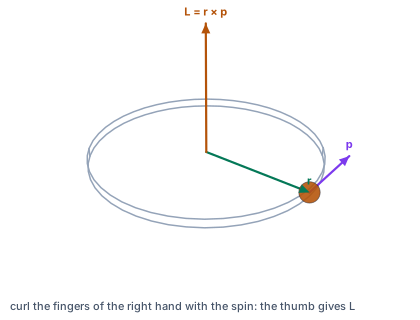
The scene shows a disk turning counterclockwise, seen from above, with a small mass on its rim. The position $\vec{r}$ runs from the center to the mass and the momentum $\vec{p}$ runs along the rim. Their cross product, $\vec{L} = \vec{r} \times \vec{p}$, points straight up the axis, at right angles to both, even though nothing on the disk moves up. Curl the fingers of your right hand the way the disk turns and your thumb points along $\vec{L}$. Every piece of the disk gives a contribution along the same axis, which is why the angular momenta of all the pieces add to $I\omega$, pointing along the axis of rotation.
A figure skater entering a spin with arms and one leg extended might have a rotational inertia of about $3.6$ kg m² and turn twice a second. Pulling her arms tight and her leg in drops the inertia to around $1.2$ kg m², and her spin rate rises to six revolutions per second, fast enough to blur on camera.
Her kinetic energy triples, supplied by the work of her arms and leg, and she can feel the effort. To come out of the spin she extends them again, slowing to a controlled exit. Judges at the U.S. Figure Skating Championships reward spins that reach high rates and hold them, and the physics of the move is a single conservation law with a rotational inertia the skater controls with her body.
The Hubble Space Telescope points at a star to a few thousandths of an arcsecond, and turns to a new target without firing any thrusters. Inside it are reaction wheels, heavy rotors driven by electric motors. Spinning a wheel one way makes the telescope turn the other, because with no external torque the total angular momentum of telescope plus wheels must stay the same.
To turn Hubble through $90°$ takes about fifteen minutes, with the wheels speeding up and then slowing down. Over months, small outside torques from sunlight and the thin upper atmosphere build up in the wheels' spin, and magnetic torquers pushing against the Earth's field are used to unload it. Nearly every American satellite, from GPS to weather satellites, steers the same way.
When a skater pulls in her arms and spins faster, it is tempting to think her kinetic energy is conserved and her speed rises to keep it so. It is angular momentum that is conserved, and her kinetic energy rises, in proportion to the drop in her rotational inertia, by the work her arms do pulling inward.
A related error is to conserve linear momentum when a body is held by a pivot. The pivot exerts a force during the collision, so linear momentum changes; angular momentum about the pivot is the conserved quantity.
A student on a stool has $I = 4.0$ kg m² and spins at $2.0$ rad/s with weights out. Find the angular momentum.
$L = 4.0 \times 2.0 = 8.0\ \text{kg m}^2/\text{s}$
$L = I\omega$.
She pulls the weights in to $I = 1.6$ kg m². Find the new rate.
$\omega_2 = \dfrac{8.0}{1.6} = 5.0\ \text{rad/s}$
Angular momentum conserved.
Find the kinetic energy before.
$K_1 = \tfrac{1}{2} \times 4.0 \times 2.0^2 = 8.0\ \text{J}$
Rotational energy.
Find the kinetic energy after.
$K_2 = \tfrac{1}{2} \times 1.6 \times 5.0^2 = 20\ \text{J}$
It rose.
Find the work her arms did.
$W = 20 - 8.0 = 12\ \text{J}$
Pulling the weights inward against their motion.
A solid sphere rolls from rest down a ramp $1.4$ m high. Write the energy balance.
$Mgh = \tfrac{1}{2}Mv^2\left(1 + \tfrac{2}{5}\right)$
$I = \tfrac{2}{5}MR^2$ and $\omega = v/R$.
Solve for the speed squared.
$v^2 = \dfrac{2gh}{1.4} = \dfrac{2 \times 9.8 \times 1.4}{1.4} = 19.6$
Mass and radius cancel.
Find the sphere's speed.
$v = 4.43\ \text{m/s}$
Take the root.
Find a hoop's speed from the same height.
$v^2 = \dfrac{2gh}{2} = 13.7 \Rightarrow v = 3.70\ \text{m/s}$
$I/MR^2 = 1$.
Find what fraction of the sphere's energy is rotational.
$\dfrac{\tfrac{2}{5}}{1 + \tfrac{2}{5}} = \dfrac{2}{7} = 29\%$
For the hoop it is half.
A uniform rod of mass $2.0$ kg and length $1.2$ m hangs from a pivot at its top. Find its rotational inertia.
$I = \tfrac{1}{3}ML^2 = \tfrac{1}{3} \times 2.0 \times 1.44 = 0.96\ \text{kg m}^2$
Rod about its end.
A $0.20$ kg lump of clay at $6.0$ m/s hits the bottom end and sticks. Find its angular momentum about the pivot.
$L = mvr = 0.20 \times 6.0 \times 1.2 = 1.44\ \text{kg m}^2/\text{s}$
Velocity perpendicular to the rod.
Find the combined inertia.
$I' = 0.96 + 0.20 \times 1.2^2 = 1.25\ \text{kg m}^2$
Clay at the end.
Conserve angular momentum.
$\omega = \dfrac{1.44}{1.25} = 1.15\ \text{rad/s}$
The pivot's force has no torque about the pivot.
Find the kinetic energy lost.
$\Delta K = \tfrac{1}{2} \times 0.20 \times 36 - \tfrac{1}{2} \times 1.25 \times 1.15^2 = 3.6 - 0.83 = 2.77\ \text{J}$
Most of it, into squashing the clay.
Explain why linear momentum is not conserved.
$\text{the pivot pushes on the rod during the impact}$
An external force, but one with no torque about the pivot.
Write the angular momentum before.
$L = 2.0 \times 6.0 = 12\ \text{kg m}^2/\text{s}$
Only the first spins.
Divide by the combined inertia.
$\omega = \dfrac{12}{4.0}$
They turn together.
Evaluate the rate.
A skater spinning at $5$ rad/s pulls in her arms, halving her rotational inertia. Ignoring friction from the ice, what happens to her spin and her kinetic energy?
Complete the worked solution: a rider on a frictionless spinning stool has rotational inertia $12$ kg m² and spins at $2$ rad/s, then pulls in weights so the inertia falls to $3$ kg m². Find the new angular velocity in rad/s, and the kinetic energy before and after, in joules.
Conserve angular momentum.
$\omega_2 = \dfrac{I_1\omega_1}{I_2} =$ w
No external torque about the stool's axis.
Find the kinetic energy before.
$K_1 = \tfrac{1}{2}I_1\omega_1^2 =$ k
Rotational energy.
Find the kinetic energy after.
$K_2 = \tfrac{1}{2}I_2\omega_2^2 =$ m
With the new inertia and rate.
Explain the gain in energy.
$\text{the rider's arms did work pulling the weights inward}$
Against their tendency to fly outward.
Match each statement about angular momentum to its expression.
| $\vec{r} \times \vec{p}$ | $I\omega$ | external torque | $\tfrac{1}{2}I\omega^2$ | |
|---|---|---|---|---|
| particle | ||||
| rigid body, fixed axis | ||||
| rate of change | ||||
| rotational energy |
A hoop, a solid disk and a solid sphere each roll without slipping from rest down a ramp $6.3$ m high. With $g = 10$ m/s², fill in the square of each one's speed at the bottom, in m²/s².
| speed squared | |
|---|---|
| hoop (m²/s²) | |
| solid disk (m²/s²) | |
| solid sphere (m²/s²) |
A spinning chair and its rider, with no external torque, have angular momentum $15$ kg m²/s. The rider moves weights in and out, changing the rotational inertia $I$. Write the angular velocity, in rad/s, as a formula in $I$ (kg m²).
Answer:
A rod of rotational inertia $0.8$ kg m² hangs from a frictionless pivot at its top. A $0.2$ kg lump of clay moving horizontally at $12$ m/s hits the rod $1.0$ m below the pivot and sticks. What is the rod's angular velocity just after, in rad/s?
Answer: rad/s just after impact
At the U.S. Figure Skating Championships, a skater enters a spin with arms out, rotational inertia $3.6$ kg m², turning $2$ times per second. She pulls in her arms to $1.2$ kg m². How many revolutions per second does she make now?
Answer: rev/s in the tucked spin
Lesson test: one question per skill, one attempt each, no hints. Your answers are checked when you submit.
A spinning chair and its rider, with no external torque, have angular momentum $22$ kg m²/s. The rider moves weights in and out, changing the rotational inertia $I$. Write the angular velocity, in rad/s, as a formula in $I$ (kg m²).
Answer:
You can use angular momentum. Explain to someone why a skater spins faster with her arms in, and where the extra kinetic energy comes from.
20. Your turn: a disk with $I = 2.0$ kg m² spinning at $6.0$ rad/s is joined by an identical disk at rest on the same axle. Find their common rate., step 3
$\omega = 3.0\ \text{rad/s}$
Half the kinetic energy is lost to friction between the disks.