Back to the on-screen lesson ·
The wave equation from Maxwell's equations, $c = 1/\sqrt{\mu_0\varepsilon_0}$, transverse fields in step with $E = cB$, intensity, radiation pressure and the spectrum.
Paper packet. Every task here also exists on screen, where it is checked automatically; answers written on paper are not assessed by Nydus. When you are back at a device, enter your answers there.
By the end of this lesson you will be able to relate the fields, frequency, intensity and pressure of electromagnetic waves, and explain how Maxwell's equations predict them.
From the last lesson you have Maxwell's four equations, including the displacement current. From Physics 2 you know that light is an electromagnetic wave and that $c = f\lambda$. This lesson shows how the equations predict those waves, finds their speed from two constants measured with capacitors and coils, and works out the energy and momentum they carry.
| Term | What it means |
|---|---|
| Electromagnetic wave | Self-sustaining oscillating electric and magnetic fields traveling through space. |
| Speed of light | $c = 1/\sqrt{\mu_0\varepsilon_0} = 3.00 \times 10^8$ m/s in vacuum. |
| Transverse | Oscillating at right angles to the direction of travel. |
| Poynting vector | $\vec{S} = \vec{E} \times \vec{B}/\mu_0$, the flow of energy per unit area per second. |
| Intensity | The average of $S$: $I = \tfrac{1}{2}c\varepsilon_0E_0^2$, in W/m². |
| Radiation pressure | $I/c$ on an absorber, $2I/c$ on a mirror. |
| Wave number | $k = 2\pi/\lambda$, radians per meter. |
In empty space there are no charges or currents, but Maxwell's equations still link the fields: a changing $\vec{B}$ makes a circulating $\vec{E}$, and a changing $\vec{E}$ makes a circulating $\vec{B}$. Combining Faraday's law and the Ampère–Maxwell law gives a wave equation for each field,
$$\frac{\partial^2E}{\partial x^2} = \mu_0\varepsilon_0\frac{\partial^2E}{\partial t^2},$$
with solutions $E = E_0\sin(kx - \omega t)$ traveling at speed
$$c = \frac{1}{\sqrt{\mu_0\varepsilon_0}} = 3.00 \times 10^8\ \text{m/s}.$$
The fields are perpendicular to each other and to the direction of travel, which is along $\vec{E} \times \vec{B}$. They oscillate in step, with $E = cB$ at every point. The wave carries energy at intensity $I = \tfrac{1}{2}c\varepsilon_0E_0^2$ and momentum, pushing on what it strikes with pressure $I/c$.
Another way: picture
Picture a rope shaken up and down, carrying a wave along its length, and a second rope shaken sideways beside it, perfectly in step. The up-and-down rope is $\vec{E}$, the sideways rope $\vec{B}$. Both peak together, both cross zero together, and the pattern moves forward at $c$. There is no rope, though: each field's change makes the other.
Another way: steps
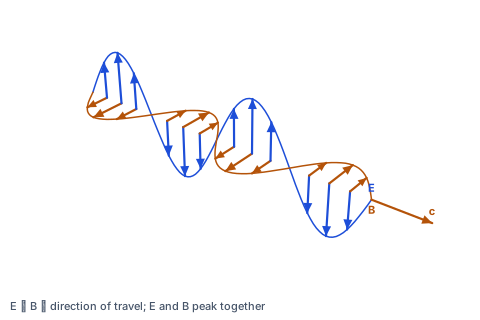
An electromagnetic wave is a changing electric field and a changing magnetic field, each sustaining the other. The figure shows two wavelengths of one traveling along $x$. $\vec{E}$ oscillates in the vertical plane and $\vec{B}$ in the horizontal plane, so the two fields are at right angles to each other and to the direction of travel: the wave is transverse. They are in step, largest and zero at the same places, and their sizes are tied by $E = cB$. The direction of travel is the direction of $\vec{E} \times \vec{B}$.
The direction in which $\vec{E}$ oscillates is called the wave's polarization. Light from the Sun or a bulb is a jumble of waves with every polarization; a polarizing filter passes only the part of $\vec{E}$ along its axis, which is how polarized sunglasses cut the glare of light reflected from water and roads, since that light is mostly polarized horizontally. Radio and TV antennas are mounted to match the polarization of the station they receive: a rod parallel to $\vec{E}$ picks up the most signal, and a rod at right angles to it picks up almost none.
Take $\vec{E}$ along $y$ and $\vec{B}$ along $z$, both depending on $x$ and $t$. Faraday's law around a thin rectangle in the $xy$-plane gives $\partial E/\partial x = -\partial B/\partial t$. The Ampère–Maxwell law around a rectangle in the $xz$-plane, with no current, gives $\partial B/\partial x = -\mu_0\varepsilon_0\,\partial E/\partial t$.
Differentiate the first with respect to $x$ and the second with respect to $t$, and combine: $\partial^2E/\partial x^2 = \mu_0\varepsilon_0\,\partial^2E/\partial t^2$. That is the wave equation with speed $1/\sqrt{\mu_0\varepsilon_0}$. Putting $E = E_0\sin(kx - \omega t)$ into the first relation gives $kE_0 = \omega B_0$, so $E_0/B_0 = \omega/k = c$.
The constants $\varepsilon_0$ and $\mu_0$ were measured in the laboratory with charges and currents: $\varepsilon_0$ from the force between charges or the capacitance of plates, $\mu_0$ from the force between currents. Neither experiment involves light. Yet $1/\sqrt{\mu_0\varepsilon_0}$ comes out to $3.00 \times 10^8$ m/s, the measured speed of light.
When Maxwell found this in 1862, he wrote that light must consist of waves in the same medium that carries electric and magnetic effects. Optics became a branch of electromagnetism. The American physicist Albert Michelson, who measured the speed of light with great precision at the Naval Academy and later in California, confirmed the agreement to ever more digits.
The wave's energy density has equal electric and magnetic parts, since $\tfrac{1}{2}\varepsilon_0E^2 = B^2/2\mu_0$ when $E = cB$. So $u = \varepsilon_0E^2$, and averaged over a cycle, $\bar{u} = \tfrac{1}{2}\varepsilon_0E_0^2$. The energy moves at $c$, so the intensity, power per unit area, is $I = c\bar{u} = \tfrac{1}{2}c\varepsilon_0E_0^2$.
The Poynting vector, $\vec{S} = \vec{E} \times \vec{B}/\mu_0$, gives the direction and rate of energy flow at each instant. Sunlight at Earth delivers about $1361$ W/m² above the atmosphere, corresponding to $E_0 \approx 1000$ V/m and $B_0 \approx 3$ μT. Intensity falls as $1/r^2$ from a point source, since the power spreads over a sphere.
An electromagnetic wave carrying energy $U$ also carries momentum $U/c$. Absorbed by a surface, it delivers that momentum, a pressure $I/c$. Reflected, its momentum reverses, and the pressure doubles to $2I/c$. Sunlight's pressure on a mirror near Earth is about $9$ μPa.
Small as that is, radiation pressure shapes comet tails, which always point away from the Sun, and pushes spacecraft over months. Laser cooling uses it to slow atoms to millionths of a degree above absolute zero, and optical tweezers use it to hold single cells.
The equations put no limit on frequency, and nature uses a vast range. Radio waves run from kilometers to centimeters; microwaves from centimeters to millimeters; infrared, visible light from $700$ to $400$ nm, ultraviolet, X-rays, and gamma rays with wavelengths smaller than atomic nuclei. All travel at $c$ in vacuum and differ only in frequency.
The Federal Communications Commission allocates bands of this spectrum in the United States: AM radio near $1$ MHz, FM near $100$ MHz, cell phones from $600$ MHz to several gigahertz, and Wi-Fi at $2.4$ and $5$ GHz. Each band's wavelength sets the size of the antennas that use it.
Checking an answer. $B$ in tesla must be about $10^{-8.5}$ times $E$ in V/m. Intensity must grow as the square of amplitude. Radiation pressure must be tiny for ordinary sources. And $\vec{E} \times \vec{B}$ must point along the direction of travel.
The derivation assumes empty space and a wave depending on only one coordinate, a plane wave. Real waves spread from sources, but far from the source, over a region small compared with the distance, any wave looks like a plane wave, so the relations $E = cB$ and $I = \tfrac{1}{2}c\varepsilon_0E_0^2$ apply.
In a material, $\varepsilon_0$ becomes $\kappa\varepsilon_0$, and the speed drops to $c/\sqrt{\kappa}$ at the relevant frequency. That ratio is the refractive index, which is why light slows in glass and bends at its surface: optics follows from Maxwell's equations applied to matter.
Accelerating charges radiate. In a radio antenna, charge surges up and down the rod at the broadcast frequency, and the changing fields near it detach and travel outward. An antenna works best when its length is about half a wavelength, so a station at $100$ MHz uses rods about $1.5$ m long, and a phone at $2$ GHz an antenna a few centimeters long.
The same physics works in reverse for reception: the wave's electric field pushes charges back and forth in the receiving antenna, making a tiny alternating current that the radio amplifies. The signal from a distant station may deliver only picowatts, yet carries a clear voice. Tuned circuits in the receiver pick that station out from all the others arriving together.
The Planetary Society, based in Pasadena, California, flew LightSail 2 in 2019: a small satellite that unfurled a $32$ m² mirror of thin Mylar and raised its orbit using nothing but the pressure of sunlight. The force was about $0.3$ mN, less than the weight of a mosquito, but it acted continuously with no fuel.
Over weeks the push added measurably to the craft's orbital energy. NASA has tested larger sails, and future sails of hundreds or thousands of square meters could carry probes to the outer solar system. Radiation pressure, $2I/c$, is the entire propulsion system.
Every wireless device in the United States operates in a band set by the Federal Communications Commission, and the band's wavelength dictates the antenna. AM radio at $1$ MHz has a wavelength of $300$ m, so AM towers are tall masts that act as quarter-wave antennas. FM at $100$ MHz needs rods about a meter and a half long.
Cell phones at $2$ GHz, with $15$ cm wavelengths, hide antennas a few centimeters long in their frames. The 5G millimeter-wave bands near $28$ GHz have wavelengths of about a centimeter, allowing arrays of dozens of tiny antennas that steer beams toward each user, but the short waves are blocked easily by walls and leaves.
In an LC circuit energy moves back and forth between electric and magnetic forms, and it is natural to picture light the same way, with $\vec{E}$ largest when $\vec{B}$ is zero. In a traveling wave that is wrong: the two fields are in phase, peaking together and passing through zero together, with $E = cB$ at every point.
A related error is to think the magnetic field is negligible because $B$ is so much smaller than $E$ in SI units. The two carry exactly equal shares of the wave's energy; the numbers differ only because the units differ.
An FM station broadcasts at $98.1$ MHz. Find the wavelength.
$\lambda = \dfrac{3.00 \times 10^8}{98.1 \times 10^6} = 3.06\ \text{m}$
$c/f$.
Find the period.
$T = \dfrac{1}{98.1 \times 10^6} = 10.2\ \text{ns}$
$1/f$.
At a receiver the electric amplitude is $0.050$ V/m. Find the magnetic amplitude.
$B_0 = \dfrac{0.050}{3.00 \times 10^8} = 1.7 \times 10^{-10}\ \text{T}$
$E/c$.
Find the intensity.
$I = \tfrac{1}{2} \times 3.00 \times 10^8 \times 8.85 \times 10^{-12} \times 0.050^2 = 3.3\ \mu\text{W/m}^2$
$\tfrac{1}{2}c\varepsilon_0E_0^2$.
Find the ideal antenna length.
$\tfrac{1}{2}\lambda = 1.53\ \text{m}$
A half-wave antenna.
Sunlight above the atmosphere has $I = 1361$ W/m². Find the amplitude $E_0$.
$E_0 = \sqrt{\dfrac{2 \times 1361}{3.00 \times 10^8 \times 8.85 \times 10^{-12}}} = 1013\ \text{V/m}$
Solve $I = \tfrac{1}{2}c\varepsilon_0E_0^2$.
Find the magnetic amplitude $B_0$.
$B_0 = \dfrac{1013}{3.00 \times 10^8} = 3.4\ \mu\text{T}$
$E/c$.
Find the average energy density.
$\bar{u} = \dfrac{I}{c} = 4.5 \times 10^{-6}\ \text{J/m}^3$
Intensity over speed.
Find the pressure on a black surface.
$P = \dfrac{I}{c} = 4.5\ \mu\text{Pa}$
Absorbed.
Find the total power the Earth intercepts.
$P = I\pi R_E^2 = 1361 \times \pi \times (6.37 \times 10^6)^2 = 1.7 \times 10^{17}\ \text{W}$
The Earth's cross section.
Find the force of sunlight on the Earth.
$F = \dfrac{1.7 \times 10^{17}}{3.00 \times 10^8} = 5.8 \times 10^8\ \text{N}$
Negligible next to the Sun's gravity, $3.5 \times 10^{22}$ N.
A $5.0$ mW laser pointer makes a spot $2.0$ mm across. Find the spot's area.
$A = \pi(0.0010)^2 = 3.1 \times 10^{-6}\ \text{m}^2$
A circle of radius $1.0$ mm.
Find the intensity.
$I = \dfrac{5.0 \times 10^{-3}}{3.1 \times 10^{-6}} = 1600\ \text{W/m}^2$
Brighter than sunlight, concentrated in a tiny spot.
Find the electric amplitude $E_0$.
$E_0 = \sqrt{\dfrac{2 \times 1600}{2.66 \times 10^{-3}}} = 1100\ \text{V/m}$
$c\varepsilon_0 = 2.66 \times 10^{-3}$.
Find the force on a mirror that reflects it.
$F = \dfrac{2P}{c} = \dfrac{2 \times 5.0 \times 10^{-3}}{3.00 \times 10^8} = 3.3 \times 10^{-11}\ \text{N}$
Twice the momentum flow.
Its wavelength is $532$ nm. Find the frequency.
$f = \dfrac{3.00 \times 10^8}{532 \times 10^{-9}} = 5.6 \times 10^{14}\ \text{Hz}$
Green light.
Find how many wavelengths fit in the spot.
$\dfrac{2.0 \times 10^{-3}}{532 \times 10^{-9}} = 3800$
Wide enough to treat as a plane wave.
Explain why eye safety limits are about intensity.
$\text{the lens focuses it further on the retina}$
Concentrated power heats tissue.
Find the wavelength.
$\lambda = \dfrac{3.00 \times 10^8}{2.45 \times 10^9} = 12.2\ \text{cm}$
$c/f$.
Divide the electric amplitude by $c$.
$B_0 = \dfrac{3000}{3.00 \times 10^8}$
$E = cB$.
Evaluate the magnetic amplitude.
A radio wave's electric field has amplitude $1500$ V/m. What is the amplitude of its magnetic field?
Complete the worked solution: a radio wave of wavelength $2$ m has an electric field amplitude of $15$ V/m. With $c = 3.00 \times 10^8$ m/s and $\varepsilon_0 = 8.85 \times 10^{-12}$ F/m, find its frequency in MHz, its magnetic field amplitude in nT, and its average intensity in W/m².
Divide the speed by the wavelength.
$f = \dfrac{c}{\lambda} =$ f
In MHz.
Divide the electric amplitude by the speed.
$B_0 = \dfrac{E_0}{c} =$ b
In nT.
Find the average intensity.
$I = \tfrac{1}{2}c\varepsilon_0E_0^2 =$ i
In W/m².
Check with the magnetic form.
$I = \dfrac{cB_0^2}{2\mu_0}$
The same value, since $E_0 = cB_0$.
Match each wave quantity to its expression.
| $1/\sqrt{\mu_0\varepsilon_0}$ | $E = cB$ | $\tfrac{1}{2}c\varepsilon_0E_0^2$ | $I/c$ | |
|---|---|---|---|---|
| wave speed | ||||
| field ratio | ||||
| average intensity | ||||
| pressure on an absorber |
A radio wave of frequency $250$ MHz has an electric field amplitude of $3$ V/m. Fill in its wavelength in m, its period in ns, and its magnetic field amplitude in nT.
| value | |
|---|---|
| wavelength (m) | |
| period (ns) | |
| magnetic amplitude (nT) |
At $t = 0$ the electric field of a wave traveling along $+x$ is $E = 2400\sin(5x)$ V/m, with $x$ in meters. Write its magnetic field at that instant, in μT, as a formula in $x$.
Answer:
A beam of light has an average intensity of $10$ W/m². With $c = 3.00 \times 10^8$ m/s and $\varepsilon_0 = 8.85 \times 10^{-12}$ F/m, what is the amplitude of its electric field, in V/m?
Answer: V/m amplitude
A solar sail like the Planetary Society's LightSail, from Pasadena, California, is a mirror $100$ m² in area facing the Sun near Earth, where sunlight's intensity is $1361$ W/m². With $c = 3.00 \times 10^8$ m/s, what force does the light exert, in μN?
Answer: μN from sunlight
Lesson test: one question per skill, one attempt each, no hints. Your answers are checked when you submit.
At $t = 0$ the electric field of a wave traveling along $+x$ is $E = 600\sin(4x)$ V/m, with $x$ in meters. Write its magnetic field at that instant, in μT, as a formula in $x$.
Answer:
You can work with electromagnetic waves. Explain to someone how the speed of light follows from measurements with capacitors and coils.
20. Your turn: a microwave oven works at $2.45$ GHz. Find the wavelength, and the magnetic amplitude where $E_0 = 3000$ V/m., step 3
$B_0 = 10\ \mu\text{T}$
Ten microtesla.