Back to the on-screen lesson ·
The Biot–Savart law and the fields of wires, loops and arcs, the field on a loop's axis, and the force between parallel currents.
Paper packet. Every task here also exists on screen, where it is checked automatically; answers written on paper are not assessed by Nydus. When you are back at a device, enter your answers there.
By the end of this lesson you will be able to find magnetic fields of wires, loops and arcs with the Biot–Savart law, and forces between currents.
From the last lesson you know how magnetic fields push on currents. From the electrostatics lessons you can integrate over a charge distribution, cancelling components by symmetry. This lesson does the same for currents: the Biot–Savart law gives the field of each small piece of current, and integration adds them up.
| Term | What it means |
|---|---|
| Biot–Savart law | $d\vec{B} = \dfrac{\mu_0}{4\pi}\dfrac{I\,d\vec{L} \times \hat{r}}{r^2}$, the field of a current element. |
| Permeability of free space | $\mu_0 = 4\pi \times 10^{-7}$ T·m/A. |
| Current element | $I\,d\vec{L}$, a short piece of a current-carrying wire. |
| Right-hand grip rule | Thumb along the current; fingers curl the way the field circles. |
| Magnetic dipole | A small current loop; far away its field has the same shape as an electric dipole's. |
| Ampere | Once defined by the force between parallel wires; now fixed by the electron's charge. |
| Solenoid | A long coil whose field inside is nearly uniform. |
The Biot–Savart law gives the field of a short piece of wire $d\vec{L}$ carrying current $I$, at a point a distance $r$ away in the direction $\hat{r}$:
$$d\vec{B} = \frac{\mu_0}{4\pi}\frac{I\,d\vec{L} \times \hat{r}}{r^2}.$$
Like Coulomb's law it falls as $1/r^2$, but its direction is a cross product: perpendicular to both the current and the line to the point. To find the field of a whole circuit, integrate, using symmetry to cancel components first. The standard results are
$$B_{\text{wire}} = \frac{\mu_0I}{2\pi r}, \qquad B_{\text{loop center}} = \frac{\mu_0I}{2R}, \qquad B_{\text{axis}} = \frac{\mu_0IR^2}{2(z^2 + R^2)^{3/2}}.$$
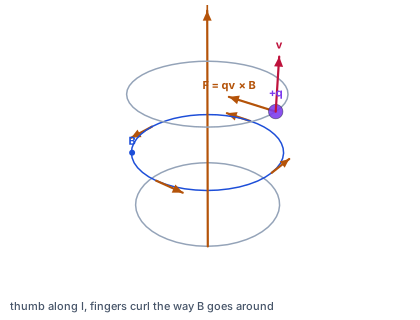
Around a long wire the field lines are circles; the right-hand grip rule gives their direction.
Another way: picture
Picture gripping a wire with your right hand, thumb pointing along the current. Your fingers curl around the wire the way the field lines circle it. The circles are crowded near the wire and spread out farther away. Bend the wire into a loop, and all those circles pass through the loop's middle in the same direction, adding up to a field along the axis.
Another way: steps
For a long wire along the $x$-axis and a point a distance $r$ away, an element at position $x$ is at distance $\sqrt{x^2 + r^2}$, and $|d\vec{L} \times \hat{r}| = dx \cdot r/\sqrt{x^2 + r^2}$. All elements give a field in the same direction, circling the wire. Integrating $\dfrac{\mu_0I}{4\pi}\displaystyle\int_{-\infty}^{\infty} \dfrac{r\,dx}{(x^2 + r^2)^{3/2}}$ gives $\mu_0I/2\pi r$.
At $1$ m from a wire carrying $1$ A the field is $0.2$ μT, far weaker than the Earth's $50$ μT. It takes large currents close by to make strong fields. For a wire of finite length, the same integral between limits gives a smaller field, which matters for the sides of rectangular loops.
At the center of a circular loop, every element is at distance $R$ and perpendicular to the line to the center, so each contributes $\mu_0I\,dL/4\pi R^2$, all along the axis. Adding around $2\pi R$ gives $\mu_0I/2R$. An arc of angle $\theta$ gives the fraction $\theta/2\pi$ of that: $\mu_0I\theta/4\pi R$.
Straight leads running toward the center of the arc contribute nothing, since $d\vec{L}$ is parallel to $\hat{r}$ and their cross product is zero. Circuits made of arcs and radial straight pieces, common on exams, reduce to adding arc contributions with the right signs.
At a point on the axis a distance $z$ from the center, every element is at distance $r = \sqrt{z^2 + R^2}$, still perpendicular to $\hat{r}$. Each element's field tilts away from the axis; around the loop the sideways parts cancel, and the axial parts, a fraction $R/r$ of each, add. The result is $B = \mu_0IR^2/2r^3$.
Far away, $z \gg R$, it becomes $\mu_0IR^2/2z^3 = \mu_0\mu/2\pi z^3$, with $\mu = I\pi R^2$: the field of a magnetic dipole, falling as $1/z^3$ like an electric dipole's. Every small current loop, and every atom with a magnetic moment, looks like this from a distance.
Two parallel wires a distance $d$ apart each sit in the other's field. Wire $1$ makes $\mu_0I_1/2\pi d$ at wire $2$, which feels a force per length $I_2B = \mu_0I_1I_2/2\pi d$. Parallel currents attract; opposite currents repel, the reverse of the rule for charges.
Until 2019 this force defined the ampere: the current that, flowing in two long wires a meter apart, makes them attract with $2 \times 10^{-7}$ N per meter. That is why $\mu_0$ was exactly $4\pi \times 10^{-7}$. The ampere is now defined through the electron's charge, and $\mu_0$ is measured, agreeing with the old value to parts in ten billion.
Checking an answer. Units: $\mu_0I/\text{m}$ is tesla. Directions must follow the right-hand grip rule. Far from a finite circuit the field should fall at least as fast as $1/r^2$, and for a loop as $1/r^3$. And pieces of wire pointing straight at the field point contribute nothing.
The Biot–Savart law holds for steady currents, which flow in closed circuits. A single isolated element is not a physical current, but adding the elements of any closed circuit gives the right field, confirmed by experiment. The law plays the role Coulomb's law plays in electrostatics.
Superposition again lets fields add, so the field of several wires is the vector sum of each one's field. And symmetry arguments work as before: if rotating the arrangement about an axis changes nothing, the field on that axis cannot have a sideways component.
Wind $N$ loops close together and their fields add: the field at the center of a flat coil is $N\mu_0I/2R$. Stack many loops along a length into a solenoid, and inside the field becomes nearly uniform and parallel to the axis, while outside it nearly cancels. The next lesson finds its value, $\mu_0nI$, quickly with Ampère's law.
Pairs of coils separated by their radius, called Helmholtz coils, make an especially uniform field between them, and are used to cancel the Earth's field in laboratories and to calibrate magnetic sensors. The spacing is chosen so that the field's first and second derivatives along the axis vanish at the midpoint, which keeps the field within a fraction of a percent of its central value over a region a good part of the coil radius across. Physics teaching labs use them to bend electron beams into circles and measure the electron's charge-to-mass ratio.
In 1820 the Danish physicist Hans Christian Oersted noticed that a compass needle swung when a nearby wire carried current. It was the first evidence that electricity and magnetism are connected. Within weeks, Biot and Savart in Paris had measured how the field depends on distance, and André-Marie Ampère had found the force between currents.
Joseph Henry at the Albany Academy in New York then wound insulated wire into powerful electromagnets, lifting more than a ton with a battery, and laid the groundwork for the telegraph. The link between currents and fields that this lesson calculates became the basis of motors, generators and the electrical age.
A straight wire of finite length gives less than $\mu_0I/2\pi r$, because the far-off parts that would have contributed are missing. Integrating the Biot–Savart law between the ends gives $B = \dfrac{\mu_0I}{4\pi r}(\sin\alpha_2 - \sin\alpha_1)$, where $\alpha_1$ and $\alpha_2$ are the angles from the perpendicular to each end, measured from the field point. For an infinitely long wire the angles are $-90°$ and $+90°$, and the bracket becomes $2$, recovering the familiar result. For a wire that starts at the foot of the perpendicular and runs off to infinity in one direction, the bracket is $1$, half of the full wire.
This formula handles any circuit made of straight segments. The field at the center of a square loop of side $a$ is four equal contributions, each from a segment seen at $\pm45°$ from a distance $a/2$, giving $B = 2\sqrt{2}\mu_0I/\pi a$, about 10 percent more than a circular loop of diameter $a$ carrying the same current. Polygons with more sides approach the circular result, as they should.
In every such problem the directions matter as much as the sizes. Each segment's field at the center of a loop points the same way, by the right-hand grip rule, so the contributions add. For a field point outside a loop, some segments push one way and some the other, and the contributions partly cancel; sketching each segment's circling field lines before adding avoids sign errors.
The scene shows the field of a long straight wire as horizontal rings around it, crowded near the wire and spreading out farther away, with $B = \mu_0I/2\pi r$ on each. Grip the wire with your right thumb along the current and your fingers curl the way the field goes around. A positive charge moving parallel to the current feels $q\vec{v} \times \vec{B}$ pointing straight at the wire, which is why two parallel currents, each a stream of moving charge, attract each other.
People living near transmission lines sometimes ask about their magnetic fields. A line carrying $500$ A, $10$ m overhead, makes about $10$ μT at ground level, less than the Earth's steady $50$ μT, though the line's field alternates $60$ times a second. The fields of the several conductors in a line partly cancel, making the real field lower still.
Household appliances make stronger fields close up: a hair dryer can make $50$ to $100$ μT a few centimeters away, falling quickly with distance. Large studies have looked for health effects of such fields; utilities, including those serving California's cities, measure them for concerned residents.
For most of the twentieth century, the force between parallel currents defined the ampere, and the National Bureau of Standards, now NIST in Gaithersburg, Maryland, measured currents with current balances that weighed that force. In 2019 the units were redefined through fixed constants of nature, the electron's charge for the ampere and Planck's constant for the kilogram.
NIST's Kibble balance now measures mass by balancing a weight against the magnetic force on a coil carrying current in a strong field. The Biot–Savart physics of this lesson, turned into a precision instrument, underlies how the world weighs a kilogram.
Electric field lines point away from charges, and it is natural to picture magnetic field lines pointing away from a wire, or along it. They do neither: the field of a straight wire circles around it, perpendicular both to the current and to the line from the wire. A compass near a wire points around it.
A related error is to think a longer loop always makes a stronger field at its center. A bigger loop has more wire, but every piece is farther away, and the field at the center falls as $1/R$.
Two long wires $10$ cm apart carry $20$ A and $30$ A in the same direction. Find the first wire's field at the second.
$B = \dfrac{2 \times 10^{-7} \times 20}{0.10} = 40\ \mu\text{T}$
$\mu_0I/2\pi d$.
Find the force per meter on the second wire.
$\dfrac{F}{L} = 30 \times 40 \times 10^{-6} = 1.2\ \text{mN/m}$
$I_2B$.
Find the direction.
$\text{toward the first wire}$
Parallel currents attract.
Find the field midway between them.
$B = \dfrac{2 \times 10^{-7}(30 - 20)}{0.050} = 40\ \mu\text{T}$
Their fields point opposite ways between the wires.
Find where the field is zero.
$\dfrac{20}{x} = \dfrac{30}{0.10 - x} \Rightarrow x = 4.0\ \text{cm from the first}$
Closer to the weaker current.
A loop of radius $5.0$ cm carries $4.0$ A. Find the field at its center.
$B = \dfrac{4\pi \times 10^{-7} \times 4.0}{2 \times 0.050} = 50\ \mu\text{T}$
$\mu_0I/2R$.
Find the distance to the loop from a point $12$ cm along the axis.
$r = \sqrt{0.12^2 + 0.050^2} = 0.13\ \text{m}$
A 5-12-13 triangle.
Find the field there.
$B = \dfrac{\mu_0IR^2}{2r^3} = \dfrac{4\pi \times 10^{-7} \times 4.0 \times 0.0025}{2 \times 0.002197} = 2.9\ \mu\text{T}$
Axial parts only.
Compare with the dipole approximation.
$\dfrac{\mu_0IR^2}{2z^3} = 3.6\ \mu\text{T}$
Not yet far enough for it to be accurate.
Find the magnetic moment.
$\mu = I\pi R^2 = 4.0 \times \pi \times 0.0025 = 0.031\ \text{A·m}^2$
Current times area.
Find how many turns would give $1.0$ mT at the center.
$N = \dfrac{1000}{50} = 20$
Fields of turns add.
A wire runs in along a straight line, around a half circle of radius $2.0$ cm, and back out parallel, carrying $5.0$ A. Find the half circle's field at its center.
$B_{\text{arc}} = \dfrac{\mu_0I\pi}{4\pi R} = \dfrac{\mu_0I}{4R} = \dfrac{4\pi \times 10^{-7} \times 5.0}{0.080} = 78.5\ \mu\text{T}$
Half a loop.
Find each straight section's field at the center.
$B_{\text{half wire}} = \tfrac{1}{2}\dfrac{\mu_0I}{2\pi R} = \dfrac{10^{-7} \times 5.0}{0.020} = 25\ \mu\text{T}$
A semi-infinite wire gives half a full wire's field at its end.
Find the directions.
$\text{all three into the page}$
Right-hand grip rule for each piece.
Add the three fields.
$B = 78.5 + 25 + 25 = 128.5\ \mu\text{T}$
Same direction.
Compare with a full loop.
$\dfrac{\mu_0I}{2R} = 157\ \mu\text{T}$
The hairpin gives a bit less.
Reverse the current and find the field.
$128.5\ \mu\text{T}, \text{ out of the page}$
Same size, opposite direction.
Find the force on a proton moving through the center at $10^5$ m/s in the plane.
$F = evB = 1.6 \times 10^{-19} \times 10^5 \times 1.285 \times 10^{-4} = 2.1 \times 10^{-18}\ \text{N}$
Perpendicular to its motion.
Write the field of a long wire.
$B = \dfrac{\mu_0I}{2\pi r}$
Circles around the wire.
Substitute the values.
$B = \dfrac{2 \times 10^{-7} \times 15}{0.030}$
$\mu_0/2\pi = 2 \times 10^{-7}$.
Evaluate the field.
A circular loop carrying a steady current makes a field of $16$ μT at its center. A loop of twice the radius carries the same current. What is the field at its center?
Complete the worked solution: two long parallel wires $4$ cm apart carry $5$ A and $4$ A in the same direction. With $\mu_0 = 4\pi \times 10^{-7}$ T·m/A, find the first wire's field at the second in μT, the force per meter on the second in μN/m, and the force on a $3.0$ m length of it in μN.
Find the first wire's field at the second.
$B_1 = \dfrac{\mu_0I_1}{2\pi d} =$ b
A long straight wire.
Multiply by the second current.
$\dfrac{F}{L} = I_2B_1 =$ f
The field is perpendicular to the second wire.
Multiply by the length.
$F = \dfrac{F}{L} \times 3.0 =$ t
Uniform along the wires.
Find the direction.
$\text{toward the first wire}$
Parallel currents attract.
Match each current arrangement to its field or force.
| $\mu_0I/2\pi r$ | $\mu_0I/2R$ | $\mu_0I\theta/4\pi R$ | $\mu_0I_1I_2/2\pi d$ | |
|---|---|---|---|---|
| long straight wire | ||||
| center of a loop | ||||
| center of an arc | ||||
| force between wires |
A long straight wire carries $3$ A. With $\mu_0 = 4\pi \times 10^{-7}$ T·m/A, fill in the field $4$ cm from it and $8$ cm from it, in μT, and the force per meter, in μN/m, on a parallel wire carrying $2.0$ A placed $4$ cm away.
| value | |
|---|---|
| field at r (μT) | |
| field at 2r (μT) | |
| force per meter (μN/m) |
A wire bent into a circular arc of radius $2$ cm carries $6$ A. The straight leads run straight toward the arc's center, so they add nothing there. With $\mu_0 = 4\pi \times 10^{-7}$ T·m/A, write the field at the center, in μT, as a formula in the arc's angle $t$ (radians).
Answer:
A circular loop of radius $0.6$ m carries $9$ A. With $\mu_0 = 4\pi \times 10^{-7}$ T·m/A, how strong is the field on its axis $0.8$ m from its center, in μT?
Answer: μT on the axis
A family in Sacramento, California, asks how strong the magnetic field is in their yard from a transmission line carrying $800$ A, $20$ m overhead. Treating the line as one long straight wire, with $\mu_0 = 4\pi \times 10^{-7}$ T·m/A, what is the field, in μT?
Answer: μT in the yard
Lesson test: one question per skill, one attempt each, no hints. Your answers are checked when you submit.
A wire bent into a circular arc of radius $1$ cm carries $5$ A. The straight leads run straight toward the arc's center, so they add nothing there. With $\mu_0 = 4\pi \times 10^{-7}$ T·m/A, write the field at the center, in μT, as a formula in the arc's angle $t$ (radians).
Answer:
You can compute fields from currents. Explain to someone why two parallel wires carrying current in the same direction attract.
21. Your turn: a long wire carries $15$ A. Find the field $3.0$ cm from it., step 3
$B = 100\ \mu\text{T}$
Twice the Earth's field.