Back to the on-screen lesson ·
Electric flux, Gauss's law, fields of spheres, lines and sheets from symmetric Gaussian surfaces, nonuniform densities, and charges on conductors.
Paper packet. Every task here also exists on screen, where it is checked automatically; answers written on paper are not assessed by Nydus. When you are back at a device, enter your answers there.
By the end of this lesson you will be able to use Gauss's law to find fields of symmetric charge distributions and the charges on conductors.
From the last lesson you can find fields by integrating over charge, using symmetry to cancel components. From calculus you know surface integrals and the idea of a normal vector. Gauss's law replaces most of those integrals with a single multiplication, whenever the charge is symmetric enough.
| Term | What it means |
|---|---|
| Electric flux | $\Phi = \int \vec{E}\cdot d\vec{A}$, the field's flow through a surface, in N·m²/C. |
| Closed surface | One that encloses a volume, with $d\vec{A}$ pointing outward. |
| Gauss's law | $\oint \vec{E}\cdot d\vec{A} = Q_{\text{enc}}/\varepsilon_0$. |
| Gaussian surface | An imaginary closed surface chosen to make the flux easy to compute. |
| Volume charge density | $\rho$, charge per unit volume, in C/m³. |
| Pillbox | A short cylinder straddling a surface, used for sheets and conductors. |
| Induced charge | Charge that moves within a conductor in response to nearby charge. |
The flux of a field through a surface measures how much field passes through it: $\Phi = \int \vec{E}\cdot d\vec{A}$, where $d\vec{A}$ points perpendicular to each patch. Gauss's law says that for any closed surface,
$$\oint \vec{E}\cdot d\vec{A} = \frac{Q_{\text{enc}}}{\varepsilon_0}.$$
The law always holds, but it gives the field directly only when symmetry lets you choose a surface over which $E$ is constant and parallel to $d\vec{A}$. Then the integral is just $E$ times an area, and
$$E = \frac{Q_{\text{enc}}}{\varepsilon_0 A}.$$
Spheres suit spherical charge, cylinders suit lines, and pillboxes suit planes. For a point charge, $E \cdot 4\pi r^2 = q/\varepsilon_0$ gives back Coulomb's law.
Another way: picture
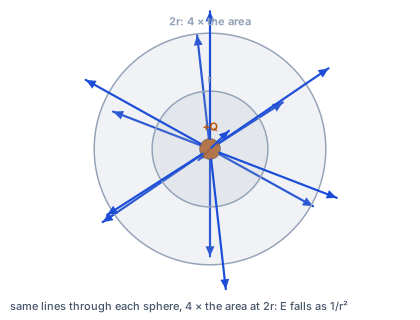
Picture field lines as a fixed number of threads leaving each positive charge. Wrap any bag around the charge, large or small, round or lumpy: every thread must pass through it once. Charges outside the bag send threads in one side and out the other, adding nothing. Counting threads through the bag counts the charge inside.
Another way: steps
For a point charge at the center of a sphere, $E = kq/r^2$ and the area is $4\pi r^2$, so the flux is $4\pi kq = q/\varepsilon_0$, whatever the radius. A lumpy surface around the same charge catches exactly the same field lines, so the same flux. A charge outside the surface contributes flux in on one side and the same flux out on the other, a net of zero.
Since fields superpose, the flux from many charges is the sum of their fluxes: $q/\varepsilon_0$ for each charge inside, zero for each outside. That is Gauss's law. It is equivalent to Coulomb's law for static charges, but it continues to hold when charges move, which is why it becomes one of Maxwell's equations.
For any spherically symmetric charge, the field is radial and depends only on $r$. On a Gaussian sphere of radius $r$, $E \cdot 4\pi r^2 = Q_{\text{enc}}/\varepsilon_0$. Outside all the charge, $Q_{\text{enc}} = Q$ and $E = kQ/r^2$: every spherical distribution looks like a point charge from outside, as Newton found for gravity.
Inside a uniform solid sphere, the enclosed charge is $Q(r/R)^3$, so $E = kQr/R^3$, growing linearly from zero at the center to $kQ/R^2$ at the surface. Inside a thin charged shell, the enclosed charge is zero, so the field is zero everywhere inside. For nonuniform densities, integrate $\rho$ over shells, $dQ = \rho\,4\pi r^2dr$, to find $Q_{\text{enc}}$.
For a long line or cylinder of charge, use a coaxial Gaussian cylinder of radius $r$ and length $\ell$. The field is radial, so no flux passes through the flat ends, and the curved side gives $E \cdot 2\pi r\ell = \lambda\ell/\varepsilon_0$. Thus $E = \lambda/2\pi\varepsilon_0r$, the $2k\lambda/r$ of the last lesson, in one line instead of a trigonometric integral.
For a large flat sheet, use a pillbox that pokes through the sheet. The field points away from the sheet on both sides, so flux leaves through both faces: $2EA = \sigma A/\varepsilon_0$, and $E = \sigma/2\varepsilon_0$, independent of distance. Two opposite sheets, as in a capacitor, give $\sigma/\varepsilon_0$ between them and zero outside.
In a conductor in equilibrium the field is zero, since otherwise charges would move. A Gaussian surface just inside the metal therefore has zero flux and encloses zero net charge, so any excess charge lies on the outer surface. If there is a cavity with a charge $q$ inside, the cavity's wall carries $-q$, and the outer surface carries the rest.
Just outside a conductor, a pillbox with one face inside the metal, where $E = 0$, gives $EA = \sigma A/\varepsilon_0$, so $E = \sigma/\varepsilon_0$, twice the field of an isolated sheet with the same density. The difference is that the conductor's field exists only on the outside.
Checking an answer. The field must be continuous across a thick distribution and jump by $\sigma/\varepsilon_0$ across a surface charge. Outside any finite distribution it must approach $kQ/r^2$. At a center of symmetry it must be zero. And the units must be N/C, since $Q/\varepsilon_0$ has units of N·m²/C and dividing by an area leaves N/C.
Gauss's law always holds, but a finite rod, a square plate, or two point charges lack the symmetry to make $E$ constant on any simple surface. The flux integral is then as hard as the direct integral, and nothing is gained; Coulomb's law and superposition are the way to go.
It is tempting to use a sphere around a cube of charge and write $E \cdot 4\pi r^2 = Q/\varepsilon_0$. The flux equation is right, but the field is not uniform over the sphere, so $E$ cannot be taken outside the integral. Only far away, where the cube looks like a point, does the result become approximately correct.
Newton's gravity has the same inverse-square form, with mass for charge and an attractive sign, so it obeys a Gauss's law too: $\oint \vec{g}\cdot d\vec{A} = -4\pi GM_{\text{enc}}$. That is why a spherical planet pulls like a point mass from outside, a result Newton took twenty years to prove with geometry.
Inside a uniform planet, $g$ grows linearly from the center, and a tunnel through the Earth would carry a dropped object in simple harmonic motion, with a period of about $84$ minutes, the same as a satellite skimming the surface. The same mathematics that describes charged spheres describes planets and stars.
The figure shows it: the same lines cross both spheres, so the flux through each is the same, while the field at the larger sphere is a quarter as strong.
Field line pictures make Gauss's law visual. Each line starts on a positive charge and ends on a negative one, and the number of lines is proportional to the charge. The density of lines crossing a surface is proportional to the field strength. Flux is then the net count of lines crossing outward.
A closed surface with no charge inside has as many lines entering as leaving. A surface around a dipole encloses zero net charge and so zero net flux, even though the field on it is far from zero. That distinction, between zero flux and zero field, is the most common source of error in using the law. Drawing the lines, even roughly, before writing any equation usually shows at once which surfaces carry flux and which do not.
Taking $E$ outside the flux integral is the heart of the method, and it needs two facts about the field on the chosen surface: its size is the same everywhere on it, and its direction is perpendicular to the surface, so that $\vec{E}\cdot d\vec{A} = E\,dA$. Both come from symmetry, not from Gauss's law. For a sphere around a spherical charge, rotating the whole arrangement about the center changes nothing, so the field cannot prefer any direction except radial, and cannot differ from one point of the sphere to another.
The symmetry argument must be made for the charge and the field point together. A uniform sphere with a small extra charge stuck to one side has lost its symmetry, and the field on a Gaussian sphere around it is no longer uniform; Gauss's law then gives the total flux correctly but not the field. When the argument holds, the law is exact, with no approximation at all, which is why its results for spheres, lines and planes are used as the starting point for so much of electrostatics.
On a clear day there is an electric field of about $100$ to $150$ N/C pointing down at the ground everywhere on Earth. Gauss's law, with a pillbox at the surface, says the ground carries a negative charge of about a nanocoulomb per square meter, adding up to about half a million coulombs over the whole planet.
That charge would leak away through the slightly conducting air in about ten minutes if nothing replenished it. Thunderstorms do: at any moment about two thousand of them worldwide pump negative charge to the ground. Researchers at the National Severe Storms Laboratory in Norman, Oklahoma, fly instruments into storms to measure the fields that build before lightning strikes.
The cable that brings television and internet service into American homes is coaxial: a central wire surrounded by insulation and a metal braid. Gauss's law with a cylinder outside the cable encloses equal and opposite charges, so the field outside is zero. The signal's fields are confined to the space between the conductors.
This shielding works both ways: outside signals cannot get in, and the cable's signal cannot leak out to interfere with nearby devices. The spacing and the insulation between the conductors set the cable's capacitance and its characteristic impedance, $75$ ohms for television cable, which the capacitance lesson returns to.
A larger surface catches a weaker field over a larger area, and the two effects cancel exactly for an inverse-square field. The flux through any closed surface depends only on the charge inside, never on the surface's size or shape or on charges outside.
A related error is to conclude that zero flux means zero field. A closed surface with no net charge inside has zero flux, but the field on it can be large: lines go in on one side and out on the other. Gauss's law gives the field only when symmetry makes it uniform over the surface.
A $4.0$ nC charge sits at the center of a cube. Find the total flux through the cube.
$\Phi = \dfrac{q}{\varepsilon_0} = \dfrac{4.0 \times 10^{-9}}{8.85 \times 10^{-12}} = 452\ \text{N·m}^2\text{/C}$
Gauss's law, any closed surface.
Find the flux through one face.
$\Phi_1 = \dfrac{452}{6} = 75\ \text{N·m}^2\text{/C}$
By symmetry the six faces share it equally.
Move the charge off center, still inside.
$\Phi = 452\ \text{N·m}^2\text{/C}$
The total is unchanged; the shares change.
Move it outside the cube.
$\Phi = 0$
Every line that enters also leaves.
Put $4.0$ nC inside and $-4.0$ nC outside.
$\Phi = 452\ \text{N·m}^2\text{/C}$
Only the enclosed charge counts.
A sphere of radius $0.20$ m holds $8.0$ nC uniformly. Find the field at its surface.
$E = \dfrac{9.0 \times 8.0}{0.040} = 1800\ \text{N/C}$
All the charge enclosed.
Find the charge enclosed at $r = 0.10$ m.
$Q_{\text{enc}} = 8.0 \times \left(\tfrac{0.10}{0.20}\right)^3 = 1.0\ \text{nC}$
Volume fraction.
Find the field there.
$E = \dfrac{9.0 \times 1.0}{0.010} = 900\ \text{N/C}$
Half the surface value.
Find the field at $r = 0.40$ m.
$E = \dfrac{9.0 \times 8.0}{0.16} = 450\ \text{N/C}$
Outside, a quarter of the surface value.
Find the field at the center.
$E = 0$
No charge enclosed.
Sketch the shape of $E(r)$.
$\text{rising linearly to } R, \text{ then falling as } 1/r^2$
Greatest at the surface.
A coaxial cable has an inner wire with $+5.0$ nC/m and an outer tube with $-5.0$ nC/m. Choose the Gaussian surface.
$\text{a cylinder coaxial with the cable}$
Cylindrical symmetry.
Find the field between them at $r = 2.0$ mm.
$E = \dfrac{2k\lambda}{r} = \dfrac{2 \times 9.0 \times 5.0}{0.0020} = 4.5 \times 10^4\ \text{N/C}$
Only the wire is enclosed.
Find the field at $r = 4.0$ mm.
$E = 2.25 \times 10^4\ \text{N/C}$
Half, at twice the distance.
Find the field outside the cable.
$\lambda_{\text{enc}} = 5.0 - 5.0 = 0 \Rightarrow E = 0$
The tube's charge cancels the wire's.
Find the field inside the metal of the tube.
$E = 0$
It is a conductor.
Find the charge on the tube's inner surface.
$-5.0\ \text{nC/m}$
A Gaussian cylinder in the metal must enclose zero.
Explain why cables are built this way.
$\text{no field outside: no interference}$
The signal's field is confined between the conductors.
Use a Gaussian sphere inside the shell.
$Q_{\text{enc}} = 0 \Rightarrow E(0.10) = 0$
All the charge is on the shell.
Use a Gaussian sphere outside it.
$E(0.60) = \dfrac{9.0 \times 6.0}{0.36}$
All the charge enclosed.
Evaluate the outside field.
The electric flux through a closed sphere around a point charge is $400$ N·m²/C. The sphere is replaced by one twice as large, still enclosing the charge. What is the flux now?
Complete the worked solution: a $+3$ nC point charge sits at the center of a thick metal shell that carries $+4$ nC of its own. With $k = 9.0 \times 10^9$ N·m²/C², find the charge on the shell's inner surface and on its outer surface, in nC, and the field $0.6$ m from the center, outside the shell, in N/C.
Use a Gaussian surface inside the metal.
$q + Q_{\text{inner}} = 0 \Rightarrow Q_{\text{inner}} =$ i
The field in a conductor is zero, so the flux and the enclosed charge are too.
Put the rest of the shell's charge outside.
$Q_{\text{outer}} = Q - Q_{\text{inner}} =$ o
The shell's total is fixed.
Use a Gaussian sphere outside the shell.
$E = \dfrac{k(q + Q)}{r^2} =$ e
It encloses the point charge and the whole shell.
Check the field in the cavity.
$E = kq/r^2 \text{, from the point charge alone}$
The shell's charges are all outside a sphere in the cavity.
Match each situation to the field Gauss's law gives.
| $kQ/r^2$ | $kQr/R^3$ | $\lambda/2\pi\varepsilon_0r$ | $\sigma/\varepsilon_0$ | |
|---|---|---|---|---|
| outside a sphere | ||||
| inside a uniform sphere | ||||
| near a long line | ||||
| just outside a conductor |
A solid insulating sphere of radius $1$ m carries $9$ nC spread uniformly through its volume. With $k = 9.0 \times 10^9$ N·m²/C², fill in the field, in N/C, halfway to the surface, at the surface, and at twice the radius from the center.
| value | |
|---|---|
| field at R/2 (N/C) | |
| field at R (N/C) | |
| field at 2R (N/C) |
A sphere of radius $3$ m has a charge density that grows in proportion to the distance from its center, $\rho = cr$. The field at its surface is $54$ kN/C. Write the field inside, in kN/C, as a formula in $r$ (m).
Answer:
A long straight wire carries $4$ nC of charge per meter. With $k = 9.0 \times 10^9$ N·m²/C², how strong is the field $6$ cm from the wire, in N/C?
Answer: N/C from the wire
An atmospheric scientist in Norman, Oklahoma, measures a fair-weather electric field of $100$ N/C pointing straight down at the ground. Treating the ground as a conductor, with $\varepsilon_0 = 8.85 \times 10^{-12}$ C²/N·m², what is the surface charge density there, in nC/m²? Give its size.
Answer: nC/m² on the ground
Lesson test: one question per skill, one attempt each, no hints. Your answers are checked when you submit.
A sphere of radius $3$ m has a charge density that grows in proportion to the distance from its center, $\rho = cr$. The field at its surface is $81$ kN/C. Write the field inside, in kN/C, as a formula in $r$ (m).
Answer:
You can apply Gauss's law. Explain to someone why the field inside a hollow charged shell is zero.
20. Your turn: a thin spherical shell of radius $0.30$ m carries $6.0$ nC. Find the field at $0.10$ m and at $0.60$ m from its center., step 3
$E = 150\ \text{N/C}$
Like a point charge at the center.