Back to the on-screen lesson ·
Newton's law of gravitation, the field $GM/r^2$ outside and inside a planet, $U = -GMm/r$, circular orbits and their energy $-GMm/2r$, and escape speed $\sqrt{2GM/R}$.
Paper packet. Every task here also exists on screen, where it is checked automatically; answers written on paper are not assessed by Nydus. When you are back at a device, enter your answers there.
By the end of this lesson you will be able to compute gravitational fields and energies at any distance, and find orbital speeds, periods, energies and escape speeds.
From Physics 1 you know Newton's law of gravitation, $g = 9.8$ m/s² at the Earth's surface, and uniform circular motion. The potential-energy lesson of this course derived $U = -GMm/r$ by integration. This lesson brings those together to describe fields, orbits and escape, the physics of every satellite launched from Cape Canaveral and every planet in the solar system.
| Term | What it means |
|---|---|
| Gravitational constant | $G = 6.674 \times 10^{-11}$ N m²/kg². |
| Gravitational field | $\vec{g} = \vec{F}/m$, of size $GM/r^2$ outside a spherical body. |
| Shell theorem | A uniform spherical shell attracts outside masses as if its mass were at the center, and exerts no force inside. |
| Gravitational potential energy | $U = -GMm/r$, with zero at infinite separation. |
| Circular orbital speed | $v = \sqrt{GM/r}$. |
| Escape speed | $v_{\text{esc}} = \sqrt{2GM/R}$, the launch speed that just reaches infinity. |
| Bound orbit | An orbit with negative total energy, which cannot escape. |
Every pair of masses attracts with Newton's law of gravitation, $F = GMm/r^2$, along the line between them. Outside a spherical body, the shell theorem lets the body be treated as a point at its center, so the field is
$$g(r) = \frac{GM}{r^2},$$
falling to a quarter at twice the distance. Inside a uniform sphere, only the mass closer to the center pulls, and $g = GMr/R^3$ grows linearly from zero. Integrating the force gives the potential energy $U = -GMm/r$, zero at infinity.
A satellite in a circular orbit is held by gravity alone, so $GMm/r^2 = mv^2/r$, giving
$$v = \sqrt{\frac{GM}{r}}, \qquad T = 2\pi\sqrt{\frac{r^3}{GM}}, \qquad E = -\frac{GMm}{2r}.$$
The total energy is negative: the orbit is bound. To escape from the surface, kinetic energy must make up the whole depth of the well, $\tfrac{1}{2}mv^2 = GMm/R$, giving the escape speed $\sqrt{2GM/R}$.
Another way: picture
Newton imagined a cannon on a mountaintop firing horizontally. A slow ball curves down to the ground nearby; a faster one lands farther away. Fire it fast enough and the ground curves away beneath the ball as fast as it falls: it never lands, and circles the Earth. Faster still, and it falls outward along a longer ellipse; faster still, and it never comes back.
Another way: steps
Newton proved, with calculus he invented partly for the purpose, that a uniform spherical shell attracts an outside particle exactly as if all its mass sat at its center, and exerts no net force at all on a particle inside it. A planet is a set of nested shells, so outside it the field is $GM/r^2$ with $r$ from the center.
This is why every gravitational distance is measured from the center, never from the surface. A satellite $400$ km up is $6771$ km from the Earth's center, so the field there is $(6371/6771)^2 = 89$ percent of its surface value. Gravity has no edge where it stops; it only weakens, at the Moon's distance to a thirty-six-hundredth of its surface value.
Inside a uniform sphere, at radius $r$, the shells outside $r$ pull in every direction and cancel, leaving only the mass within $r$, which is $M(r/R)^3$. The field there is $G M r^3/R^3/r^2 = GMr/R^3$, growing linearly from zero at the center to $g_0$ at the surface.
A famous consequence: a straight tunnel through a uniform Earth would carry a dropped object back and forth in simple harmonic motion, since the force is proportional to the distance from the center, with a one-way trip of about $42$ minutes whatever the tunnel's route. The real Earth is denser near its core, so its interior field actually rises a little with depth before falling to zero at the center.
For a circular orbit, gravity provides exactly the centripetal force: $GMm/r^2 = mv^2/r$. The satellite's mass cancels, so a space station and an astronaut beside it orbit together. The speed $v = \sqrt{GM/r}$ falls with radius, and the period $T = 2\pi r/v = 2\pi\sqrt{r^3/GM}$ grows as $r^{3/2}$: Kepler's third law for circular orbits.
Low orbits are fast and short: the International Space Station circles at $7.66$ km/s every $92$ minutes. At $42{,}164$ km the period is one sidereal day, and a satellite there over the equator appears to hang still in the sky, which is why weather and communications satellites use that geostationary orbit.
In a circular orbit the kinetic energy is $\tfrac{1}{2}mv^2 = GMm/2r$, exactly half the size of the potential energy $-GMm/r$. The total is $E = -GMm/2r$: negative, so the satellite is bound. Raising the orbit makes $E$ less negative, which takes energy, yet the satellite ends up moving more slowly. The extra energy, and then some, has gone into potential energy.
This leads to a paradox that surprises everyone once: a satellite losing energy to atmospheric drag speeds up. Drag lowers $E$, the orbit shrinks, and the smaller orbit is faster. Satellites in low orbits, including the space station, sink and speed up slowly until reboosted.
An object escapes if it can reach infinity, where $U = 0$, with some speed left over; that needs total energy at least zero. From the surface, $\tfrac{1}{2}mv^2 - GMm/R \ge 0$, so the escape speed is $\sqrt{2GM/R}$, $\sqrt{2}$ times the speed of an orbit skimming the surface. For the Earth it is $11.2$ km/s; for the Moon, $2.4$ km/s; for Mars, $5.0$ km/s.
Escape speed does not depend on direction, only on getting clear of the surface, and it does not depend on the mass of the object. It sets how hard it is to leave a world: missions returning from Mars must carry or make enough propellant for $5$ km/s, one reason NASA studies making rocket fuel from Martian air.
Checking an answer. Orbital speed must fall with radius, and period rise. Escape speed must exceed the surface orbital speed by $\sqrt{2}$. An orbit's total energy must be negative. And at the surface every formula must reduce to the familiar value: $g = GM/R^2 = 9.8$ m/s² for the Earth.
Astronauts on the International Space Station float, but not because gravity is absent: at $400$ km it is $8.7$ m/s². They float because they and the station are falling together, both in free fall around the Earth, so the floor pushes on nothing. A person in a falling elevator would feel the same.
That free fall is what an orbit is. Every object in the station follows the same orbit, whatever its mass, because gravity accelerates them all equally. Tiny differences remain: parts of the station farther from the Earth would orbit slightly slower on their own, which produces the microgravity forces that experiments aboard the station must account for.
Nobody has weighed the Earth on a scale, yet its mass is known to a few parts in ten thousand. Henry Cavendish measured $G$ in 1798 with a torsion balance, and then the surface gravity gives $M = gR^2/G = 5.97 \times 10^{24}$ kg. For other planets, the orbits of their moons do the job: a moon at radius $r$ with period $T$ requires $GM = 4\pi^2r^3/T^2$.
Spacecraft refine these masses. When NASA's Juno probe passes Jupiter, its radio signal shifts in frequency as gravity speeds it up and slows it down, and tracking stations of the Deep Space Network in California measure the shift to a fraction of a millimeter per second. The result gives Jupiter's mass, and the details of its gravity even reveal its interior structure.
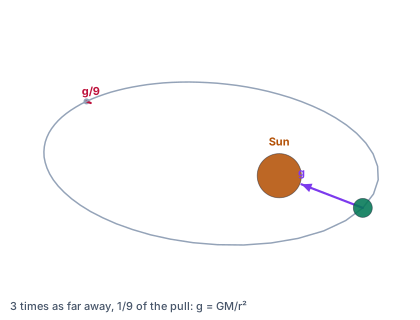
Circular orbits are the simplest case; most orbits are ellipses with the attracting body at one focus. The scene shows a planet on an orbit of eccentricity $0.5$, where the farthest point is three times as far from the Sun as the nearest. Watch the planet speed around the near end and crawl around the far end, as angular momentum conservation requires. The arrows show the field at the two ends: the far one is a ninth as long, because three times the distance gives a ninth of the field. A model that treated the field as the same everywhere could produce neither the ellipse nor the changing speed.
The International Space Station orbits about $420$ km above the Earth, $6790$ km from its center, at $7.66$ km/s, circling every $92$ minutes: sixteen sunrises a day for the crew. Gravity there is $8.6$ m/s², and the crew floats because the station is in free fall.
At that altitude a thin trace of atmosphere drags on the station, removing energy. Its orbit sinks by about $2$ km a month, and, following $v = \sqrt{GM/r}$, it speeds up as it sinks. Every few months the station fires thrusters, often on a docked cargo vehicle, to raise the orbit again. Flight controllers at the Johnson Space Center in Houston plan these reboosts with the energy formula $E = -GMm/2r$, which says how much energy each kilometer of altitude costs.
Artemis missions to the Moon launch from the Kennedy Space Center on a trajectory that nearly escapes the Earth: at the start of the coast to the Moon, the Orion spacecraft is moving at close to $11$ km/s, just under the escape speed of $11.2$ km/s from near the surface. It does not quite escape; it rises toward the Moon's distance on a long ellipse, and the Moon's gravity captures it.
Leaving the Moon to return is far easier: its escape speed is only $2.4$ km/s, a fifth of the Earth's, because the Moon's $GM/R$ is about a twentieth as large. The same calculation gives $5.0$ km/s for Mars, the figure planners use when sizing the rockets a crew would need to come home.
Pictures of astronauts floating suggest that space has no gravity. At the space station's altitude gravity is about $89$ percent of its surface value. The astronauts float because they and the station fall together around the Earth, so nothing pushes on them. Without gravity the station would fly off in a straight line.
A second error is to measure distances from the surface. In $g = GM/r^2$, $r$ is from the center: a satellite one Earth radius above the surface is at $2R$ and feels a quarter of surface gravity, not zero and not half.
The station orbits $400$ km above the surface, and the Earth's radius is $6371$ km. Find its distance from the center.
$r = 6371 + 400 = 6771\ \text{km}$
Distances are from the center.
Form the ratio of fields.
$\dfrac{g}{g_0} = \left(\dfrac{6371}{6771}\right)^2 = 0.885$
Inverse square.
Evaluate the field.
$g = 0.885 \times 9.8 = 8.7\ \text{m/s}^2$
Not zero, only a little weaker.
Find the orbital speed.
$v = \sqrt{\dfrac{3.986 \times 10^{14}}{6.771 \times 10^6}} = 7.67\ \text{km/s}$
$v = \sqrt{GM/r}$.
Find the period.
$T = \dfrac{2\pi \times 6.771 \times 10^6}{7670} = 5547\ \text{s} = 92\ \text{min}$
Circumference over speed.
A $1000$ kg satellite moves from $r = 2R$ to $r = 4R$. Write its energy in each orbit.
$E = -\dfrac{GMm}{2r}$
Circular orbits.
Evaluate at $2R$ with $GM/R = gR = 6.24 \times 10^7$ J/kg.
$E_1 = -\dfrac{1000 \times 6.24 \times 10^7}{4} = -1.56 \times 10^{10}\ \text{J}$
$GMm/2r = GMm/4R$.
Evaluate at $4R$.
$E_2 = -\dfrac{1000 \times 6.24 \times 10^7}{8} = -7.8 \times 10^9\ \text{J}$
Less negative.
Find the energy needed.
$\Delta E = E_2 - E_1 = 7.8 \times 10^9\ \text{J}$
Supplied by the rocket.
Compare the orbital speeds.
$\dfrac{v_2}{v_1} = \sqrt{\dfrac{2R}{4R}} = 0.71$
The higher orbit is slower, despite the energy added.
Mars has $GM = 4.28 \times 10^{13}$ m³/s² and radius $3.39 \times 10^6$ m. Write the escape condition.
$\tfrac{1}{2}v^2 = \dfrac{GM}{R}$
Total energy zero.
Evaluate the depth of the well per kilogram.
$\dfrac{GM}{R} = \dfrac{4.28 \times 10^{13}}{3.39 \times 10^6} = 1.26 \times 10^7\ \text{J/kg}$
Energy needed per kilogram.
Solve for the escape speed.
$v = \sqrt{2 \times 1.26 \times 10^7} = 5.0 \times 10^3\ \text{m/s}$
About $5$ km/s.
Find the surface orbital speed.
$v_{\text{circ}} = \sqrt{1.26 \times 10^7} = 3.55\ \text{km/s}$
$\sqrt{GM/R}$.
Compare with the Earth.
$\dfrac{5.0}{11.2} = 0.45$
Less than half the Earth's escape speed.
Find the surface gravity as a check.
$g = \dfrac{GM}{R^2} = \dfrac{4.28 \times 10^{13}}{(3.39 \times 10^6)^2} = 3.7\ \text{m/s}^2$
The known value for Mars.
Write the period.
$T = 2\pi\sqrt{\dfrac{r^3}{GM}}$
Kepler's third law for a circle.
Substitute the values.
$T = 2\pi\sqrt{\dfrac{6.4 \times 10^{22}}{4.0 \times 10^{14}}} = 2\pi\sqrt{1.6 \times 10^8}$
$(4.0 \times 10^7)^3 = 6.4 \times 10^{22}$.
Evaluate the period.
A planet's surface gravity is $12$ m/s². What is the gravitational field at a height above the surface equal to the planet's radius?
Complete the worked solution: a satellite circles a planet at $r = 5R$. Find the field there as a fraction of the surface value, the orbital speed squared in units of $g_0R$, and the satellite's total energy in units of $GMm/R$.
Divide the surface field by the square of the multiple.
$\dfrac{g}{g_0} = \dfrac{1}{n^2} =$ g
Inverse-square law.
Divide by the multiple for the speed squared.
$\dfrac{v^2}{g_0R} = \dfrac{1}{n} =$ v
$v^2 = GM/r$ and $GM = g_0R^2$.
Add the kinetic and potential energies.
$E = \tfrac{1}{2}mv^2 - \dfrac{GMm}{r} = -\dfrac{GMm}{2r} =$ e
The kinetic energy is half the size of the potential energy.
Interpret the sign of the total energy.
$\text{negative total energy} \Rightarrow \text{bound orbit}$
It cannot escape without extra energy.
Match each gravitational quantity to its expression.
| $GMm/r^2$ | $-GMm/r$ | $\sqrt{GM/r}$ | $\sqrt{2GM/R}$ | |
|---|---|---|---|---|
| force | ||||
| potential energy | ||||
| circular orbital speed | ||||
| escape speed |
A satellite orbits at $r = 2R$, with $R$ the planet's radius. Fill in the field there as a fraction of the surface value, the potential energy in units of $GMm/R$, and the circular speed squared in units of $gR$.
| value | |
|---|---|
| field ratio | |
| potential energy (GMm/R) | |
| speed squared (gR) |
Around a certain planet, $GM = 6 \times 10^{13}$ m³/s². Writing $r$ for the orbit radius in units of $10^{6}$ m, write the square of the circular orbital speed, in units of $10^{7}$ m²/s², as a formula in $r$.
Answer:
For Mercury, $GM = 2.203 \times 10^{13}$ m³/s² and the radius is $2.440 \times 10^6$ m. What is the escape speed from its surface, ignoring any atmosphere, in km/s?
Answer: km/s to escape
The orbit of a Landsat satellite is nearly circular, $7080$ km from the Earth's center. With $GM = 3.986 \times 10^{14}$ m³/s², how fast does it travel, in km/s?
Answer: km/s in orbit
Lesson test: one question per skill, one attempt each, no hints. Your answers are checked when you submit.
Around a certain planet, $GM = 7 \times 10^{13}$ m³/s². Writing $r$ for the orbit radius in units of $10^{6}$ m, write the square of the circular orbital speed, in units of $10^{7}$ m²/s², as a formula in $r$.
Answer:
You can analyze gravitation and orbits. Explain to someone why astronauts on the space station float even though gravity there is nearly as strong as on the ground.
20. Your turn: find the period of a circular orbit at $r = 4.0 \times 10^7$ m around the Earth, $GM = 4.0 \times 10^{14}$ m³/s²., step 3
$T = 2\pi \times 1.26 \times 10^4 = 7.9 \times 10^4\ \text{s} \approx 22\ \text{h}$
Close to geostationary.