Back to the on-screen lesson ·
Velocity $v = dx/dt$ and acceleration $a = dv/dt$ from a position function, turning points, speeding up and slowing down, and derivatives read off graphs.
Paper packet. Every task here also exists on screen, where it is checked automatically; answers written on paper are not assessed by Nydus. When you are back at a device, enter your answers there.
By the end of this lesson you will be able to find velocity and acceleration from any position function, locate turning points, and decide when an object speeds up or slows down.
From Physics 1 you know position, displacement, velocity and acceleration for motion at constant acceleration, and how to read slopes off motion graphs. From calculus you know the derivative as a limit of difference quotients and the power, product and chain rules. This lesson joins the two: every kinematic quantity is a derivative of the one before it, so any motion described by a formula can be analyzed exactly, not only motion at constant acceleration.
| Term | What it means |
|---|---|
| Position | $x(t)$, where the object is along a chosen axis at time $t$, measured from an origin. |
| Instantaneous velocity | $v = dx/dt$, the limit of $\Delta x/\Delta t$ as the interval shrinks to zero. |
| Instantaneous acceleration | $a = dv/dt = d^2x/dt^2$, the rate of change of velocity. |
| Speed | $\vert v\vert $, the size of the velocity. |
| Turning point | A time at which $v$ passes through zero and changes sign. |
| Jerk | $da/dt$, the rate of change of acceleration. |
| Tangent line | The line whose slope is the derivative at a point of a graph. |
Average velocity over an interval is $\Delta x/\Delta t$. Shrinking the interval to an instant gives the instantaneous velocity,
$$v(t) = \lim_{\Delta t \to 0}\frac{x(t + \Delta t) - x(t)}{\Delta t} = \frac{dx}{dt},$$
the slope of the tangent to the position graph. Doing the same to the velocity gives the instantaneous acceleration,
$$a(t) = \frac{dv}{dt} = \frac{d^2x}{dt^2}.$$
So a position given as a formula yields velocity and acceleration by differentiation, whatever the formula is. For $x = pt^3 - qt^2 + rt$, the power rule gives $v = 3pt^2 - 2qt + r$ and $a = 6pt - 2q$. The object is momentarily at rest, a turning point, where $v = 0$ and changes sign. It is speeding up where $v$ and $a$ have the same sign and slowing down where they have opposite signs, because $d(v^2)/dt = 2va$.
Another way: picture
Draw the position graph and lay a ruler along it at one instant so it just touches the curve. The ruler's slope is the velocity then. Slide the ruler along: where it tilts up the object moves forward, where it lies flat the object is at rest, and where the tilt itself is changing the object is accelerating. How quickly the tilt changes is the acceleration.
Another way: steps
A car covering $120$ m in $6$ s has an average velocity of $20$ m/s, but that says nothing about how fast it was going at the third second. Take a shorter interval around $t = 3$ s, then a shorter one still. The ratios $\Delta x/\Delta t$ approach a limit, and that limit is the velocity at $t = 3$ s. Calculus supplies the limit exactly: for a position given as a formula, the derivative gives it in one line.
The same idea applied to velocity gives acceleration. Physics 1 worked with constant acceleration, where $v = v_0 + at$ and $x = x_0 + v_0t + \tfrac{1}{2}at^2$. Differentiating the second gives the first, and differentiating the first gives $a$: the familiar equations are the special case of a quadratic position. Real motions, a rocket burning fuel or a car shifting gears, have accelerations that change, and derivatives handle them just as easily.
Most positions in mechanics are built from a few functions. Polynomials use the power rule: $d(t^n)/dt = nt^{n-1}$. Oscillations use $d(\sin\omega t)/dt = \omega\cos\omega t$ and $d(\cos\omega t)/dt = -\omega\sin\omega t$, so $x = A\cos\omega t$ gives $v = -A\omega\sin\omega t$ and $a = -A\omega^2\cos\omega t = -\omega^2x$. Decays use $d(e^{-t/\tau})/dt = -e^{-t/\tau}/\tau$.
The chain rule handles compositions: $x = \sqrt{1 + t^2}$ has $v = t/\sqrt{1 + t^2}$. The product rule handles damped motions: $x = e^{-t}\sin t$ has $v = e^{-t}(\cos t - \sin t)$. Each rule is from calculus; the physics is in reading the results: units, signs and what the numbers say about the motion.
A negative acceleration does not mean slowing down. The speed is $|v|$, and $\frac{d}{dt}(v^2) = 2va$. If $v$ and $a$ have the same sign, $v^2$ is growing and the object is speeding up; if they have opposite signs, it is slowing down. A car backing up with increasing speed has negative velocity and negative acceleration, and it is speeding up.
This matters because many problems ask when an object is slowing down. The answer comes from a sign chart: find where $v = 0$ and where $a = 0$, which divide the time axis into intervals, then check the signs of $v$ and $a$ in each. The object slows down on the intervals where the signs differ. The mistake of equating negative acceleration with slowing down fails every time the velocity is negative.
The object stops and reverses where $v = 0$ and changes sign. Since $v = dx/dt$, these are the local maxima and minima of $x(t)$, found exactly as extrema are found in calculus. At a maximum of position, $v$ goes from positive to negative and the acceleration there is negative, pulling it back; at a minimum, the reverse.
Turning points also separate displacement from distance traveled. Between two times, the displacement is $x(t_2) - x(t_1)$, but the distance is the sum of the absolute changes over each stretch between turning points. A particle that goes forward $8$ m and back $3$ m has displacement $5$ m and distance $11$ m. The next lesson finds both from the velocity by integration.
A graph of $x(t)$ carries the same information as the formula. The slope of the tangent at each point is $v$; where the curve is steepest the object moves fastest. Where the curve bends upward, concave up, the slope is increasing and $a > 0$; where it bends down, $a < 0$. An inflection point, where the bending changes, is where $a = 0$.
On a $v(t)$ graph the slope is $a$. Physics C problems often show one graph and ask for another: sketch $v$ from $x$ by estimating slopes at several points, or sketch $a$ from $v$. The check is consistency: every zero of $v$ must line up with a flat point of $x$, and every zero of $a$ with a flat point of $v$.
Checking an answer. Units must work: each derivative divides by seconds. At $t = 0$, $v$ must equal the coefficient of $t$ in $x(t)$ and $a$ must equal twice the coefficient of $t^2$. A turning point must be where the position graph is flat. And substituting before differentiating is the most common error: the derivative of a number is zero, which is almost never the velocity.
In more than one dimension, position is a vector, $\vec{r}(t) = x(t)\hat{x} + y(t)\hat{y} + z(t)\hat{z}$, and velocity and acceleration are its derivatives component by component: $\vec{v} = \dot{x}\hat{x} + \dot{y}\hat{y} + \dot{z}\hat{z}$. The fixed unit vectors differentiate to zero, so each direction is an independent one-dimensional problem.
A projectile with $x = v_{0x}t$ and $y = v_{0y}t - \tfrac{1}{2}gt^2$ has $\vec{v} = (v_{0x}, v_{0y} - gt)$ and $\vec{a} = (0, -g)$: the familiar result, now derived. The speed is the size of $\vec{v}$, $\sqrt{v_x^2 + v_y^2}$, and the velocity is always tangent to the path. That tangent property is what makes the velocity vector the right description of which way an object is heading at each instant.
Laboratory positions come as a table, not a formula: a motion sensor might record a cart's position every $0.05$ s. The derivative is then estimated by a difference quotient. The central difference, $v(t) \approx [x(t + h) - x(t - h)]/2h$, is much more accurate than the one-sided $[x(t + h) - x(t)]/h$, because its errors from the curvature of $x(t)$ cancel.
Differentiating data amplifies noise. A small jitter in position, divided by a small time step, becomes a large jitter in velocity, and a second difference for acceleration is worse again. That is why motion-sensor software smooths the data first, and why the accelerations shown on a lab screen are noisier than the velocities. When the physics gives a formula, differentiate the formula; when it gives data, choose the step size to balance the error from curvature against the error from noise.
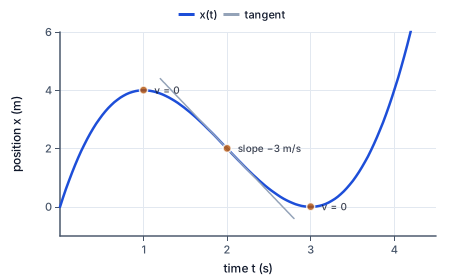
The graph shows $x = t^3 - 6t^2 + 9t$. Its slope at any instant is the velocity, $v = 3t^2 - 12t + 9$. Where the curve levels off, at $1$ s and $3$ s, the velocity is zero and the object turns around; between them the curve falls, so the velocity is negative. The straight line is the tangent at $t = 2$ s: it passes through $2$ m and drops $3$ m for every second, the velocity of $-3$ m/s that the derivative gives. Reading slopes this way is a quick check on any derivative you compute.
In the first half minute after liftoff from Cape Canaveral, a rocket's acceleration grows as it burns fuel and gets lighter, so its altitude is not a simple quadratic. A model such as $h(t) = 4t^2 + 0.2t^3$ captures that: differentiating gives $v = 8t + 0.6t^2$ and $a = 8 + 1.2t$, an acceleration that starts at $8$ m/s² and climbs.
At $t = 20$ s the rocket is $2.2$ km up and rising at $400$ m/s, and its acceleration has reached $32$ m/s², more than three times gravity. Flight engineers watch exactly these derivatives. Tracking radar and GPS on the vehicle give position many times a second; differentiating the data gives velocity and acceleration, which are compared with the planned trajectory to confirm the engines are performing. A shortfall in the derivatives shows up long before one in the altitude itself.
Passengers in an elevator feel acceleration as a change in their apparent weight, but what they notice most is jerk, the rate at which acceleration changes. An elevator that switched instantly from rest to $1.5$ m/s² would jolt everyone aboard. Elevator controllers in tall buildings in Chicago and New York ramp the acceleration up and down smoothly, keeping jerk below about $2$ m/s³.
A smooth profile for a trip might use $x(t)$ built from polynomial pieces whose first, second and third derivatives all join without jumps. Designers differentiate the planned position three times and check each derivative against its comfort limit: speed for the trip time, acceleration for the feeling in the stomach, jerk for the lurch. The same third derivative matters for roller coaster track and highway ramp design.
Acceleration is a signed rate of change of velocity, and its sign depends on the chosen axis, not on whether the object is slowing. An object slows down only when its velocity and acceleration point in opposite directions. A ball thrown upward, with up positive, has negative acceleration all the way; it slows on the way up and speeds up on the way down.
A second error is to substitute the time into $x(t)$ first and then differentiate the number. A number's derivative is zero. Differentiate the function, then substitute.
A particle has $x(t) = 2t^3 - 9t^2 + 12t$ (meters, seconds). Differentiate for the velocity.
$v = 6t^2 - 18t + 12$
Power rule on each term.
Differentiate again for the acceleration.
$a = 12t - 18$
The derivative of the velocity.
Evaluate the velocity at $t = 3$ s.
$v(3) = 54 - 54 + 12 = 12\ \text{m/s}$
Substitute after differentiating.
Evaluate the acceleration at $t = 3$ s.
$a(3) = 36 - 18 = 18\ \text{m/s}^2$
Same sign as $v$.
Describe the motion at that instant.
$v > 0, \ a > 0 \Rightarrow \text{speeding up, moving forward}$
Same signs mean the speed grows.
For the same particle, set the velocity to zero.
$6t^2 - 18t + 12 = 0$
Turning points need $v = 0$.
Divide by six.
$t^2 - 3t + 2 = 0$
The same roots, smaller numbers.
Factor the quadratic.
$(t - 1)(t - 2) = 0 \Rightarrow t = 1 \text{ s}, \ 2 \text{ s}$
Two turning times.
Find the positions there.
$x(1) = 2 - 9 + 12 = 5\ \text{m}, \quad x(2) = 16 - 36 + 24 = 4\ \text{m}$
Substitute into $x(t)$.
Classify each with the acceleration.
$a(1) = -6 < 0 \Rightarrow \text{farthest forward}; \quad a(2) = 6 > 0 \Rightarrow \text{farthest back}$
Like the second-derivative test.
Find the intervals where it slows down.
$0 < t < 1\ \text{s} \quad\text{and}\quad 1.5 < t < 2\ \text{s}$
A sign chart with $v = 0$ at $1$ and $2$ s and $a = 0$ at $1.5$ s shows $v$ and $a$ opposite in sign on just these intervals.
A cart on a spring has $x(t) = 0.20\cos(5t)$ (meters, seconds). Differentiate for the velocity.
$v = -0.20 \times 5\sin(5t) = -1.0\sin(5t)\ \text{m/s}$
Chain rule on the cosine.
Differentiate again for the acceleration.
$a = -1.0 \times 5\cos(5t) = -5.0\cos(5t)\ \text{m/s}^2$
Chain rule on the sine.
Compare the acceleration with the position.
$a = -25x$
Proportional and opposite: the mark of simple harmonic motion.
Find the largest speed.
$|v|_{\max} = 1.0\ \text{m/s}$
When $\sin(5t) = \pm 1$, at the center.
Find the largest acceleration.
$|a|_{\max} = 5.0\ \text{m/s}^2$
At the ends, where $x = \pm 0.20$ m.
Evaluate the state at $t = 0.10$ s.
$x = 0.20\cos 0.5 = 0.176\ \text{m}, \quad v = -\sin 0.5 = -0.479\ \text{m/s}$
Moving back toward the center.
Differentiate for the velocity.
$v = 3t^2 - 4 \Rightarrow v(2) = 8\ \text{m/s}$
Power rule, then substitute.
Differentiate for the acceleration.
$a = 6t$
The derivative of the velocity.
Evaluate the acceleration.
At one instant a cart on a track has velocity $-4$ m/s and acceleration $-4$ m/s². Is it speeding up or slowing down?
Complete the worked solution: a test car's position is $x(t) = 3t^3 + 5t^2$ (meters, seconds). Find its velocity in m/s and acceleration in m/s² at $t = 4$ s, and its jerk in m/s³.
Differentiate once and substitute the time.
$v = 3ct^2 + 2dt =$ v
The rate of change of position.
Differentiate again and substitute the time.
$a = 6ct + 2d =$ a
The rate of change of velocity.
Differentiate a third time.
$j = 6c =$ j
Constant, because the position is a cubic.
Check the signs of the velocity and acceleration.
$\text{both positive} \Rightarrow \text{speeding up}$
Velocity and acceleration point the same way.
Match each quantity to its definition in terms of position $x(t)$.
| $dx/dt$ | $d^2x/dt^2$ | $da/dt$ | $|v|$ | |
|---|---|---|---|---|
| velocity | ||||
| acceleration | ||||
| jerk | ||||
| speed |
A particle moves along a line with $x(t) = 2t^3 - 9t^2 + 3t$ (meters, seconds). Fill in its position, velocity and acceleration at $t = 3$ s.
| value | |
|---|---|
| position (m) | |
| velocity (m/s) | |
| acceleration (m/s²) |
A glider's position is $x(t) = 4t^3 - 5t^2 + 6t + 5$ (meters, seconds). Write its velocity $v$ as a formula in $t$, in m/s.
Answer:
A particle's position is $x(t) = t^3 - 15t^2 + 63t$ (meters, seconds). It turns around twice. At what time, in seconds, does it turn around the second time?
Answer: s at the second turn
In the first half minute after liftoff from Cape Canaveral, a rocket's altitude is modeled as $h(t) = 6t^2 + 0.5t^3$ (meters, seconds). How fast is it rising at $t = 27$ s, in m/s?
Answer: m/s upward
Lesson test: one question per skill, one attempt each, no hints. Your answers are checked when you submit.
A glider's position is $x(t) = 3t^3 - 5t^2 + 5t + 5$ (meters, seconds). Write its velocity $v$ as a formula in $t$, in m/s.
Answer:
You can use derivatives in kinematics. Explain to someone why a car backing up with negative acceleration can be speeding up.
20. Your turn: a particle has $x(t) = t^3 - 4t$ (meters, seconds). Find its velocity and acceleration at $t = 2$ s., step 3
$a(2) = 12\ \text{m/s}^2$
Speeding up, since $v$ and $a$ are both positive.