Back to the on-screen lesson ·
Displacement $\int v\,dt$ and distance $\int|v|\,dt$, velocity and position from acceleration with initial conditions, and areas under motion graphs.
Paper packet. Every task here also exists on screen, where it is checked automatically; answers written on paper are not assessed by Nydus. When you are back at a device, enter your answers there.
By the end of this lesson you will be able to find displacement, distance, velocity and position by integration, using initial conditions to fix the constants.
The last lesson found velocity and acceleration by differentiating position. From calculus you know antiderivatives, the definite integral as a signed area, and the fundamental theorem that connects them. From Physics 1 you know that the area under a velocity–time graph is a displacement, and that the area under an acceleration–time graph is a change in velocity. This lesson runs kinematics backward: given how fast something moves, or how it accelerates, find where it goes, and learn which extra facts the answer needs that the rates alone cannot supply.
| Term | What it means |
|---|---|
| Displacement | $\Delta x = \int_{t_1}^{t_2}v\,dt$, the signed change in position. |
| Distance traveled | $\int_{t_1}^{t_2}\vert v\vert \,dt$, the total path length, never negative. |
| Antiderivative | A function whose derivative is the given one; defined up to a constant. |
| Initial condition | A known value at one time, such as $x(0)$ or $v(0)$, that fixes a constant of integration. |
| Signed area | Area above the time axis counted positive and below counted negative. |
| Fundamental theorem of calculus | $\int_a^bf'(t)\,dt = f(b) - f(a)$. |
Because $v = dx/dt$, the fundamental theorem of calculus gives
$$x(t_2) - x(t_1) = \int_{t_1}^{t_2}v(t)\,dt,$$
the displacement as the signed area under the velocity graph. In the same way, $v(t_2) - v(t_1) = \int_{t_1}^{t_2}a(t)\,dt$. Running kinematics backward needs one piece of information that differentiation threw away: a starting value. Integrating $a(t)$ gives $v(t)$ only up to a constant, fixed by the initial condition $v(0)$; integrating again gives $x(t)$ up to a constant fixed by $x(0)$.
Displacement and distance traveled differ when the velocity changes sign. Stretches of backward motion subtract from $\int v\,dt$ but add to the distance, which is $\int|v|\,dt$. To compute a distance, find where $v = 0$, integrate over each stretch separately, and add the absolute values.
Another way: picture
Picture a car's odometer and a map. The map shows how far the car is from where it started, which can shrink when it turns back; that is displacement. The odometer only ever counts up; that is distance. Integrating velocity keeps the map; integrating speed keeps the odometer. They read the same only if the car never reverses.
Another way: steps
Divide a time interval into small steps $\Delta t$. In each, the object moves about $v\Delta t$, the area of a thin rectangle under the velocity graph. Adding them and letting the steps shrink gives $\int v\,dt$, the displacement. Where $v$ is negative the rectangles lie below the axis and count negative, because the object is moving backward.
For constant acceleration the velocity graph is a straight line and the area is a trapezoid: $\Delta x = \tfrac{1}{2}(v_0 + v)t$, one of the familiar equations of Physics 1. For any other acceleration the area is still the displacement, but it has to be found by integration. A velocity $v = 3t^2$ over $2$ s gives $\Delta x = [t^3]_0^2 = 8$ m, which no constant-acceleration formula could produce.
Every antiderivative carries an arbitrary constant. That is not a technicality but physics: knowing how fast something moves tells you nothing about where it started. Two cars with identical velocity histories, one leaving Dallas and one leaving Houston, end up in different places. The initial position is extra information that must be given.
Working from acceleration needs two such facts, $v(0)$ and $x(0)$, one per integration. Writing the integral with limits, $v(t) = v(0) + \int_0^ta(t')\,dt'$, builds the constant in automatically and avoids forgetting it. The dummy variable $t'$ keeps the variable of integration separate from the upper limit, which is the time at which the answer is wanted.
To find the distance traveled, first find every time the velocity is zero in the interval. Those times split it into stretches on which the object moves in one direction. On each, integrate $v$; then add the absolute values. Equivalently, integrate $|v|$, but in practice the splitting is how the absolute value is handled.
For $v = 4 - 2t$ from $0$ to $3$ s, the velocity is zero at $t = 2$ s. From $0$ to $2$ s the cart moves forward $4$ m; from $2$ to $3$ s it moves back $1$ m. The displacement is $3$ m, but the distance is $5$ m. Forgetting to split is the most common error in these problems, and a quick sketch of $v(t)$ shows at once whether splitting is needed.
Many Physics C questions give a graph rather than a formula. On a velocity–time graph, the displacement over an interval is the signed area between the curve and the time axis; count grid squares, or split the region into triangles and rectangles. On an acceleration–time graph, the area is the change in velocity, which then must be added to a known starting velocity.
Graphs also make the difference between displacement and distance visible: shade the areas above and below the axis in different colors. The displacement is the difference of the shaded totals, the distance their sum. When a graph is made of straight segments, the areas are exact; when it is curved, integrate its formula or estimate with a rule such as the trapezoid rule.
When acceleration depends on time, the constant-acceleration equations do not apply, but integration does. For $a = 6t$ starting from rest at the origin, $v = 3t^2$ and $x = t^3$. After $2$ s the object is at $8$ m moving at $12$ m/s. A constant-acceleration formula using the final acceleration of $12$ m/s² would give $24$ m, three times too far.
The same method handles an acceleration that falls off, such as $a = a_0e^{-t/\tau}$ for a sprinter tiring: $v = a_0\tau(1 - e^{-t/\tau})$, approaching a top speed $a_0\tau$. Every such problem is two integrations and two initial conditions, and the result can always be checked by differentiating back.
Checking an answer. Differentiate $x(t)$ and you must get back $v(t)$; differentiate again and you must get $a(t)$. The distance must be at least the size of the displacement. Units: integrating m/s over seconds gives meters. And at $t = 0$ your formulas must reproduce the initial conditions.
Some accelerations have no antiderivative in elementary functions, and real data never do. Then the integral is computed numerically. The trapezoid rule adds areas of thin trapezoids: $\int v\,dt \approx \sum\tfrac{1}{2}(v_i + v_{i+1})\Delta t$. Simpson's rule fits parabolas through groups of points and is more accurate for smooth data.
Integrating data is well behaved where differentiating was not: random errors in the samples tend to cancel in the sum instead of being magnified. That is why inertial navigation systems in aircraft and submarines integrate their accelerometers' readings twice to track position. Their weakness is the constants: a small error in the initial velocity grows linearly in the position, which is why such systems are regularly corrected by GPS.
The average of a quantity over time is its integral divided by the interval: the average velocity is $\bar{v} = \frac{1}{t_2 - t_1}\int_{t_1}^{t_2}v\,dt = \Delta x/\Delta t$, which agrees with the definition from Physics 1. The average acceleration is $\Delta v/\Delta t$ in the same way. The mean value theorem guarantees that at some instant in the interval the velocity actually equals its average, which is why a speed camera that times a car between two points can prove it was speeding at some moment in between.
Averages of speed are different. The average speed is the distance divided by the time, $\frac{1}{\Delta t}\int|v|\,dt$, and it can be large when the average velocity is zero. A runner who laps a $400$ m track in $80$ s has an average speed of $5$ m/s and an average velocity of zero. Keeping the two apart is the integral form of keeping distance and displacement apart, and questions that ask for an average rate are usually testing exactly that distinction, so read which one is asked before integrating anything.
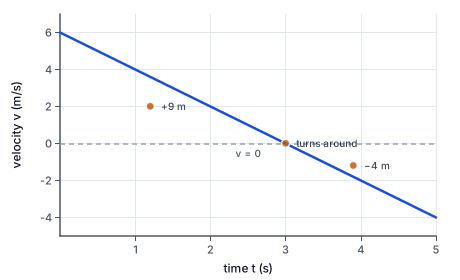
The graph shows $v = 6 - 2t$. The area between the line and the time axis is the integral of the velocity, and it counts with a sign. From $0$ to $3$ s the line is above the axis and encloses a triangle of area $\tfrac{1}{2} \times 3 \times 6 = 9$ m: forward motion. From $3$ to $5$ s it is below, enclosing $\tfrac{1}{2} \times 2 \times 4 = 4$ m of backward motion. The displacement is $9 - 4 = 5$ m, the definite integral; the distance traveled adds the two areas without signs, $13$ m.
Automakers test braking systems at proving grounds in Michigan and Arizona. A smooth stop does not use constant deceleration: the brakes are applied gradually so the car's nose does not dip and passengers are not thrown forward. A deceleration that grows in time, $a = -ct$, is a simple model of that.
Integrating gives $v = v_0 - \tfrac{1}{2}ct^2$ and $x = v_0t - \tfrac{1}{6}ct^3$. The car stops at $t = \sqrt{2v_0/c}$, after a distance of $\tfrac{2}{3}v_0t$. From $27$ m/s with $c = 6$ m/s³, it stops in $3$ s after $54$ m. With constant deceleration reaching the same stop in the same time it would cover $40.5$ m, so the gentle stop costs $13.5$ m of road. Engineers integrate exactly these profiles to set the distances automatic emergency braking must allow.
A submarine cannot use GPS underwater, so it navigates by integration. Its inertial navigation system measures acceleration along three axes, integrates once for velocity and again for position, and keeps doing so for weeks. The U.S. Navy's submarines have relied on such systems since the 1950s, when the USS Nautilus used one to cross under the North Pole.
The weakness is in the constants of integration and small biases. An accelerometer error of just $10^{-5}$ m/s², integrated twice, grows as $\tfrac{1}{2}\epsilon t^2$: after an hour that is $65$ m, and after a day nearly $40$ km. Real systems use extremely precise instruments and correct themselves whenever an outside fix is available, but the physics of the error is the double integral of this lesson.
Because distance and displacement coincide for motion in one direction, it is easy to treat $\int v\,dt$ as the distance. When the velocity changes sign, the backward motion subtracts from the integral, so the result can be much smaller than the distance, or even zero for a round trip. To find the distance, split the interval at every zero of $v$.
A second error is to drop the constant of integration. Integrating an acceleration gives the change in velocity; the starting velocity must be added before the result is a velocity.
A cart has $v = 4 - 2t$ (m/s). Find when it turns around.
$4 - 2t = 0 \Rightarrow t = 2\ \text{s}$
Where the velocity changes sign.
Integrate for the displacement from $0$ to $3$ s.
$\Delta x = \left[4t - t^2\right]_0^3 = 12 - 9 = 3\ \text{m}$
Signed area under $v$.
Find the forward stretch from $0$ to $2$ s.
$\left[4t - t^2\right]_0^2 = 4\ \text{m}$
Positive velocity.
Find the backward stretch from $2$ to $3$ s.
$\left[4t - t^2\right]_2^3 = 3 - 4 = -1\ \text{m}$
Negative velocity.
Add the magnitudes for the distance.
$d = 4 + 1 = 5\ \text{m}$
Larger than the displacement.
A particle has $a = 6t - 4$ (m/s²), with $v(0) = 1$ m/s and $x(0) = 2$ m. Integrate for the velocity.
$v = 3t^2 - 4t + C_1$
Antiderivative term by term.
Fix the constant with the initial velocity.
$v(0) = C_1 = 1 \Rightarrow v = 3t^2 - 4t + 1$
The first initial condition.
Integrate again for the position.
$x = t^3 - 2t^2 + t + C_2$
Antiderivative of the velocity.
Fix the constant with the initial position.
$x(0) = C_2 = 2 \Rightarrow x = t^3 - 2t^2 + t + 2$
The second initial condition.
Evaluate at $t = 3$ s.
$x(3) = 27 - 18 + 3 + 2 = 14\ \text{m}, \quad v(3) = 27 - 12 + 1 = 16\ \text{m/s}$
Substitute into both formulas.
A sprinter's acceleration is $a = 8e^{-t/1.25}$ (m/s², s), starting from rest. Integrate for the velocity.
$v = \displaystyle\int_0^t8e^{-t'/1.25}\,dt' = 8 \times 1.25\left(1 - e^{-t/1.25}\right)$
The antiderivative of $e^{-t/\tau}$ is $-\tau e^{-t/\tau}$.
Simplify the velocity.
$v = 10\left(1 - e^{-t/1.25}\right)\ \text{m/s}$
Top speed $10$ m/s.
Integrate for the position.
$x = 10t - 12.5\left(1 - e^{-t/1.25}\right)$
Integrate each term from $0$.
Evaluate after $10$ s.
$x(10) = 100 - 12.5(1 - e^{-8}) = 100 - 12.5 = 87.5\ \text{m}$
$e^{-8}$ is negligible.
Find the time for $100$ m.
$10t - 12.5 = 100 \Rightarrow t = 11.25\ \text{s}$
Once $e^{-t/1.25}$ has died away.
Interpret the start.
$\text{12.5 m lost to the start} = 1.25\ \text{s of top speed}$
The acceleration phase costs the time constant.
Integrate the velocity.
$\Delta x = \left[t^3 - 12t\right]_0^3$
The antiderivative of $3t^2 - 12$.
Evaluate the antiderivative at the limits.
$\Delta x = 27 - 36 - 0$
Upper limit minus lower.
Simplify the displacement.
A cart's velocity $v(t)$ is positive for part of the interval from $0$ to $4$ s and negative for the rest. Which integral gives the total distance it travels?
Complete the worked solution: a particle's velocity is $v = 3t^2 - 3$ (m/s). Find the time at which it turns around, its displacement from $t = 0$ to $t = 3$ s, and the distance it travels in that time, in meters.
Set the velocity to zero.
$t =$ k
It is negative before and positive after.
Evaluate the antiderivative at the end of the interval.
$\Delta x = \left[t^3 - 3k^2t\right]_0^{T} =$ x
The signed area.
Add back twice the backward stretch.
$d = \Delta x + 2 \times 2k^3 =$ d
The backward part was subtracted once; distance needs it added.
Check that the distance is at least the size of the displacement.
$d \ge |\Delta x|$
They are equal only for motion in one direction.
Match each integral over an interval to what it measures.
| displacement | distance traveled | change in velocity | the change in velocity, read from a graph | |
|---|---|---|---|---|
| $\int v\,dt$ | ||||
| $\int|v|\,dt$ | ||||
| $\int a\,dt$ | ||||
| area under $a$ against $t$ |
A cart's velocity is $v(t) = 12 - 3t$ (m/s). Fill in the time at which it turns around, its displacement from $t = 0$ to $t = 7$ s, and the distance it travels in that time.
| value | |
|---|---|
| turning time (s) | |
| displacement (m) | |
| distance (m) |
A car's acceleration is $a(t) = 10t$ (m/s²) and its velocity at $t = 0$ is $6$ m/s. Write its velocity $v$ as a formula in $t$, in m/s.
Answer:
A particle has acceleration $a(t) = 6t$ (m/s²). At $t = 0$ it is at $x = 8$ m moving at $6$ m/s. Where is it at $t = 4$ s, in meters?
Answer: m from the origin
A self-driving test car on a Michigan proving ground brakes from $18$ m/s with the brakes applied more and more firmly: $a(t) = -9t$ (m/s²). How far does it travel before it stops, in meters?
Answer: m to stop
Lesson test: one question per skill, one attempt each, no hints. Your answers are checked when you submit.
A car's acceleration is $a(t) = 10t$ (m/s²) and its velocity at $t = 0$ is $3$ m/s. Write its velocity $v$ as a formula in $t$, in m/s.
Answer:
You can use integrals in kinematics. Explain to someone why a round trip can have zero displacement but a large distance.
20. Your turn: a particle starts at $x = 0$ with $v = 3t^2 - 12$ (m/s). Find its displacement from $0$ to $3$ s., step 3
$\Delta x = -9\ \text{m}$
It ends $9$ m behind where it started.