Back to the on-screen lesson ·
Magnetic flux $\int \vec{B}\cdot d\vec{A}$ through tilted loops and in nonuniform fields, flux beside a wire, zero flux through closed surfaces, and flux linkage of coils.
Paper packet. Every task here also exists on screen, where it is checked automatically; answers written on paper are not assessed by Nydus. When you are back at a device, enter your answers there.
By the end of this lesson you will be able to compute magnetic flux through loops and coils in uniform and nonuniform fields.
From Gauss's law you know electric flux, $\int \vec{E}\cdot d\vec{A}$, and how to integrate over surfaces. From the last lessons you can find magnetic fields of wires, loops and solenoids. This lesson defines the magnetic flux through a surface and computes it, because the next lesson, Faraday's law, says that a changing magnetic flux makes a voltage.
| Term | What it means |
|---|---|
| Magnetic flux | $\Phi_B = \int \vec{B}\cdot d\vec{A}$, the amount of field passing through a surface. |
| Weber | The unit of flux: $1$ Wb $= 1$ T·m². |
| Area vector | $\vec{A}$, perpendicular to a flat surface with size equal to its area. |
| Normal | The direction perpendicular to a surface. |
| Gauss's law for magnetism | $\oint \vec{B}\cdot d\vec{A} = 0$: no magnetic monopoles. |
| Flux linkage | $N\Phi$, the total flux through a coil of $N$ turns. |
| Dip angle | The angle of the Earth's field below the horizontal. |
The magnetic flux through a surface adds up the component of $\vec{B}$ perpendicular to it:
$$\Phi_B = \int \vec{B}\cdot d\vec{A}.$$
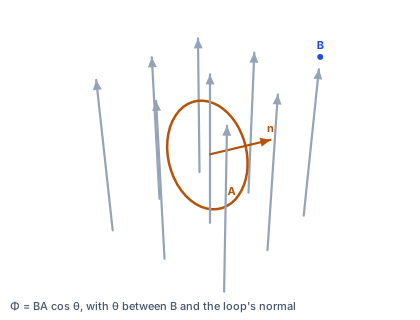
For a flat loop of area $A$ in a uniform field, with $\theta$ the angle between $\vec{B}$ and the loop's normal,
$$\Phi_B = BA\cos\theta.$$
Flux is greatest when the loop faces the field squarely and zero when the field lies along the loop's plane. Its unit is the weber, one tesla times one square meter. When the field varies across the loop, cut the loop into strips on which $B$ is constant and integrate. Through any closed surface the net flux is zero, because magnetic field lines form closed loops: every line that enters must leave.
Another way: picture
Picture field lines as threads and the loop as a hoop. The flux is how many threads pass through the hoop. Face the hoop into the threads and it catches the most; tilt it and it catches fewer; turn it edge-on and it catches none. A stronger field means denser threads, and a bigger hoop catches more.
Another way: steps
The angle in $BA\cos\theta$ is between the field and the normal to the loop, not the loop's plane. A loop lying flat on a table in a vertical field has $\theta = 0$ and full flux. The same loop standing on edge has $\theta = 90°$ and zero flux, even though the field fills the space around it.
The sign of the flux depends on which way the normal is chosen. For an open loop the choice is arbitrary, but it must be kept consistent, since the next lesson ties the normal's direction to the direction of induced current by the right-hand rule. Reversing a loop in a field changes its flux from $+BA$ to $-BA$, a change of $2BA$.
When the field varies across a loop, the flux is an integral. Choose strips along which the field is constant. Beside a long straight wire the field depends only on the distance $r$, so strips parallel to the wire work: each has area $w\,dr$ and flux $(\mu_0I/2\pi r)w\,dr$. Integrating from $a$ to $b$ gives $(\mu_0Iw/2\pi)\ln(b/a)$.
Doubling both distances leaves the flux unchanged, since only their ratio appears. Moving the loop away from the wire at fixed size, however, lowers the ratio and the flux. That changing flux, as a loop moves near a current, is what the induction lessons will turn into a voltage.
For a closed surface, outward flux is positive and inward negative. Electric flux through a closed surface counts the charge inside. Magnetic flux through any closed surface is always zero: $\oint \vec{B}\cdot d\vec{A} = 0$. Every field line that enters a closed surface also leaves it, because magnetic field lines have no beginnings or ends.
Physically, this says there are no magnetic monopoles, no isolated north or south poles. Break a bar magnet in half and each piece has both poles. Physicists have searched for monopoles in cosmic rays and accelerator collisions, so far without success, and this law is one of Maxwell's four equations.
A coil of $N$ turns wound closely has the same flux through each turn, and its total, the flux linkage, is $N\Phi$. For a small coil of area $A$ placed inside a long solenoid with $n$ turns per meter carrying $I$, each turn links $\mu_0nIA$.
For the solenoid itself, each of its own turns links the flux of its own field, $\mu_0nIA$, and the whole solenoid links $N\mu_0nIA$. That quantity, proportional to the current, is the basis of self-inductance two lessons ahead. The flux outside a long solenoid is small, since its field there is nearly zero.
Checking an answer. Units: T·m² is Wb. The flux must be zero for a loop edge-on to the field and greatest facing it. For a closed surface it must be zero. And an integral over a nonuniform field must reduce to $BA$ when the field is made uniform.
Cutting a surface into strips and adding $B\,dA$ is the definition of the surface integral, valid as the strips become thin. Choosing strips along which $B$ is constant is a convenience that turns a two-dimensional integral into a one-dimensional one; any correct slicing gives the same answer.
The zero flux through closed surfaces follows from the Biot–Savart law: the field of every current element circles around it, so every field line closes on itself. No arrangement of currents can produce a field line that starts or stops.
Field line drawings encode field strength in the density of lines, and flux is the count of lines through a surface. A tube of field lines carries the same flux along its whole length, so where the tube narrows the field is strong, and where it widens the field is weak.
Inside a bar magnet the lines are crowded; outside they spread out and loop back. Iron channels field lines, carrying flux through transformer cores and motor frames, much as copper carries current. Engineers even speak of magnetic circuits, with flux in place of current and a reluctance in place of resistance. An air gap in an iron path acts like a large resistor in an electric circuit, which is why transformer cores are built as closed rings.
The Earth's magnetic field is about $50$ μT at the surface, pointing roughly north and dipping into the ground in the Northern Hemisphere. In Colorado it dips about $65°$ to $67°$ below the horizontal; in Florida about $55°$; near the magnetic pole in northern Canada it points nearly straight down.
Because of the dip, a horizontal surface catches the vertical component, $B\sin\delta$, and a wall facing north catches the horizontal component, $B\cos\delta$. The NOAA National Centers for Environmental Information in Boulder publish the World Magnetic Model, used by phone compasses and aircraft navigation, which gives the field's size and direction anywhere on Earth.
Since $\Phi = BA\cos\theta$ for a flat loop in a uniform field, there are exactly three ways to change the flux through it: change the field, change the area, or change the angle. Each one is the working principle of a family of devices, and the next lesson shows that every one of them produces a voltage.
Changing the field is what a transformer does: the current in one coil alternates, so the field it makes in the core alternates, and the flux through the other coil rises and falls with it. Changing the area is what happens when a metal rod slides along rails in a field, sweeping out more area each second, or when a loop is pushed into or pulled out of a region of field. Changing the angle is what a generator does: a coil spins in a steady field, and its flux follows $BA\cos\omega t$, rising and falling sixty times a second in an American power plant.
In a nonuniform field there is a fourth way, which is really a combination of the others: move the loop to where the field is different. A loop carried away from a current-carrying wire loses flux as it goes, because the field it passes through weakens. For the rate of change of flux, which is what the next lesson needs, each of these cases gives a derivative: $A\cos\theta\,dB/dt$, $B\cos\theta\,dA/dt$, $-BA\sin\theta\,d\theta/dt$, or the chain rule through the loop's position when the field depends on where it is.
The scene shows a uniform field pointing straight up and a circular loop tilted so that its normal makes $60°$ with the field. Only the component of $\vec{B}$ along the normal passes through the loop, so the flux is $BA\cos 60° = \tfrac{1}{2}BA$. Turn the scene to look along the field and you can see why: the tilted loop's shadow on a horizontal plane is an ellipse with half the loop's area, and that shadow is what the field lines pass through.
Every phone compass and airplane navigation system corrects for the Earth's field, which points neither exactly north nor horizontally. NOAA's National Centers for Environmental Information in Boulder, Colorado, with the British Geological Survey, publish the World Magnetic Model, giving the field's strength, its angle from true north and its dip at every point on Earth.
The field drifts: the magnetic north pole has moved from northern Canada toward Siberia at up to $50$ km a year, so the model is updated every five years. Runways are numbered by their magnetic heading and are occasionally renamed as the field shifts, as happened at airports in Florida and Minnesota.
A transformer is two coils wound on a shared iron core. Current in the first coil drives magnetic flux around the core, and nearly all of it passes through the second coil too. The iron channels the flux, as copper channels current, so that little leaks out.
The flux through each turn is the same, so the flux linkage of each coil is its number of turns times that shared flux. When the flux changes, as it does sixty times a second on the American grid, each coil develops a voltage in proportion to its turns, which is how transformers step voltages up and down. The next lesson makes that precise.
It is easy to confuse the loop's plane with its normal and say the flux is greatest when the loop lies along the field. The opposite is true: a loop lying along the field is edge-on, and no field lines pass through it. Flux is greatest when the loop's normal is parallel to the field.
A related error is to think a strong field always means large flux. A strong field through a tiny loop, or through a loop turned edge-on, gives little flux. Flux depends on field, area and orientation together.
A $20$ cm by $30$ cm loop sits in a $0.40$ T field. Find its area.
$A = 0.20 \times 0.30 = 0.060\ \text{m}^2$
Convert to meters.
Find the flux when it faces the field.
$\Phi = 0.40 \times 0.060 = 24\ \text{mWb}$
$\cos 0 = 1$.
Find the flux with its normal at $30°$.
$\Phi = 24\cos 30° = 20.8\ \text{mWb}$
A slight tilt loses little.
Find the flux edge-on.
$\Phi = 0$
$\cos 90° = 0$.
Find the change when it is flipped over.
$\Delta\Phi = -24 - 24 = -48\ \text{mWb}$
The normal reverses relative to the field.
A $10$ cm by $20$ cm loop lies with its long sides parallel to a wire carrying $40$ A, the near side $5.0$ cm away. Find the far side's distance.
$b = 5.0 + 10 = 15\ \text{cm}$
The short sides are $10$ cm.
Write the flux through a strip.
$d\Phi = \dfrac{\mu_0I}{2\pi r}(0.20)\,dr$
Strips parallel to the wire.
Integrate across the loop.
$\Phi = 2 \times 10^{-7} \times 40 \times 0.20 \times \ln 3$
From $5$ cm to $15$ cm.
Evaluate the flux.
$\Phi = 1.76\ \mu\text{Wb}$
$\ln 3 = 1.099$.
Compare with the field at the center times the area.
$B(0.10) \times 0.020 = 80\ \mu\text{T} \times 0.020 = 1.6\ \mu\text{Wb}$
Close, but low, since $1/r$ is curved.
Move the loop to $10$ cm away and recompute.
$\Phi = 1.6 \times 10^{-6} \times \ln 2 = 1.11\ \mu\text{Wb}$
Farther away, less flux.
A solenoid with $2000$ turns per meter carries $5.0$ A. Find its field.
$B = 4\pi \times 10^{-7} \times 2000 \times 5.0 = 12.6\ \text{mT}$
$\mu_0nI$.
A $50$-turn coil of area $4.0$ cm² sits inside, facing along the axis. Find the flux per turn.
$\Phi = 12.6 \times 10^{-3} \times 4.0 \times 10^{-4} = 5.0\ \mu\text{Wb}$
$BA$.
Find its flux linkage.
$N\Phi = 50 \times 5.0 = 250\ \mu\text{Wb}$
Fifty turns.
Tilt the coil to $60°$.
$N\Phi = 125\ \mu\text{Wb}$
$\cos 60° = 0.5$.
Double the current in the solenoid.
$N\Phi = 250\ \mu\text{Wb}$
Flux is proportional to the current.
Place the coil outside the solenoid.
$N\Phi \approx 0$
The field outside a long solenoid is nearly zero.
Explain why this matters next.
$\text{changing } I \Rightarrow \text{changing } N\Phi$
A changing flux linkage will induce a voltage in the coil.
Write the flux.
$\Phi = BA\cos\theta$
Uniform field, flat loop.
Substitute the values.
$\Phi = 0.20 \times 0.050 \times 0.80$
SI units.
Evaluate the flux.
A flat loop faces a uniform magnetic field squarely, and the flux through it is $4$ mWb. The loop is turned until its normal makes $60°$ with the field. What is the flux now?
Complete the worked solution: a rectangular coil of $30$ turns, $6$ cm by $8$ cm, sits in a uniform $4$ T field with its normal at $37°$ to the field. Taking $\cos 37° = 0.8$, find its area in cm², the flux through one turn in mWb, and the coil's flux linkage in mWb.
Multiply the sides for the area.
$A = wh =$ a
In square centimeters.
Find the flux through one turn.
$\Phi = BA\cos\theta = 4 \times A \times 10^{-4} \times 0.8 \text{ Wb} =$ f
In mWb after converting.
Multiply by the number of turns.
$N\Phi =$ l
Each turn links the same flux.
Note the unit.
$1\ \text{Wb} = 1\ \text{T·m}^2$
The weber is a tesla times a square meter.
Match each situation to its magnetic flux.
| $BA\cos\theta$ | $0$ | $(\mu_0Iw/2\pi)\ln(b/a)$ | $N\Phi$ | |
|---|---|---|---|---|
| flat loop, uniform field | ||||
| closed surface | ||||
| rectangle beside a wire | ||||
| coil of N turns |
A flat loop of area $90$ cm² sits in a uniform $2$ mT field. Fill in the flux through it in μWb when it faces the field squarely, the flux when its normal is at $60°$ to the field, and the flux linkage in μWb of a $50$-turn coil of the same area facing the field squarely.
| value | |
|---|---|
| flux facing the field (μWb) | |
| flux at 60° (μWb) | |
| flux linkage of 50 turns (μWb) |
A square loop of side $L$ (m) lies in the $xy$-plane with one edge along the $y$-axis, from $x = 0$ to $x = L$. The field is perpendicular to the loop and grows across it, $B = 16x$ mT. Write the flux through the loop, in mWb, as a formula in $L$.
Answer:
A long straight wire carries $20$ A. A rectangular loop in the same plane has its $30$ cm sides parallel to the wire, one $5$ cm from it and the other $15$ cm from it. With $\mu_0 = 4\pi \times 10^{-7}$ T·m/A, what is the flux through the loop, in μWb?
Answer: μWb through the loop
A geophysicist in Boulder, Colorado, notes that the Earth's field there is $55$ μT, dipping $70°$ below the horizontal. How much magnetic flux passes through a flat, horizontal roof of $150$ m², in mWb?
Answer: mWb through the roof
Lesson test: one question per skill, one attempt each, no hints. Your answers are checked when you submit.
A square loop of side $L$ (m) lies in the $xy$-plane with one edge along the $y$-axis, from $x = 0$ to $x = L$. The field is perpendicular to the loop and grows across it, $B = 14x$ mT. Write the flux through the loop, in mWb, as a formula in $L$.
Answer:
You can compute magnetic flux. Explain to someone why the flux through any closed surface is zero.
21. Your turn: a $0.050$ m² loop in a $0.20$ T field has its normal at $37°$ to the field. Find the flux, taking $\cos 37° = 0.80$., step 3
$\Phi = 8.0\ \text{mWb}$
Eight milliwebers.