Back to the on-screen lesson ·
$\vec{F} = q\vec{v} \times \vec{B}$ and circular orbits, velocity selectors and mass spectrometers, forces on wires by integration, and torques on coils.
Paper packet. Every task here also exists on screen, where it is checked automatically; answers written on paper are not assessed by Nydus. When you are back at a device, enter your answers there.
By the end of this lesson you will be able to find magnetic forces on charges, wires and coils, and the paths of charges in uniform fields.
From Physics 2 you know that magnets exert forces on currents and on moving charges, and the right-hand rule. From calculus you have the cross product. From mechanics you know circular motion and torque. This lesson puts the magnetic force in vector form and uses it for charges, wires and coils.
| Term | What it means |
|---|---|
| Magnetic field | $\vec{B}$, measured in tesla (T); the Earth's is about $5 \times 10^{-5}$ T. |
| Lorentz force | $\vec{F} = q(\vec{E} + \vec{v} \times \vec{B})$, the total electromagnetic force on a charge. |
| Cyclotron frequency | $\omega = qB/m$, the angular frequency of a charge circling in a field. |
| Magnetic moment | $\vec{\mu} = NI\vec{A}$, a coil's strength as a magnet, in A·m². |
| Velocity selector | Crossed $\vec{E}$ and $\vec{B}$ that pass only charges with $v = E/B$. |
| Mass spectrometer | An instrument that sorts ions by mass using the radius of their paths. |
| Right-hand rule | Fingers along $\vec{v}$ or $I$, curl toward $\vec{B}$; the thumb gives the force on positive charge. |
A charge $q$ moving with velocity $\vec{v}$ through a magnetic field feels
$$\vec{F} = q\vec{v} \times \vec{B}, \qquad F = qvB\sin\theta.$$
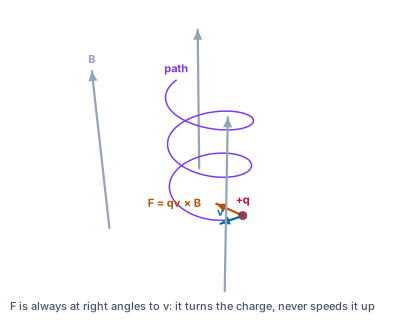
The force is perpendicular to both $\vec{v}$ and $\vec{B}$, so it never does work: it changes the direction of motion but not the speed. A charge moving perpendicular to a uniform field goes in a circle:
$$qvB = \frac{mv^2}{r} \quad\Rightarrow\quad r = \frac{mv}{qB}, \qquad \omega = \frac{qB}{m}.$$
The angular frequency does not depend on the speed. A wire carrying current $I$ is a stream of moving charges, so it feels $\vec{F} = I\vec{L} \times \vec{B}$, or for a curved wire or nonuniform field $d\vec{F} = I\,d\vec{L} \times \vec{B}$. A coil with moment $\vec{\mu} = NI\vec{A}$ feels a torque $\vec{\tau} = \vec{\mu} \times \vec{B}$ that turns it to line up with the field.
Another way: picture
Picture a ball on a string whirled in a circle: the string's pull is always sideways to the motion, so the ball keeps its speed and only turns. A magnetic field acts on a moving charge like that invisible string, always pulling sideways. A faster charge needs more pull to turn as tightly, and the field supplies more, but not enough, so the circle widens.
Another way: steps
The magnitude of $\vec{v} \times \vec{B}$ is $vB\sin\theta$, largest when the velocity is perpendicular to the field and zero when parallel. A charge moving along the field lines feels nothing. The direction is given by the right-hand rule: point the fingers along $\vec{v}$, curl them toward $\vec{B}$, and the thumb points along the force on a positive charge. For a negative charge, such as an electron, the force is opposite.
In components, with $\vec{B} = B\hat{z}$ and $\vec{v} = v\hat{x}$, $\vec{v} \times \vec{B} = vB(\hat{x} \times \hat{z}) = -vB\hat{y}$. Writing out unit vectors this way is the safest check on the right-hand rule in three-dimensional problems.
The figure shows the helical case: the velocity across B turns in a circle, the part along B is untouched, and the force always points to the axis.
In a uniform field, a charge moving at right angles to $\vec{B}$ circles with radius $mv/qB$ and period $2\pi m/qB$. A faster particle makes a bigger circle in the same time. If the velocity has a component along the field, that part is unaffected, and the charge spirals along the field lines in a helix.
This is why charged particles from the Sun spiral along the Earth's field lines toward the poles, producing auroras, and why the radiation belts discovered by James Van Allen's instruments on Explorer 1 in 1958 trap particles in the field. The field turns them but cannot slow them or speed them up.
Add an electric field perpendicular to both $\vec{v}$ and $\vec{B}$, and a charge feels $qE$ one way and $qvB$ the other. They balance when $v = E/B$: charges at that speed go straight through, faster or slower ones are deflected. This velocity selector was how J. J. Thomson measured the charge-to-mass ratio of the electron in 1897.
A mass spectrometer accelerates ions through a known voltage and bends them in a field; since $r = \sqrt{2mV/q}/B$, heavier ions follow larger circles. Chemists identify molecules by their masses, and accelerator mass spectrometers count individual carbon-14 atoms for radiocarbon dating.
A wire of length $L$ carrying current $I$ contains moving charge; adding $q\vec{v} \times \vec{B}$ over all of it gives $\vec{F} = I\vec{L} \times \vec{B}$. For a curved wire or a field that varies along it, cut the wire into pieces $d\vec{L}$ and integrate $I\,d\vec{L} \times \vec{B}$.
Two useful results follow. A closed loop of any shape in a uniform field feels no net force, since the pieces' forces cancel. And a curved wire between two points in a uniform field feels the same force as a straight wire joining those points. In a nonuniform field, neither is true, and a loop can be pulled toward stronger field, which is how magnets attract.
In a uniform field a current loop feels no net force but can feel a torque. For a rectangular loop, the forces on the two sides parallel to the axis form a couple, with torque $IAB\sin\theta$, where $\theta$ is the angle between the loop's normal and the field. For $N$ turns, $\tau = NIAB\sin\theta = \mu B\sin\theta$.
The torque turns the coil until its moment lines up with the field, the lowest-energy position, with $U = -\mu B\cos\theta$. This is how a compass needle aligns, how an analog meter's needle deflects, and, with a commutator reversing the current every half turn, how an electric motor keeps turning.
Checking an answer. The force must be perpendicular to both $\vec{v}$ and $\vec{B}$. The speed of a charge in a pure magnetic field must not change. Units: $qvB$ is C·m/s·T, and a tesla is N/(A·m), so this is N. And a charge moving along the field must feel no force.
Work is $\vec{F}\cdot d\vec{s}$, and for a charge $d\vec{s} = \vec{v}\,dt$. Since $\vec{F} = q\vec{v} \times \vec{B}$ is perpendicular to $\vec{v}$, the dot product is zero at every instant. A static magnetic field can never change a charge's kinetic energy.
Yet motors lift loads, and magnets lift paper clips. In a motor, the energy comes from the power supply pushing current through the coil against the back emf, which the induction lessons explain. The magnetic force redirects the energy supplied by electric forces; it does not supply energy itself.
Pass a current along a flat strip in a perpendicular magnetic field. The moving charges are pushed toward one edge, and they pile up until the electric field they create balances the magnetic force: $qE = qv_dB$. The resulting voltage across the strip, the Hall voltage, is $v_dBw$.
The sign of the Hall voltage reveals whether the moving charges are positive or negative, which is how Edwin Hall showed in 1879 that current in metals is carried by negative charges, and how semiconductor makers check their materials today. Hall sensors in phones detect the magnetic field for the compass, and in cars measure wheel speed for antilock brakes.
Because the period of a charge circling in a field does not depend on its speed, a fixed-frequency electric kick can speed it up once each half turn. Ernest Lawrence built the first cyclotron on this principle at the University of California, Berkeley, in 1931: two hollow D-shaped electrodes in a magnet, with an alternating voltage between them.
The particles spiral outward as they gain speed and emerge at the edge with energies of millions of electron volts. Hospitals now use compact cyclotrons to make short-lived radioactive isotopes for PET scans, and to accelerate protons for cancer therapy.
Because charges spiral along field lines rather than crossing them, a strong magnetic field can hold a hot gas of charged particles away from any wall. That is the idea behind magnetic confinement fusion. In a tokamak, a doughnut-shaped chamber, fields of several tesla bend the paths of hydrogen nuclei at a hundred million degrees into tight helices that follow the field lines around and around the ring without touching the metal.
The radius of each helix, $mv_\perp/qB$, is only millimeters for the ions and far smaller for the electrons, so a chamber a few meters across can hold them. The DIII-D tokamak run by General Atomics in San Diego for the Department of Energy has studied such plasmas for decades, and the international ITER machine under construction in France is designed to make more fusion power than it consumes.
The difficulty is that the plasma is not a set of independent particles. Its own currents create fields that can twist and break the confining field, and a great deal of fusion research is the study of those instabilities. The single-particle picture of this lesson is where every design begins.
A loudspeaker is a coil of wire attached to a paper or plastic cone, sitting in the gap of a permanent magnet whose field points radially outward. Every part of the coil is perpendicular to the field, so a current in the coil feels a force along its axis, pushing the cone in or out.
The audio signal is a current that changes thousands of times a second, and the cone follows it, pushing the air in step to make sound. Speaker makers in southern California and elsewhere design the magnet, coil and cone together: a stronger field or more turns give more force per ampere, and a lighter cone responds to higher frequencies.
Accelerator mass spectrometry counts individual atoms of carbon-14 in a sample by accelerating its ions and bending them in magnetic fields. Carbon-14 ions, a little heavier than carbon-12 and carbon-13, follow a slightly wider path and land in their own detector.
Laboratories such as the one at the University of Arizona can date samples of less than a milligram, back about $50{,}000$ years, where older methods needed grams and waited for rare decays. The same principle, $r = mv/qB$, sorts isotopes in medicine, geology and nuclear safeguards.
Because a magnetic field exerts a force on moving charges, it is tempting to think it can speed them up or slow them down. It cannot: the force is always perpendicular to the velocity, so it does no work, and the speed stays constant. Only the direction changes.
A related error is to expect a force on a charge at rest, or on one moving along the field. The magnetic force is zero in both cases: it needs motion with a component across the field lines.
An electron moves at $2.0 \times 10^6$ m/s perpendicular to a $1.0$ mT field. Find the force on it.
$F = evB = 1.6 \times 10^{-19} \times 2.0 \times 10^6 \times 1.0 \times 10^{-3} = 3.2 \times 10^{-16}\ \text{N}$
$\sin 90° = 1$.
Find the radius of its circle.
$r = \dfrac{mv}{eB} = \dfrac{9.11 \times 10^{-31} \times 2.0 \times 10^6}{1.6 \times 10^{-19} \times 1.0 \times 10^{-3}} = 11.4\ \text{mm}$
$r = mv/qB$.
Find the period.
$T = \dfrac{2\pi m}{eB} = 3.6 \times 10^{-8}\ \text{s}$
Independent of speed.
Find the work done by the field in one orbit.
$W = 0$
The force is always perpendicular to the motion.
Double the speed and find the new radius.
$r = 22.8\ \text{mm}$
Proportional to momentum.
Plates $1.0$ cm apart at $300$ V make a field between them. Find it.
$E = \dfrac{300}{0.010} = 3.0 \times 10^4\ \text{V/m}$
Uniform field.
A $0.060$ T magnetic field crosses it. Find the speed that passes.
$v = \dfrac{E}{B} = \dfrac{3.0 \times 10^4}{0.060} = 5.0 \times 10^5\ \text{m/s}$
Electric and magnetic forces balance.
Check that the charge does not matter.
$qE = qvB \Rightarrow v = E/B$
The charge cancels.
The selected protons enter a region with only $B = 0.060$ T. Find their radius.
$r = \dfrac{1.67 \times 10^{-27} \times 5.0 \times 10^5}{1.6 \times 10^{-19} \times 0.060} = 8.7\ \text{cm}$
$r = mv/qB$.
Find the radius for deuterons of the same speed.
$r = 17.4\ \text{cm}$
Twice the mass, twice the radius.
Find how far apart they land after a half circle.
$2(17.4 - 8.7) = 17.4\ \text{cm}$
Diameters differ by that much.
A rectangular coil $5.0$ cm by $8.0$ cm has $100$ turns carrying $2.0$ A. Find its magnetic moment.
$\mu = NIA = 100 \times 2.0 \times 0.0040 = 0.80\ \text{A·m}^2$
Area $0.050 \times 0.080$.
It sits in a $0.25$ T field. Find the greatest torque.
$\tau = \mu B = 0.80 \times 0.25 = 0.20\ \text{N·m}$
When $\vec{\mu} \perp \vec{B}$.
Find the torque when the normal is $30°$ from the field.
$\tau = 0.20\sin 30° = 0.10\ \text{N·m}$
Smaller near alignment.
Find the force on one $8.0$ cm side.
$F = NILB = 100 \times 2.0 \times 0.080 \times 0.25 = 4.0\ \text{N}$
Each turn contributes.
Find the lever arm that gives the greatest torque.
$\tau = 2 \times 4.0 \times 0.025 = 0.20\ \text{N·m}$
Two sides, each $2.5$ cm from the axis.
Find the energy difference between aligned and opposed.
$2\mu B = 2 \times 0.80 \times 0.25 = 0.40\ \text{J}$
$U = -\mu B\cos\theta$.
Explain how a motor keeps it turning.
$\text{reverse } I \text{ each half turn}$
Otherwise the coil would just settle at alignment.
Write the radius.
$r = \dfrac{mv}{qB}$
Magnetic force supplies the centripetal force.
Substitute the values.
$r = \dfrac{1.67 \times 10^{-27} \times 3.0 \times 10^6}{1.6 \times 10^{-19} \times 0.50}$
SI units.
Evaluate the radius.
A proton moving perpendicular to a uniform magnetic field circles with radius $5$ cm. A second proton enters the same field at twice the speed. What is the radius of its circle?
Complete the worked solution: a square coil $10$ cm on a side has $24$ turns carrying $5$ A in a uniform $0.7$ T field. Find its magnetic moment in A·m², the greatest torque on it in N·m, and the work needed to turn it from aligned with the field to opposed, in J.
Find the magnetic moment.
$\mu = NIA = 24 \times 5 \times 0.010 =$ m
Turns times current times area.
Find the greatest torque.
$\tau_{\max} = \mu B =$ t
When the moment is perpendicular to the field.
Find the work to flip it.
$W = U(180°) - U(0°) = 2\mu B =$ w
$U = -\mu B\cos\theta$ goes from $-\mu B$ to $+\mu B$.
Note the stable direction.
$\vec{\mu} \parallel \vec{B}$
Lowest energy, like a compass needle.
Match each magnetic quantity to its expression.
| $qvB\sin\theta$ | $mv/qB$ | $ILB\sin\theta$ | $NIAB\sin\theta$ | |
|---|---|---|---|---|
| force on a charge | ||||
| radius of the circle | ||||
| force on a wire | ||||
| torque on a coil |
A straight wire $20$ cm long carries $7$ A in a uniform $0.2$ T field. Fill in the force on it, in N, when it is perpendicular to the field and when it is at $30°$ to the field, and the greatest torque, in N·m, on a square one-turn loop of side $20$ cm carrying the same current in that field.
| value | |
|---|---|
| force, perpendicular (N) | |
| force at 30° (N) | |
| greatest loop torque (N·m) |
A straight wire along the $x$-axis from $x = 0$ to $x = L$ (m) carries $7$ A. A magnetic field perpendicular to the wire grows along it, $B = 8x$ tesla. Write the total force on the wire, in N, as a formula in $L$.
Answer:
Singly charged ions of mass number $16$ are accelerated from rest through $1500$ V and enter a $0.15$ T field at right angles. With $1$ u $= 1.66 \times 10^{-27}$ kg and $e = 1.60 \times 10^{-19}$ C, what is the radius of their path, in cm?
Answer: cm radius
An audio engineer in Los Angeles designs a loudspeaker whose voice coil has $30$ turns of radius $3$ cm sitting in a radial magnetic field of $1.5$ T. How large a force pushes the coil, and the cone, when the current is $1.2$ A, in newtons?
Answer: N on the voice coil
Lesson test: one question per skill, one attempt each, no hints. Your answers are checked when you submit.
A straight wire along the $x$-axis from $x = 0$ to $x = L$ (m) carries $2$ A. A magnetic field perpendicular to the wire grows along it, $B = 6x$ tesla. Write the total force on the wire, in N, as a formula in $L$.
Answer:
You can use the magnetic force. Explain to someone why a magnetic field cannot change the speed of a charged particle.
21. Your turn: a proton moves at $3.0 \times 10^6$ m/s perpendicular to a $0.50$ T field. Find the radius of its path., step 3
$r = 6.3\ \text{cm}$
A few centimeters.