Back to the on-screen lesson ·
Conservative forces, $\Delta U = -\int F\,dx$ and $F = -dU/dx$, energy diagrams with equilibria and turning points, $-GMm/r$, and friction's work on the mechanical energy.
Paper packet. Every task here also exists on screen, where it is checked automatically; answers written on paper are not assessed by Nydus. When you are back at a device, enter your answers there.
By the end of this lesson you will be able to build potential energies from forces and forces from potential energies, read energy diagrams, and apply energy conservation with and without friction.
From Physics 1 you know gravitational potential energy $mgh$, spring energy $\tfrac{1}{2}kx^2$ and conservation of mechanical energy. The last lesson defined the work of a variable force as an integral and derived the work–energy theorem. This lesson asks which forces have a potential energy, how to build it from the force and the force from it, and how to read an entire motion off a graph of $U(x)$ before solving anything.
| Term | What it means |
|---|---|
| Conservative force | A force whose work between two points is the same along every path. |
| Potential energy | $U$, with $\Delta U = -W$ for a conservative force: energy stored in a configuration. |
| Mechanical energy | $E = K + U$, conserved when only conservative forces do work. |
| Nonconservative force | A force, such as kinetic friction, whose work depends on the path. |
| Energy diagram | A graph of $U(x)$ with a horizontal line at the total energy $E$. |
| Turning point | A position where $E = U$, so the kinetic energy and speed are zero. |
| Stable equilibrium | A minimum of $U$, where a small displacement produces a restoring force. |
A force is conservative when the work it does moving an object between two points is the same along every path. Gravity, spring forces and electric forces are conservative; kinetic friction and drag are not. For a conservative force, the work defines a potential energy:
$$\Delta U = -W = -\int_{x_1}^{x_2}F(x)\,dx, \qquad F(x) = -\frac{dU}{dx}.$$
The minus sign means the force points toward lower potential energy. Because only changes in $U$ appear, the zero of $U$ can be chosen anywhere: at the floor for $mgh$, at the natural length for $\tfrac{1}{2}kx^2$, at infinity for gravity far away, where $U = -GMm/r$.
When only conservative forces do work, the mechanical energy $E = K + U$ is constant. When nonconservative forces act, $\Delta E = W_{\text{nc}}$: friction removes exactly the energy its work says, and that energy appears as heat.
Another way: picture
Draw $U(x)$ as a landscape of hills and valleys and roll a marble on it. The marble speeds up going downhill and slows going uphill. Draw a horizontal line at its total energy: the marble can go only where the landscape is below the line, turns back where the line meets the landscape, and would rest at the bottom of any valley. The slope at each point is the force, reversed.
Another way: steps
Carry a book from the floor to a shelf by any route: gravity does $-mgh$ of work whichever way you go, because only the vertical part of each step counts. So the work depends only on the endpoints, and a function $U = mgh$ can record it. Now slide a box across a floor to a spot and back: friction does negative work both ways, and the longer the route, the more. No function of position can record that.
A useful test: a force is conservative if its work around every closed loop is zero. Springs pass, since stretching and relaxing return the energy. Friction fails, since every loop costs energy. Forces that depend on velocity, like drag, are never conservative in this sense.
Given a conservative force, integrate: $U(x) = U(x_0) - \int_{x_0}^xF(x')\,dx'$. For a spring, $F = -kx$ gives $U = \tfrac{1}{2}kx^2$ with zero at the natural length. For gravity near the ground, $F = -mg$ with $y$ up gives $U = mgy$. For gravity far away, $F = -GMm/r^2$ gives $U = -GMm/r$ with zero at infinity.
The reverse direction is differentiation: $F = -dU/dx$. It is the quicker way to find a force when the energy is known, and it gives the check on any potential energy you build: differentiate it, change the sign, and you must recover the force. A sign error here turns every stable equilibrium into an unstable one, so the check is worth doing every time.
With the zero at infinity, $U = -GMm/r$ is negative everywhere and rises toward zero as the object moves out. The negative sign is not mysterious: it records that energy must be supplied to pull the object away. Near the surface, $U(R + h) - U(R) = GMm\left(\frac{1}{R} - \frac{1}{R + h}\right) \approx \frac{GMm}{R^2}h = mgh$, so the familiar formula is the near-surface approximation.
Working in units of $GMm/R$, the potential energy at $r = nR$ is simply $-1/n$. Raising a satellite from $2R$ to $5R$ takes $0.3$ units of energy, and from $5R$ to infinity another $0.2$. The same energy picture decides orbits and escape, which the gravitation lesson develops.
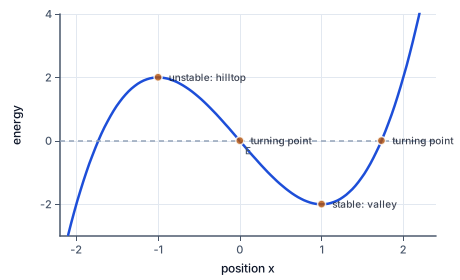
Read the figure from the line down: where the curve lies below E the particle moves, faster where the gap is larger, and where the two meet it stops and turns back.
A graph of $U(x)$ with a horizontal line at the total energy $E$ tells the whole story of a one-dimensional motion. The kinetic energy at each $x$ is the gap $E - U(x)$, so the particle is fastest where $U$ is lowest. It cannot be where $U > E$. Where the line meets the curve, $E = U$, it stops and turns back: a turning point.
Where the curve is flat, $dU/dx = 0$, there is no force: an equilibrium. At a minimum it is stable, since a small push produces a restoring force; at a maximum it is unstable. A particle between two turning points in a valley oscillates; one with enough energy to clear the hills moves off. Physics C questions often give only the graph and ask all of these.
With nonconservative forces, the work–energy theorem splits: $W_{\text{net}} = W_{\text{c}} + W_{\text{nc}} = \Delta K$, and $W_{\text{c}} = -\Delta U$, so $\Delta K + \Delta U = W_{\text{nc}}$. The mechanical energy changes by exactly the nonconservative work. Friction's work is negative, and the lost mechanical energy becomes thermal energy in the surfaces.
For kinetic friction of constant size on a path of length $d$, $W_f = -\mu_kNd$. A sled sliding down a snowy hill with friction arrives at the bottom with $mgh - |W_f|$ of kinetic energy. When the friction force changes along the path, integrate it; the energy bookkeeping is the same.
Checking an answer. Kinetic energy can never come out negative; if it does, the object never reached that position. Changing the zero of $U$ must not change the answer. Friction must lower the final speed compared with the frictionless case. And for gravity far from the Earth, $-GMm/r$ must reduce to $mgh$ for small heights.
Energy conservation is not a separate law; it is Newton's second law integrated once. That is why it cannot give everything: it gives speeds at positions, not times, and not the direction of motion. For those, the equation of motion is still needed.
But energy methods win whenever the path is complicated and only the endpoints matter. A coaster's first drop twists and turns, and the normal force from the track changes constantly, yet the speed at the bottom follows from one line. Newton's laws would need the track's shape at every point. Learning to ask first, "is this an energy question?", saves more work than any other habit in mechanics.
Strictly, potential energy is a property of a system of interacting objects, not of one object. The gravitational potential energy $mgh$ belongs to the Earth and the ball together; we assign it to the ball only because the Earth barely moves. The energy stored in a stretched spring belongs to the spring, not to the block it pushes.
Keeping track of the system matters when both objects move. Two carts pushed apart by a compressed spring share its energy as kinetic energy in inverse proportion to their masses, since momentum is also conserved. The energy was never in either cart; it was in the configuration, and the configuration changed.
Millennium Force at Cedar Point in Ohio drops $91$ m on its first hill. With the train cresting at $2.0$ m/s, energy conservation gives $v = \sqrt{2.0^2 + 2 \times 9.8 \times 91} = 42$ m/s at the bottom, about $95$ miles per hour, whatever the mass of the train or its passengers. The park lists its top speed as $93$ mph; the small shortfall is friction and air.
Designers use the same equation in reverse to size every later hill: a hill $20$ m below the lift top can be crossed at $\sqrt{2g \times 20} = 20$ m/s less losses, and a hill taller than the lift can never be crossed by a train powered only by gravity. The energy diagram of a coaster is literally the track's height profile, and the train moves along it exactly as a particle in a potential well does.
The Ludington Pumped Storage Plant on the shore of Lake Michigan stores energy as gravitational potential energy. When electricity is cheap, it pumps water up about $110$ m into a reservoir holding some $100$ billion liters; when demand peaks, the water flows back down through turbines.
The stored energy is $mgh \approx 10^{11}\ \text{kg} \times 9.8 \times 110 = 1.1 \times 10^{14}$ J, about $30$ gigawatt-hours, enough to supply a city for hours. About a quarter of it is lost to friction in the pipes and inefficiency in the pumps and turbines, nonconservative work that appears as heat. Pumped storage is the largest form of grid energy storage in the United States, and every plant is sized with the energy equation of this lesson.
It is tempting to treat $mgh$ or $-GMm/r$ as how much energy an object has. But the zero of potential energy is a choice: measure heights from the table instead of the floor and every $U$ changes by the same constant, while every force, speed and prediction stays the same. Only differences are physical, which is why $-GMm/r$ can be negative without meaning anything strange.
A second error is to apply energy conservation when friction acts. Mechanical energy is conserved only if nonconservative forces do no work; otherwise include $W_{\text{nc}}$, the work of friction, drag or any push from outside the system, in the energy equation.
A particle moves in $U = 2x^2 - 8x$ (J, m). Differentiate the potential energy.
$\dfrac{dU}{dx} = 4x - 8$
Power rule.
Write the force.
$F = -\dfrac{dU}{dx} = -4x + 8$
Minus the slope.
Find the equilibrium position.
$-4x + 8 = 0 \Rightarrow x = 2.0\ \text{m}$
Where the force vanishes.
Classify the equilibrium.
$\dfrac{d^2U}{dx^2} = 4 > 0 \Rightarrow \text{stable}$
A minimum of $U$.
Find the turning points for $E = 0$.
$2x^2 - 8x = 0 \Rightarrow x = 0 \text{ and } 4.0\ \text{m}$
Where $E = U$; the particle oscillates between them.
A $40$ kg sled starts from rest $12$ m up a slope and slides $30$ m to the bottom, with friction $50$ N. Write the energy equation.
$K_2 = mgh + W_f$
From rest, with the bottom as zero height.
Find the potential energy at the top.
$mgh = 40 \times 9.8 \times 12 = 4704\ \text{J}$
Near the surface.
Find the work of friction.
$W_f = -50 \times 30 = -1500\ \text{J}$
Constant friction over the path length.
Find the kinetic energy at the bottom.
$K_2 = 4704 - 1500 = 3204\ \text{J}$
Mechanical energy minus the loss.
Find the speed.
$v = \sqrt{\dfrac{2 \times 3204}{40}} = 12.7\ \text{m/s}$
Without friction it would be $15.3$ m/s.
Write the gravitational potential energy far from the Earth.
$U = -\dfrac{GMm}{r}$
Zero at infinity.
Find the energy needed to raise a $500$ kg satellite from the surface to $r = 2R$.
$\Delta U = GMm\left(\dfrac{1}{R} - \dfrac{1}{2R}\right) = \dfrac{GMm}{2R}$
Half the depth of the well at the surface.
Use $GM/R = gR$ to evaluate it.
$\Delta U = \tfrac{1}{2}mgR = \tfrac{1}{2} \times 500 \times 9.8 \times 6.37 \times 10^6$
Since $g = GM/R^2$.
Evaluate the energy.
$\Delta U = 1.56 \times 10^{10}\ \text{J}$
About $15.6$ GJ.
Compare with $mgh$ for $h = R$.
$mgR = 3.12 \times 10^{10}\ \text{J}$
Twice too large: gravity weakens with height.
Find the energy to escape from the surface.
$\Delta U = \dfrac{GMm}{R} = mgR = 3.12 \times 10^{10}\ \text{J}$
Raising it to infinity takes twice the energy of raising it to $2R$.
Write energy conservation.
$\tfrac{1}{2}mv^2 = mgh$
Potential energy becomes kinetic.
Solve for the speed.
$v = \sqrt{2gh} = \sqrt{2 \times 9.8 \times 5.0}$
The mass cancels.
Evaluate the speed.
At a certain point on an energy diagram, the potential energy is falling as $x$ increases, with $dU/dx = -9$ J/m. Which way does the force on the particle point, and how large is it?
Complete the worked solution: in units of $GMm/R$, with $R$ the Earth's radius, find the gravitational potential energy of a satellite at $r = 4R$ and at $r = 5R$, and the work needed to raise it from the first to the second.
Divide minus one by the first multiple of the radius.
$U_1 = -\dfrac{GMm}{r_1} =$ u
Negative, with zero at infinity.
Divide minus one by the second multiple.
$U_2 = -\dfrac{GMm}{r_2} =$ v
Closer to zero, farther out.
Subtract the first from the second.
$W = U_2 - U_1 =$ w
The work needed equals the rise in potential energy.
Check the sign of the work.
$\text{raising a satellite always takes positive work}$
The potential energy rises toward zero as it moves out.
Match each idea to its expression.
| $-dU/dx$ | $-\int F\,dx$ | $dU/dx = 0$ | $E = U(x)$ | |
|---|---|---|---|---|
| force from $U$ | ||||
| $U$ from force | ||||
| equilibrium | ||||
| turning point |
A particle moves in $U(x) = 3x^2 - 24x$ (joules, meters). Fill in the force on it at $x = 0$, the position of its equilibrium, and the potential energy there.
| value | |
|---|---|
| force at the origin (N) | |
| equilibrium position (m) | |
| potential energy there (J) |
A particle moves in the potential energy $U(x) = 2x^3 - 8x$ (joules, meters). Write the force on it, in newtons, as a formula in $x$.
Answer:
A $3$ kg sled starts from rest at the top of a hill $10$ m high. Friction does $-10$ J of work on it on the way down. With $g = 10$ m/s², what is its kinetic energy at the bottom, in joules?
Answer: J at the bottom
The train of Fury 325 at Carowinds in North Carolina crests its lift hill at $2.0$ m/s and falls $98$ m down its first drop. Ignoring friction and drag, how fast is it moving at the bottom, in m/s? Use $g = 9.8$ m/s².
Answer: m/s at the bottom of the drop
Lesson test: one question per skill, one attempt each, no hints. Your answers are checked when you submit.
A particle moves in the potential energy $U(x) = x^3 - 4x$ (joules, meters). Write the force on it, in newtons, as a formula in $x$.
Answer:
You can use potential energy. Explain to someone why the train on a coaster reaches the same speed at the bottom of the drop whether it is full or empty.
19. Your turn: a $2.0$ kg ball falls $5.0$ m from rest with no air resistance. Find its speed with $g = 9.8$ m/s²., step 3
$v = 9.9\ \text{m/s}$
The same for any mass.