Back to the on-screen lesson ·
Acceleration is how much the velocity changes each second; it can speed an object up or slow it down.
Paper packet. Every task here also exists on screen, where it is checked automatically; answers written on paper are not assessed by Nydus. When you are back at a device, enter your answers there.
By the end of this lesson you will be able to find an acceleration from a change in velocity, keep its sign, and predict a later velocity with $v = u + at$.
You can find a displacement and a velocity, with a sign for direction, and you know that velocity is displacement per second. This lesson applies the same idea one level up: acceleration is velocity change per second.
| Term | What it means |
|---|---|
| Velocity | Displacement per second, with a direction. |
| Acceleration | Change in velocity per second, $a = (v - u)/t$. |
| Initial velocity | The velocity at the start, written $u$. |
| Final velocity | The velocity at the end, written $v$. |
| Meters per second squared | The unit of acceleration, m/s², meters per second gained each second. |
| Deceleration | An everyday word for slowing down: acceleration opposite to the velocity. |
Acceleration measures how quickly an object's velocity changes:
$$a = \dfrac{v - u}{t},$$
where $u$ is the starting velocity, $v$ the final velocity and $t$ the time taken.
Another way: picture
Picture sitting in a car at a green light. As the driver presses the gas, you feel pushed back into your seat: the car is accelerating. Once it reaches a steady highway speed, the push disappears, even though the car is moving fast. Braking, you lurch forward: the acceleration now points backward.
Another way: steps
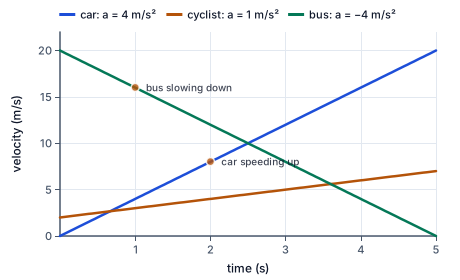
The graph shows the velocity of three vehicles over five seconds. The car starts from rest and gains $4$ m/s every second, so its line climbs steeply. The cyclist gains only $1$ m/s every second, a gentle climb. The bus starts at $20$ m/s and loses $4$ m/s every second, so its line falls to zero.
The steepness of each line is its acceleration. A steep rising line means a large acceleration; a gentle one, a small acceleration; a falling line, slowing down. The next lesson reads graphs like this in detail.
Velocity is already a rate: meters per second. Acceleration is how fast that rate changes, so its unit is meters per second, per second, written m/s². An acceleration of $2$ m/s² means the velocity grows by $2$ m/s every second.
Starting from rest with $2$ m/s², after one second the velocity is $2$ m/s, after two seconds $4$ m/s, after three seconds $6$ m/s. The velocity climbs steadily, and the acceleration is the size of each step.
Choose a positive direction. If an object moves in the positive direction and speeds up, its acceleration is positive. If it moves in the positive direction and slows down, its acceleration is negative.
What matters is whether the acceleration points the same way as the velocity. Same way: speeding up. Opposite ways: slowing down. The sign of the acceleration alone does not tell you, because it depends on which direction you called positive.
A car cruising at a steady $30$ m/s on the interstate has zero acceleration. Its velocity is large, but it is not changing. Acceleration is about change, not about how fast something is going.
Likewise, an object can have a large acceleration while moving slowly. A sprinter leaving the starting blocks has a large acceleration but, for an instant, almost no velocity.
Rearranging the definition gives the velocity after a time $t$: $v = u + at$. Start with the initial velocity and add the acceleration once for every second.
A bike moving at $3$ m/s that accelerates at $2$ m/s² for $4$ s reaches $3 + 2 \times 4 = 11$ m/s. A car moving at $20$ m/s that slows at $5$ m/s² for $3$ s reaches $20 - 5 \times 3 = 5$ m/s.
Checking an answer. A speeding-up object has acceleration in its direction of motion. A steady speed means zero acceleration. The unit must be m/s², not m/s.
Acceleration is defined as the change in velocity divided by the time taken. When the acceleration is steady, the velocity changes by equal amounts in equal times, so the average rate equals the rate at every moment.
The formula $v = u + at$ is just the definition rearranged. It works only while the acceleration stays the same; if the driver presses harder on the gas, a new acceleration and a new calculation begin.
A braking car has acceleration opposite to its velocity. To stop from $24$ m/s while slowing by $6$ m/s every second takes $24 \div 6 = 4$ seconds. The faster the car, or the gentler the braking, the longer it takes to stop.
Wet or icy roads let tires grip less, so the braking acceleration is smaller and the stopping time longer. That is why drivers are told to leave more space between cars in bad weather.
Anything dropped near Earth's surface, without much air resistance, speeds up by about $9.8$ m/s every second. This acceleration due to gravity is written $g$.
A stone dropped from a bridge is moving at about $9.8$ m/s after one second and $19.6$ m/s after two. It does not fall at a steady speed; it keeps gaining speed until it hits the water or air resistance becomes large.
Sprinters accelerate hardest in the first few strides out of the blocks, reaching top speed after about five or six seconds. After that their acceleration is nearly zero: they run at a steady speed to the finish.
In baseball, a pitcher's arm gives the ball a huge acceleration for a fraction of a second. The ball goes from rest to over forty meters per second in about a tenth of a second, an acceleration of several hundred m/s².
Your body does not feel speed, but it does feel acceleration. On a smooth airplane flight at nine hundred kilometers per hour, you can pour a drink without spilling. During takeoff, as the plane accelerates, you feel pressed into your seat.
Roller coasters are designed around acceleration. The thrilling moments are the launches, the sudden drops and the sharp turns, where your velocity changes quickly, not the steady stretches in between.
The most common error is dividing the final velocity by the time and forgetting the starting velocity. A car going from $10$ m/s to $30$ m/s in $5$ s gains $20$ m/s, so its acceleration is $4$ m/s², not $6$.
Another is to confuse m/s and m/s². Velocity is in meters per second; acceleration is in meters per second, per second. Writing the unit on every number catches this at once.
A table of velocities taken once a second shows the acceleration directly: it is the amount the velocity changes from one row to the next. If each row is two more than the last, the acceleration is $2$ m/s².
If the changes between rows are not equal, the acceleration is not steady. Then the definition still gives an average acceleration over the whole time, but the simple rule $v = u + at$ no longer predicts each second exactly.
American drivers measure speed in miles per hour, so car acceleration is often given as a time from zero to sixty miles per hour. Sixty miles per hour is about $26.8$ m/s, so a car that takes eight seconds accelerates at about $3.4$ m/s².
Converting to meters per second first keeps the units consistent. Dividing sixty by the time gives miles per hour per second, a real but awkward unit.
A few everyday numbers help check answers. A car pulling away gently accelerates at one or two meters per second squared; a hard stop on dry pavement, about seven or eight; a dropped object, nearly ten. An answer of hundreds for a family car means a unit or a division went wrong.
American car reviews report how many seconds a car takes to go from zero to sixty miles per hour, about twenty-seven meters per second. A family sedan like a Toyota Camry takes about eight seconds, an average acceleration of about three and a half meters per second squared.
High-performance electric cars have changed the numbers. A Tesla Model S Plaid reaches sixty in just over two seconds, an average acceleration of more than twelve meters per second squared, greater than the acceleration of a falling object. Electric motors deliver their full force from a standstill, which is why they accelerate so hard off the line, while gasoline engines need to rev up first.
Driver's education courses across the country teach a following distance of at least three seconds behind the car ahead. The reason is acceleration: a car braking hard on dry pavement slows by about seven or eight meters per second every second, so stopping from highway speed takes several seconds.
On wet roads the braking acceleration may drop by half, doubling the stopping time. Add the driver's reaction time, about one and a half seconds, and the gap needed grows quickly. State highway safety agencies recommend doubling the following distance in rain and tripling it on snow, because the car simply cannot lose its velocity any faster.
Because accelerating cars are often fast, it is easy to think acceleration means going fast. But acceleration measures how quickly the velocity changes. A jet cruising at nine hundred kilometers per hour has zero acceleration; a car pulling away from a stop sign at walking pace may have a large one.
A related error is to think a negative acceleration always means slowing down. It means slowing down only when the velocity is positive. An object moving in the negative direction and speeding up also has a negative acceleration.
A car starts from rest and reaches $15$ m/s in $5$ s. Find the change in velocity.
$\Delta v = 15 - 0 = 15\ \text{m/s}$
Final minus start.
Find the acceleration.
$a = \dfrac{15}{5} = 3\ \text{m/s}^2$
Change per second.
Find the velocity after $2$ s.
$v = 0 + 3 \times 2 = 6\ \text{m/s}$
$v = u + at$.
Find the velocity after $4$ s.
$v = 0 + 3 \times 4 = 12\ \text{m/s}$
Twice as long, twice the gain.
Describe the pattern.
$\text{3 m/s gained every second}$
Steady acceleration.
A bus moving at $18$ m/s brakes to $6$ m/s in $4$ s. Find the change in velocity.
$\Delta v = 6 - 18 = -12\ \text{m/s}$
It lost velocity.
Find the acceleration.
$a = \dfrac{-12}{4} = -3\ \text{m/s}^2$
Negative: slowing.
Compare with the velocity's sign.
$v > 0, \ a < 0$
Opposite directions.
Find the time to stop from $6$ m/s.
$t = \dfrac{6}{3} = 2\ \text{s}$
Same braking rate.
Find the total braking time.
$4 + 2 = 6\ \text{s}$
From $18$ m/s to rest.
Check with one step.
$\dfrac{0 - 18}{6} = -3\ \text{m/s}^2$
The same rate.
A stone is dropped from a bridge. Gravity gives it $9.8$ m/s² downward. Choose down as positive.
$a = +9.8\ \text{m/s}^2$
Along the motion.
Find its velocity after $1$ s.
$v = 0 + 9.8 \times 1 = 9.8\ \text{m/s}$
From rest.
Find its velocity after $2$ s.
$v = 9.8 \times 2 = 19.6\ \text{m/s}$
Twice as fast.
Find its velocity after $3$ s.
$v = 9.8 \times 3 = 29.4\ \text{m/s}$
Still speeding up.
Find the gain between $2$ s and $3$ s.
$29.4 - 19.6 = 9.8\ \text{m/s}$
One step of $g$.
Convert the $3$ s speed to miles per hour.
$29.4 \times 2.237 = 66\ \text{mph}$
Highway speed.
Explain why real stones gain less.
$\text{air resistance grows with speed}$
It pushes back.
Find the change in velocity.
$\Delta v = 8 - 2 = 6\ \text{m/s}$
Final minus start.
Divide by the time.
$a = \dfrac{6}{3}$
Change per second.
Evaluate the acceleration.
A car moving at $10$ m/s speeds up steadily to $28$ m/s in $6$ s. What is its acceleration, in m/s²?
Complete the worked solution: a cyclist speeds up steadily from $4$ m/s to $10$ m/s in $2$ s. Find the change in velocity in m/s, the acceleration in m/s², and the velocity in m/s after another $4$ s at the same acceleration.
Find the change in velocity.
$\Delta v = v - u =$ d
Final minus starting.
Find the acceleration.
$a = \dfrac{\Delta v}{t} =$ a
Change per second.
Find the later velocity.
$v_{\text{later}} = v + a \times 4 =$ w
Four more steps.
Note the steady pattern.
$\text{same gain every second}$
Constant acceleration.
Match each motion or idea to what it says about acceleration.
| acceleration in the same direction as the velocity | acceleration opposite to the velocity | zero acceleration | the velocity changes by 3 m/s every second | |
|---|---|---|---|---|
| a car speeding up | ||||
| a car braking | ||||
| a car cruising at a steady 30 m/s | ||||
| an acceleration of 3 m/s² |
A cart starts at $30$ m/s with a steady acceleration of $-4$ m/s². Fill in its velocity in m/s after $1$ s, after $3$ s, and after $5$ s.
| velocity | |
|---|---|
| velocity after 1 s (m/s) | |
| velocity after 3 s (m/s) | |
| velocity after 5 s (m/s) |
A sled starts down a hill at $5$ m/s and speeds up with a steady acceleration of $1.5$ m/s². Write its velocity, in m/s, as a function of the time $t$ in seconds.
Answer:
A car moving at $24$ m/s brakes, slowing down by $6$ m/s every second. How long does it take to stop, in s?
Answer: s
Car magazines report that a Chevrolet Corvette goes from $0$ to $60$ mph, about $26.82$ m/s, in $2.9$ s. What is its average acceleration, in m/s²?
Answer: m/s²
Lesson test: one question per skill, one attempt each, no hints. Your answers are checked when you submit.
A sled starts down a hill at $3$ m/s and speeds up with a steady acceleration of $2$ m/s². Write its velocity, in m/s, as a function of the time $t$ in seconds.
Answer:
You can find and use accelerations. Explain to someone why a car cruising steadily on the highway has no acceleration, however fast it goes.
26. Your turn: a skateboard speeds up from $2$ m/s to $8$ m/s in $3$ s. What is its acceleration?, step 3
$a = 2\ \text{m/s}^2$
Speeding up.