Back to the on-screen lesson ·
Noncommuting components, the ladder operators, $L^2 = l(l + 1)\hbar^2$ and $L_z = m\hbar$, spherical harmonics, and the rotational spectra of molecules.
Paper packet. Every task here also exists on screen, where it is checked automatically; answers written on paper are not assessed by Nydus. When you are back at a device, enter your answers there.
By the end of this lesson you will be able to find the allowed values of angular momentum and its components, use the ladder operators, and predict the rotational spectra of molecules.
You know classical angular momentum $\vec{L} = \vec{r} \times \vec{p}$, the ladder operators of the harmonic oscillator, and from the last lesson that commuting observables share eigenstates while noncommuting ones cannot all be sharp. This lesson combines those ideas to find the quantized values of angular momentum, the key to every problem in three dimensions.
| Term | What it means |
|---|---|
| Orbital angular momentum | $\hat{\vec{L}} = \hat{\vec{r}} \times \hat{\vec{p}}$, with components that do not commute. |
| Quantum number $l$ | Labels $L^2 = l(l + 1)\hbar^2$, with $l = 0, 1, 2, \ldots$ for orbital motion. |
| Magnetic quantum number $m$ | Labels $L_z = m\hbar$, with $m = -l, \ldots, l$. |
| Angular momentum ladder operators | $\hat{L}_\pm = \hat{L}_x \pm i\hat{L}_y$, which raise or lower $m$ by one. |
| Spherical harmonics | $Y_l^m(\theta, \phi)$, the simultaneous eigenfunctions of $\hat{L}^2$ and $\hat{L}_z$. |
| Rigid rotor | Two masses at fixed separation rotating freely, with $E_l = l(l + 1)\hbar^2/2I$. |
| Rotational constant | $B = \hbar^2/2I$, the energy scale of a rotor's levels. |
The components of $\hat{\vec{L}} = \hat{\vec{r}} \times \hat{\vec{p}}$ do not commute:
$$[\hat{L}_x, \hat{L}_y] = i\hbar\hat{L}_z, \quad [\hat{L}_y, \hat{L}_z] = i\hbar\hat{L}_x, \quad [\hat{L}_z, \hat{L}_x] = i\hbar\hat{L}_y.$$
No state can have two components sharp at once (unless all are zero). But $\hat{L}^2 = \hat{L}_x^2 + \hat{L}_y^2 + \hat{L}_z^2$ commutes with every component, so states can be labeled by $L^2$ and one component, conventionally $L_z$.
The ladder operators $\hat{L}_\pm = \hat{L}_x \pm i\hat{L}_y$ satisfy $[\hat{L}_z, \hat{L}_\pm] = \pm\hbar\hat{L}_\pm$, so they raise or lower $L_z$ by $\hbar$ without changing $L^2$. Since $L_z^2$ cannot exceed $L^2$, the ladder must have a top and a bottom, and working out where they are gives
$$L^2 = l(l + 1)\hbar^2, \qquad L_z = m\hbar, \qquad m = -l, -l + 1, \ldots, l - 1, l.$$
The algebra allows $l$ to be an integer or a half-integer; orbital angular momentum, whose eigenfunctions must be single-valued in the angle $\phi$, takes only integers. The eigenfunctions are the spherical harmonics $Y_l^m(\theta, \phi)$, whose $\phi$ dependence is $e^{im\phi}$.
The simplest system governed by these results is the rigid rotor, a molecule spinning freely with moment of inertia $I$. Its energy is $L^2/2I$, so
$$E_l = \frac{\hbar^2}{2I}\,l(l + 1) = B\,l(l + 1),$$
with each level $(2l + 1)$-fold degenerate.
Another way: picture
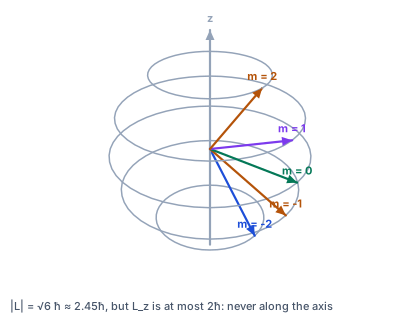
Picture a vector of length $\sqrt{l(l + 1)}\,\hbar$ standing on the tip of a cone around the $z$ axis. Its height above the origin is fixed at $m\hbar$, but its direction around the cone is completely uncertain, so $L_x$ and $L_y$ are spread out. Because $\sqrt{l(l + 1)} > l$, even the cone with $m = l$ has a nonzero opening angle: the vector can never point straight up. This vector model is a picture, not a literal motion, but it gets every number right.
Another way: steps
Checks. $L^2$ must exceed $L_z^2$ for every state: $l(l + 1) > m^2$. The number of states must be odd for integer $l$. Rotational constants are about a millielectronvolt or less for most molecules, so rotational lines lie in the microwave and far infrared, well below the vibrational quanta of the infrared.
Let the top rung be $|l, m_{\max}\rangle$, with $\hat{L}_+$ giving zero there. The identity $\hat{L}_-\hat{L}_+ = \hat{L}^2 - \hat{L}_z^2 - \hbar\hat{L}_z$ applied to the top rung gives $0 = \lambda - \hbar^2m_{\max}^2 - \hbar^2m_{\max}$, where $\lambda$ is the eigenvalue of $\hat{L}^2$. So $\lambda = \hbar^2m_{\max}(m_{\max} + 1)$. Doing the same at the bottom rung gives $\lambda = \hbar^2m_{\min}(m_{\min} - 1)$, which requires $m_{\min} = -m_{\max}$. Calling $m_{\max} = l$, the eigenvalue is $l(l + 1)\hbar^2$.
Going from $-l$ to $l$ in unit steps takes an integer number of steps, $2l$, so $l$ must be an integer or a half-integer. The algebra alone allows both; the requirement that orbital wave functions return to themselves after a full turn, $e^{im(\phi + 2\pi)} = e^{im\phi}$, removes the half-integers. The half-integers are not wasted: they are the spins of electrons, protons and neutrons, the subject of lesson 15.
The figure draws the result for $l = 2$. Every allowed vector has length $\sqrt{6}\hbar$, and its $z$ component is one of the five rungs, $-2\hbar$ to $2\hbar$. Because $\sqrt{6} > 2$, even the top rung leaves the vector leaning off the axis, somewhere on a cone whose $x$ and $y$ components are not sharp.
In spherical coordinates, $\hat{L}_z = -i\hbar\,\partial/\partial\phi$, whose eigenfunctions are $e^{im\phi}$, and $\hat{L}^2$ is $-\hbar^2$ times the angular part of the Laplacian. Their joint eigenfunctions are the spherical harmonics. The first few are $Y_0^0 = 1/\sqrt{4\pi}$, a uniform sphere; $Y_1^0 = \sqrt{3/4\pi}\cos\theta$, a dumbbell along $z$; and $Y_1^{\pm 1} = \mp\sqrt{3/8\pi}\sin\theta\,e^{\pm i\phi}$, a doughnut around the $z$ axis.
These are the angular shapes of every atomic orbital: $s$ for $l = 0$, $p$ for $l = 1$, $d$ for $l = 2$, $f$ for $l = 3$. Chemists' $p_x$ and $p_y$ orbitals are real combinations of $Y_1^{\pm 1}$, which is why they have definite shapes but not definite $L_z$. The harmonics also appear far from atoms: the temperature map of the cosmic microwave background is analyzed by expanding it in $Y_l^m$ up to $l$ of several thousand.
A diatomic molecule's rotational levels $Bl(l + 1)$ absorb and emit light only between neighbors, $\Delta l = \pm 1$, because a photon carries one unit of angular momentum. The lines are therefore at $2B, 4B, 6B, \ldots$, evenly spaced by $2B$. Measuring that spacing gives $B$, then $I = \hbar^2/2B$, then the bond length $r = \sqrt{I/\mu}$: carbon monoxide's lines at multiples of $115.27$ GHz give $r = 0.113$ nm.
At room temperature many rotational levels are occupied, because $B$ is much smaller than $k_BT = 25$ meV, and the populations follow the Boltzmann factor times the degeneracy $2l + 1$. That makes the intensities of the lines a thermometer. In a vibrational band of the infrared, rotational lines appear as a comb on either side of the vibrational frequency, with a spacing that reveals the molecule's moment of inertia — the standard way chemists first measured bond lengths.
For any spherically symmetric potential, $V(r)$, the Hamiltonian commutes with $\hat{L}^2$ and $\hat{L}_z$. The energy eigenstates can therefore be written as $R(r)Y_l^m(\theta, \phi)$: all the angular dependence is a spherical harmonic, and the problem reduces to a one-dimensional radial equation with an extra centrifugal term $l(l + 1)\hbar^2/2mr^2$ added to the potential.
This is why angular momentum comes first in three dimensions. It explains the $2l + 1$ degeneracy of every level in any atom without magnetic fields, it gives the angular shapes of orbitals, and the centrifugal term explains why states of higher $l$ stay farther from the nucleus. The next lesson solves the radial equation for the Coulomb potential and obtains the hydrogen atom.
A magnetic field couples to angular momentum. An electron's orbital motion gives it a magnetic moment $-\mu_B L_z/\hbar$ along $z$, with the Bohr magneton $\mu_B = 5.788 \times 10^{-5}$ eV/T, so a field $B_z$ shifts each state by $m\mu_BB_z$. The $2l + 1$ degenerate states split into evenly spaced levels, the normal Zeeman effect, and spectral lines split into three.
Pieter Zeeman saw this splitting in 1896, and the count of components — always an odd number for orbital motion — was one of the first clues that angular momentum is quantized. When the count came out even for some atoms, the anomalous Zeeman effect, it pointed to a half-integer angular momentum that orbital motion could not supply: spin.
Stars form in cold clouds of molecular hydrogen, but molecular hydrogen, being symmetric, has no electric dipole and barely radiates at the clouds' temperatures of $10$ to $20$ K. Astronomers instead observe carbon monoxide, which has a dipole and whose lowest rotational level lies only $5.5$ K above the ground state, easily excited by collisions. Its $J = 1 \to 0$ line at $115.27$ GHz, a wavelength of $2.6$ mm, is the most widely used tracer of molecular gas in the universe.
Surveys with telescopes such as the Arizona Radio Observatory's $12$ m dish have mapped carbon monoxide across the whole Milky Way, revealing its spiral arms and giant molecular clouds. The Atacama Large Millimeter/submillimeter Array, of which the United States is a major partner, observes the higher lines at $230.54$ and $345.80$ GHz — close to $2$ and $3$ times the lowest, as the rigid-rotor formula predicts — to measure the temperature and density of gas in galaxies billions of light-years away.
A microwave oven's $2.45$ GHz radiation is often said to excite a rotational resonance of water, but that is not quite right. Isolated water molecules have rotational lines at $22$ GHz and much higher, as its moments of inertia predict; at $2.45$ GHz there is no sharp absorption line. In liquid water, hydrogen bonds prevent free rotation, the sharp rotational levels are washed out, and the molecules' dipoles are instead dragged back and forth by the oscillating field, losing energy to their neighbors as heat.
The $22.2$ GHz rotational line of water vapor is itself important. Weather satellites and ground-based radiometers measure its strength to find the amount of water vapor in the atmosphere, and the same line, amplified by maser action in the gas around young stars and black holes, lets radio astronomers measure distances across the galaxy by precise interferometry. The rigid-rotor levels, with a more complicated moment of inertia, set every one of these frequencies.
Classically, a spinning top can have its angular momentum pointing exactly along $z$, with $L_z = |L|$. Quantum mechanically the largest $L_z$ is $l\hbar$ while the magnitude is $\sqrt{l(l + 1)}\,\hbar$, always larger. The difference is forced by the commutators: if $\vec{L}$ pointed exactly along $z$, then $L_x$ and $L_y$ would both be exactly zero, and two noncommuting components would be sharp at once. The gap shrinks in relative terms for large $l$, which is how the classical limit is recovered.
A related error is to write $L^2 = l^2\hbar^2$. The eigenvalue is $l(l + 1)\hbar^2$, and the extra $l\hbar^2$ is the average of $L_x^2 + L_y^2$ in the state with $m = l$: the quantum fluctuation of the components that cannot be sharp.
Find the magnitude of the angular momentum.
$|L| = \sqrt{l(l + 1)}\,\hbar = \sqrt{6}\,\hbar = 2.45\hbar$
$l(l + 1) = 6$ for $l = 2$.
List the allowed $z$ components.
$L_z = -2\hbar, -\hbar, 0, \hbar, 2\hbar$
$m$ from $-2$ to $2$: five values.
Find the smallest angle to the $z$ axis.
$\cos\theta_{\min} = \dfrac{2}{\sqrt{6}} = 0.816 \quad\Rightarrow\quad \theta_{\min} = 35.3°$
For $m = 2$, the most nearly aligned state.
Find the angle for $m = 1$.
$\cos\theta = \dfrac{1}{\sqrt{6}} = 0.408 \quad\Rightarrow\quad \theta = 65.9°$
Each $m$ has its own cone.
Find the perpendicular part.
$\langle L_x^2 + L_y^2\rangle = L^2 - L_z^2 = (6 - m^2)\hbar^2 = 2\hbar^2 \text{ for } m = 2$
Never zero: the vector can never point straight along $z$.
State the raising operator's action.
$\hat{L}_+|l, m\rangle = \hbar\sqrt{l(l + 1) - m(m + 1)}\,|l, m + 1\rangle$
From the commutation relations and normalization.
Apply it to $|1, -1\rangle$.
$\hat{L}_+|1, -1\rangle = \hbar\sqrt{2 - 0}\,|1, 0\rangle = \sqrt{2}\,\hbar|1, 0\rangle$
$m(m + 1) = (-1)(0) = 0$.
Apply it again.
$\hat{L}_+|1, 0\rangle = \hbar\sqrt{2 - 0}\,|1, 1\rangle = \sqrt{2}\,\hbar|1, 1\rangle$
$m(m + 1) = 0$ again.
Try to go above the top.
$\hat{L}_+|1, 1\rangle = \hbar\sqrt{2 - 2}\,|1, 2\rangle = 0$
The square root vanishes: the ladder stops.
Build the matrix of $L_x$ for $l = 1$.
$L_x = \tfrac{1}{2}(L_+ + L_-) = \dfrac{\hbar}{\sqrt{2}}\begin{pmatrix} 0 & 1 & 0 \\ 1 & 0 & 1 \\ 0 & 1 & 0 \end{pmatrix}$
In the basis $m = 1, 0, -1$.
Check its eigenvalues.
$\lambda = 0, \pm\hbar$
The same as $L_z$'s, as symmetry demands.
Find the reduced mass.
$\mu = \dfrac{12.000 \times 15.995}{12.000 + 15.995}\ \text{u} = 6.856\ \text{u} = 1.1385 \times 10^{-26}\ \text{kg}$
Carbon-12 and oxygen-16.
Find the moment of inertia.
$I = \mu r^2 = 1.1385 \times 10^{-26} \times (0.1128 \times 10^{-9})^2 = 1.449 \times 10^{-46}\ \text{kg m}^2$
Bond length $0.1128$ nm.
Find the rotational constant in joules.
$B = \dfrac{\hbar^2}{2I} = \dfrac{(1.0546 \times 10^{-34})^2}{2 \times 1.449 \times 10^{-46}} = 3.838 \times 10^{-23}\ \text{J}$
The energy scale of the rotor.
Convert the constant to meV.
$B = \dfrac{3.838 \times 10^{-23}}{1.602 \times 10^{-19}} = 0.240\ \text{meV}$
A hundred times smaller than $k_BT$ at room temperature.
Find the lowest line's frequency.
$f_{1 \to 0} = \dfrac{2B}{h} = \dfrac{2 \times 3.838 \times 10^{-23}}{6.626 \times 10^{-34}} = 115.9\ \text{GHz}$
The measured value is $115.27$ GHz.
Find the wavelength.
$\lambda = \dfrac{c}{f} = \dfrac{3.00 \times 10^{8}}{1.159 \times 10^{11}} = 2.6\ \text{mm}$
A millimeter-wave line, observed by radio telescopes.
Find the next two lines.
$f_{2 \to 1} = 2 \times 115.9 = 231.7\ \text{GHz}, \quad f_{3 \to 2} = 347.6\ \text{GHz}$
Evenly spaced by $2B/h$.
Count the states of the $l = 3$ level.
$2l + 1 = 7$
Seven orientations share each rotational energy.
Write the rotor energy.
$E_l = Bl(l + 1)$
The ground level $l = 0$ has zero energy.
Substitute the values.
$E_2 = 0.24 \times 2 \times 3$
$l(l + 1) = 6$.
Evaluate the energy.
A state has orbital angular momentum quantum number $l = 3$. How many different values can a measurement of $L_z$ give?
Complete the worked solution: a rotor has rotational constant $B = 9$ μeV. Find the energies of its $l = 1$ and $l = 2$ levels and the gap between them.
Evaluate the first excited level.
$E_1 = B \times 1 \times 2 =$ a μeV
$l(l + 1) = 2$.
Evaluate the second excited level.
$E_2 = B \times 2 \times 3 =$ c μeV
$l(l + 1) = 6$.
Subtract to find the gap.
$E_2 - E_1 =$ d μeV
Twice the first gap: rotor spacings grow linearly.
For an angular momentum eigenstate $|l, m\rangle$ with $l = 3$, match each operator statement to its result.
| $12\hbar^2$ times the state | $m\hbar$ times the state | a multiple of $|3, m + 1\rangle$ | $i\hbar\hat{L}_z$ | |
|---|---|---|---|---|
| $\hat{L}^2$ acting on $|3, m\rangle$ | ||||
| $\hat{L}_z$ acting on $|3, m\rangle$ | ||||
| $\hat{L}_+$ acting on $|3, m\rangle$ | ||||
| $[\hat{L}_x, \hat{L}_y]$ |
Fill in $L^2/\hbar^2$ and the number of allowed $m$ values for $l = 2$, $3$ and $4$.
| $L^2/\hbar^2$ | number of $m$ | |
|---|---|---|
| $l = 2$ | ||
| $l = 3$ | ||
| $l = 4$ |
Carbon monoxide's rotational constant is $B = 0.2384$ meV. How much energy, in meV, does it absorb when jumping from $l = 3$ to $l = 4$?
Answer: meV
A hydrogen fluoride molecule has reduced mass $0.9571$ u ($1$ u $= 1.6605 \times 10^{-27}$ kg) and bond length $0.0917$ nm. Treating it as a rigid rotor, at what frequency, in GHz, does it absorb when jumping from $l = 0$ to $l = 1$?
Answer: GHz
Radio astronomers map cold molecular gas in the Milky Way using carbon monoxide, whose $J = 1 \to 0$ rotational line is at $115.27$ GHz. Treating the molecule as a rigid rotor, at what frequency, in GHz, is its $J = 5 \to 4$ line?
Answer: GHz
Lesson test: one question per skill, one attempt each, no hints. Your answers are checked when you submit.
Fill in $L^2/\hbar^2$ and the number of allowed $m$ values for $l = 3$, $4$ and $5$.
| $L^2/\hbar^2$ | number of $m$ | |
|---|---|---|
| $l = 3$ | ||
| $l = 4$ | ||
| $l = 5$ |
You can work with quantized angular momentum. Explain to someone why the angular momentum vector can never point exactly along the $z$ axis.
17. Your turn: how far above the ground level is the $l = 2$ level of a rotor with $B = 0.24$ meV?, step 3
$E_2 = 1.44\ \text{meV}$
Still well below $k_BT$ at room temperature.