Back to the on-screen lesson ·
Evenly spaced levels $(n + \tfrac{1}{2})\hbar\omega$ from the ladder operators, the Gaussian ground state and zero-point energy, and molecular vibrations and trapped ions.
Paper packet. Every task here also exists on screen, where it is checked automatically; answers written on paper are not assessed by Nydus. When you are back at a device, enter your answers there.
By the end of this lesson you will be able to find the energies of a quantum oscillator, derive them with the ladder operators, compute the ground state's spreads, and use vibrational spectra to find the stiffness of chemical bonds.
You know classical simple harmonic motion, with $\omega = \sqrt{k/m}$ and potential energy $\tfrac{1}{2}kx^2 = \tfrac{1}{2}m\omega^2x^2$, and from the previous lessons how to find stationary states and energies. You also met the Gaussian as the minimum-uncertainty wave packet. This lesson solves the quantum oscillator, the most important exactly solvable problem in physics.
| Term | What it means |
|---|---|
| Harmonic oscillator | A particle in the potential $V = \tfrac{1}{2}m\omega^2x^2$. |
| Ladder operators | $\hat{a}_\pm = (\mp i\hat{p} + m\omega\hat{x})/\sqrt{2\hbar m\omega}$, which raise or lower the energy by $\hbar\omega$. |
| Quantum of vibration | $\hbar\omega$, the spacing between neighboring levels. |
| Zero-point energy | $E_0 = \tfrac{1}{2}\hbar\omega$, the ground-state energy. |
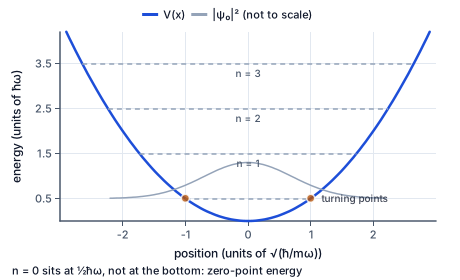
| Classical turning point | Where a classical oscillator of the same energy would stop and turn: $\tfrac{1}{2}m\omega^2x^2 = E$. |
| Reduced mass | $\mu = m_1m_2/(m_1 + m_2)$, the mass that two atoms vibrating on a bond behave as. |
| Hermite polynomials | The polynomial factors $H_n$ in the excited states $\psi_n \propto H_n(\xi)e^{-\xi^2/2}$. |
Near the bottom of any smooth potential well, $V(x) \approx V(x_0) + \tfrac{1}{2}V''(x_0)(x - x_0)^2$: every stable equilibrium looks harmonic for small displacements. So the potential $V = \tfrac{1}{2}m\omega^2x^2$ describes molecular vibrations, atoms in crystals, ions in traps and, in quantum field theory, the modes of light itself.
The Hamiltonian $\hat{H} = \hat{p}^2/2m + \tfrac{1}{2}m\omega^2\hat{x}^2$ can be factored almost like a difference of squares, using the ladder operators
$$\hat{a}_\pm = \frac{1}{\sqrt{2\hbar m\omega}}(\mp i\hat{p} + m\omega\hat{x}).$$
Because $\hat{x}$ and $\hat{p}$ do not commute, the factoring leaves a remainder: $\hat{H} = \hbar\omega(\hat{a}_+\hat{a}_- + \tfrac{1}{2})$. Two facts follow. If $\psi$ has energy $E$, then $\hat{a}_+\psi$ has energy $E + \hbar\omega$ and $\hat{a}_-\psi$ has energy $E - \hbar\omega$. And the lowering cannot go on forever, so there is a lowest state with $\hat{a}_-\psi_0 = 0$, which makes $\hat{H}\psi_0 = \tfrac{1}{2}\hbar\omega\,\psi_0$. Climbing from it,
$$E_n = \left(n + \frac{1}{2}\right)\hbar\omega, \qquad n = 0, 1, 2, \ldots$$
The levels are evenly spaced by one quantum $\hbar\omega$, and the lowest is half a quantum above the bottom of the well: the zero-point energy. The ground state, from solving $\hat{a}_-\psi_0 = 0$, is a Gaussian,
$$\psi_0(x) = \left(\frac{m\omega}{\pi\hbar}\right)^{1/4}e^{-m\omega x^2/2\hbar},$$
with $\sigma_x = \sqrt{\hbar/2m\omega}$ and $\sigma_p = \sqrt{m\omega\hbar/2}$, whose product is exactly $\hbar/2$. The excited states are the ground state times polynomials: $\psi_n$ has $n$ nodes.
Another way: picture
Picture a ladder whose rungs are all the same height, $\hbar\omega$, with its bottom rung raised half a rung off the ground. The raising operator lifts the particle one rung; the lowering operator drops it one, until it reaches the bottom rung, below which there is nothing. A box's ladder, by contrast, has rungs spaced farther apart the higher you go. The even spacing is the quantum form of the classical fact that an oscillator's period does not depend on its amplitude.
Another way: steps
Checks. Every level is at least $\tfrac{1}{2}\hbar\omega$ above the bottom. Stiffer springs or lighter masses give larger quanta: hydrogen's vibration, with the lightest atoms, has the largest quantum of any molecule. Molecular quanta lie between about $0.05$ and $0.5$ eV, in the infrared. And the ground state's $\sigma_x\sigma_p$ must equal $\hbar/2$ exactly; excited states give $(n + \tfrac{1}{2})\hbar$.
A diatomic molecule's bond behaves, for small vibrations, like a spring joining two masses, and the pair vibrates like a single particle of reduced mass $\mu$. Hydrogen chloride absorbs infrared light strongly at a wavelength of $3.46$ μm, which lifts it from $n = 0$ to $n = 1$. The quantum is $\hbar\omega = 1239.8/3463 = 0.358$ eV, so
$$\omega = \frac{0.358 \times 1.602 \times 10^{-19}}{1.0546 \times 10^{-34}} = 5.44 \times 10^{14}\ \text{rad/s}.$$
With $\mu = (1.008 \times 35.45)/(1.008 + 35.45)$ u $= 1.628 \times 10^{-27}$ kg, the spring constant is $k = \mu\omega^2 = 481$ N/m. Carbon monoxide, with a triple bond, comes out near $1860$ N/m, four times stiffer; molecular nitrogen, also triple-bonded, near $2240$ N/m. Chemists use exactly these numbers to compare bond strengths, and the infrared spectrometers in every chemistry department identify compounds by the frequencies at which their bonds vibrate.
A classical oscillator with energy $E_0 = \tfrac{1}{2}\hbar\omega$ swings between turning points where $\tfrac{1}{2}m\omega^2x^2 = \tfrac{1}{2}\hbar\omega$, that is $|x| = \sqrt{\hbar/m\omega} = \sqrt{2}\,\sigma_x$. It never goes farther. The quantum ground state is a Gaussian with no edge at all, and the probability of finding the particle beyond the classical turning points is
$$P(|x| > \sqrt{2}\sigma_x) = 1 - \text{erf}(1) = 0.157.$$
Nearly one time in six the particle is found in the classically forbidden region, where its kinetic energy would be negative. There is no contradiction, because position and kinetic energy are not sharp at the same time. This penetration into forbidden regions is the same physics that lets particles tunnel through barriers, the subject of the lesson on finite wells.
At high $n$ the density concentrates near the turning points, where a classical oscillator moves slowest and spends most of its time: another instance of the correspondence principle.
The ladder method depends only on the commutator $[\hat{x}, \hat{p}] = i\hbar$, which gives $[\hat{a}_-, \hat{a}_+] = 1$. From it, $\hat{H}\hat{a}_+ = \hat{a}_+(\hat{H} + \hbar\omega)$: acting on a state of energy $E$, $\hat{a}_+$ produces a state of energy $E + \hbar\omega$. No differential equation needs to be solved to find the spectrum.
The same algebra reappears throughout physics. The quantized electromagnetic field is a collection of oscillators, one per mode, and $\hat{a}_+$ creates a photon in that mode — which is why photons are called quanta of the field. Lattice vibrations become phonons the same way. Angular momentum, later in this course, has its own raising and lowering operators built on the same pattern. Learning the oscillator's algebra is learning a tool used everywhere quantum mechanics is applied.
A real chemical bond is not a perfect spring. Stretch it far enough and it breaks, so the potential flattens out at large separations; squeeze it and it stiffens sharply as the electron clouds overlap. The Morse potential captures both, and its levels are no longer evenly spaced: they crowd together as the energy rises, and there are only finitely many of them below the dissociation energy. For hydrogen chloride the spacing between the second and third levels is about four percent smaller than between the first two.
The harmonic model is still the right starting point, because the lowest few levels, the ones populated at room temperature, sit near the bottom of the well where the parabola fits well. Spectroscopists measure the small departures, called anharmonicity, and use them to map the shape of the bond. The same approach, a harmonic first guess corrected by perturbation theory, returns in the unit on approximation methods, where the size of the correction can be calculated rather than measured.
A useful check on any oscillator problem is the ratio of the quantum to the thermal energy $kT$, about $0.026$ eV at room temperature. When $\hbar\omega \gg kT$, as for most molecular vibrations, nearly every molecule is in its ground state; when $\hbar\omega \ll kT$, as for a trapped ion before laser cooling, many levels are occupied and the motion is effectively classical.
Every molecule with a vibration that changes its electric dipole absorbs infrared light at the frequency of its vibrational quantum. Carbon dioxide's bending vibration has a quantum of $0.083$ eV, corresponding to a wavelength of $1239.8/0.083 = 15$ μm, right in the middle of the infrared glow of the Earth's surface, which by Wien's law peaks near $10$ μm. Water vapor absorbs across a broad band for the same reason. Nitrogen and oxygen, whose symmetric vibrations have no changing dipole, do not absorb at all.
That is the physics of the greenhouse effect, and it rests on the oscillator: the quantum $\hbar\omega = \hbar\sqrt{k/\mu}$ of each vibration sets which wavelengths a gas traps. The same absorption is how the handheld infrared analyzers used by mechanics measure the carbon monoxide and carbon dioxide in a car's exhaust: each gas has its own vibrational fingerprint — carbon monoxide at $4.67$ μm, carbon dioxide at $4.26$ μm for its stretching mode — and the analyzer measures how much light at each wavelength the sample absorbs.
Some of the most advanced quantum computers, built by companies such as IonQ and Quantinuum, store information in single ions held in electromagnetic traps. Near its center each trap is a harmonic well, with frequencies of about $1$ to $5$ MHz, and the ions' motion in it is a quantum oscillator.
Laser cooling brings each ion to its motional ground state. For a calcium-40 ion, $m = 6.64 \times 10^{-26}$ kg, in a $1$ MHz trap, $\omega = 2\pi \times 10^{6}$ rad/s and the ground state's spread is $\sigma_x = \sqrt{\hbar/(2m\omega)} = 11$ nm, about fifty times smaller than the wavelength of the laser that manipulates it. The quantum of motion, $\hbar\omega = 4.1 \times 10^{-9}$ eV, corresponds to a temperature of only $48$ μK, which is why the cooling is so demanding.
The oscillator's ladder is not just a nuisance to be frozen out. Logic gates between ions work by briefly exciting their shared motion by exactly one quantum, using the raising and lowering of the oscillator to carry information from one ion to another.
Classically, an oscillator with no energy sits motionless at the bottom of its well. The quantum oscillator cannot: its lowest energy is $\tfrac{1}{2}\hbar\omega$, and its ground state has a spread of positions and momenta whose product is exactly $\hbar/2$. Confining a particle near the minimum costs kinetic energy; spreading it out costs potential energy; the Gaussian ground state is the best compromise, and it leaves half a quantum behind. This zero-point motion is real and measurable: it shifts the energies of chemical bonds, and it is why helium stays liquid at absolute zero under ordinary pressure.
A second misconception carries the box's spacing over to the oscillator. The box's levels go as $n^2$ with growing gaps; the oscillator's go as $n + \tfrac{1}{2}$, evenly spaced. The difference comes from the shape of the potential: an oscillator's walls spread apart as the energy rises, giving higher states more room.
Hydrogen chloride absorbs infrared light of wavelength $3.46$ μm. Find the vibrational quantum.
$\hbar\omega = \dfrac{hc}{\lambda} = \dfrac{1239.8\ \text{eV nm}}{3463\ \text{nm}} = 0.358\ \text{eV}$
The absorbed photon lifts the molecule by one quantum.
Convert to angular frequency.
$\omega = \dfrac{0.358 \times 1.602 \times 10^{-19}}{1.0546 \times 10^{-34}} = 5.44 \times 10^{14}\ \text{rad/s}$
Divide the energy in joules by $\hbar$.
Find the reduced mass.
$\mu = \dfrac{1.008 \times 35.45}{1.008 + 35.45}\ \text{u} = 0.980\ \text{u} = 1.628 \times 10^{-27}\ \text{kg}$
Both atoms move, and the light hydrogen dominates.
Find the spring constant.
$k = \mu\omega^2 = 1.628 \times 10^{-27} \times (5.44 \times 10^{14})^2 = 481\ \text{N/m}$
From $\omega = \sqrt{k/\mu}$.
Find the zero-point energy.
$E_0 = \tfrac{1}{2}\hbar\omega = 0.179\ \text{eV}$
Even in its ground state the bond vibrates, with seven times $kT$ at room temperature.
Write the ground state's probability density.
$|\psi_0|^2 = \sqrt{\dfrac{m\omega}{\pi\hbar}}\,e^{-m\omega x^2/\hbar}$
A Gaussian centered on the equilibrium point.
Match it to a normal distribution.
$e^{-m\omega x^2/\hbar} = e^{-x^2/2\sigma_x^2} \quad\Rightarrow\quad \sigma_x^2 = \dfrac{\hbar}{2m\omega}$
A Gaussian $e^{-x^2/2\sigma^2}$ has variance $\sigma^2$.
Use the virial result for the potential energy.
$\langle V\rangle = \tfrac{1}{2}m\omega^2\langle x^2\rangle = \tfrac{1}{2}m\omega^2\dfrac{\hbar}{2m\omega} = \tfrac{1}{4}\hbar\omega$
Half of the ground-state energy $\tfrac{1}{2}\hbar\omega$.
Find the kinetic energy and momentum spread.
$\langle K\rangle = \tfrac{1}{2}\hbar\omega - \tfrac{1}{4}\hbar\omega = \tfrac{1}{4}\hbar\omega = \dfrac{\langle p^2\rangle}{2m} \quad\Rightarrow\quad \sigma_p^2 = \dfrac{m\hbar\omega}{2}$
The rest of the energy is kinetic; $\langle p\rangle = 0$.
Multiply the variances.
$\sigma_x^2\sigma_p^2 = \dfrac{\hbar}{2m\omega} \cdot \dfrac{m\hbar\omega}{2} = \dfrac{\hbar^2}{4}$
Mass and frequency cancel.
Take the root.
$\sigma_x\sigma_p = \dfrac{\hbar}{2}$
Exactly the minimum: the oscillator's ground state is the minimum-uncertainty state.
Write the Hamiltonian in terms of the ladder operators.
$\hat{H} = \hbar\omega\left(\hat{a}_+\hat{a}_- + \tfrac{1}{2}\right)$
The factoring leaves a half from $[\hat{x}, \hat{p}] = i\hbar$.
Use the commutator of the ladder operators.
$[\hat{a}_-, \hat{a}_+] = 1$
It follows from $[\hat{x}, \hat{p}] = i\hbar$.
Show that raising adds a quantum.
$\hat{H}(\hat{a}_+\psi) = \hbar\omega\left(\hat{a}_+\hat{a}_-\hat{a}_+ + \tfrac{1}{2}\hat{a}_+\right)\psi = \hat{a}_+\left(\hat{H} + \hbar\omega\right)\psi = (E + \hbar\omega)\hat{a}_+\psi$
Replace $\hat{a}_-\hat{a}_+$ by $\hat{a}_+\hat{a}_- + 1$.
Find the bottom of the ladder.
$\hat{a}_-\psi_0 = 0 \quad\Rightarrow\quad \hat{H}\psi_0 = \tfrac{1}{2}\hbar\omega\,\psi_0$
The lowering operator must stop somewhere; there, the first term of $\hat{H}$ vanishes.
Climb $n$ rungs.
$\psi_n \propto (\hat{a}_+)^n\psi_0, \qquad E_n = \left(n + \tfrac{1}{2}\right)\hbar\omega$
Each application adds one quantum.
Evaluate for a quantum of $40$ meV.
$E_0 = 20, \quad E_1 = 60, \quad E_2 = 100, \quad E_3 = 140\ \text{meV}$
Evenly spaced by $40$ meV.
Find the number of nodes of each state.
$\psi_n \propto H_n(\xi)e^{-\xi^2/2}: \quad n \text{ nodes}$
Each raising adds one power of $x$ to the polynomial, and one zero.
Compare with a box.
$\text{box: } 1 : 4 : 9 : 16; \qquad \text{oscillator: } 1 : 3 : 5 : 7$
The shape of the potential sets the spacing of the ladder.
Write the ground-state energy.
$E_0 = \tfrac{1}{2}\hbar\omega$
Half a quantum.
Substitute the values.
$E_0 = \tfrac{1}{2} \times 0.358$
The quantum from the infrared spectrum.
Evaluate the result.
A quantum oscillator's two lowest levels are $23$ meV apart. How far apart are its fourth and fifth levels?
Complete the worked solution: an oscillator has quantum $\hbar\omega = 90$ meV. Find the energies of its three lowest levels.
Take half a quantum for the ground state.
$E_0 = \tfrac{1}{2}\hbar\omega =$ a meV
The zero-point energy.
Add one quantum for the first excited state.
$E_1 = E_0 + \hbar\omega =$ b meV
One rung up.
Add another quantum for the second excited state.
$E_2 = E_1 + \hbar\omega =$ c meV
The rungs are evenly spaced.
For a harmonic oscillator of mass $m$ and angular frequency $\omega$, match each result to its formula (for level $n = 2$ where needed).
| $(2 + \tfrac{1}{2})\hbar\omega$ | $(m\omega/\pi\hbar)^{1/4}e^{-m\omega x^2/2\hbar}$ | $\sqrt{3}\,\psi_{3}$ | $\hbar/2$ | |
|---|---|---|---|---|
| the energy of level $2$ | ||||
| the ground-state wave function | ||||
| the raising operator acting on level $2$ | ||||
| the ground state's $\sigma_x\sigma_p$ |
An oscillator has quantum $\hbar\omega = 68$ meV. Fill in the energies of its four lowest levels, in meV.
| energy (meV) | |
|---|---|
| $E_0$ | |
| $E_1$ | |
| $E_2$ | |
| $E_3$ |
Infrared spectroscopy shows that a nitrogen molecule absorbs light when it gains one vibrational quantum of $0.289$ eV. Its reduced mass is $11.6296 \times 10^{-27}$ kg. What is the spring constant of its bond, in N/m?
Answer: N/m
The bond in a hydrogen molecule acts as a spring of constant $576$ N/m, and the molecule's reduced mass is $0.8369 \times 10^{-27}$ kg. What is its vibrational quantum $\hbar\omega$, in eV? Use $\hbar = 1.0546 \times 10^{-34}$ J s and $1$ eV $= 1.602 \times 10^{-19}$ J.
Answer: eV
Quantum computers built from trapped ions hold each calcium-40 ion ($m = 6.64 \times 10^{-26}$ kg) in a harmonic trap. Cooled to its ground state in a trap of frequency $f = 2$ MHz, how large is its position spread, in nm?
Answer: nm
Lesson test: one question per skill, one attempt each, no hints. Your answers are checked when you submit.
An oscillator has quantum $\hbar\omega = 41$ meV. Fill in the energies of its four lowest levels, in meV.
| energy (meV) | |
|---|---|
| $E_0$ | |
| $E_1$ | |
| $E_2$ | |
| $E_3$ |
You can work with the quantum oscillator's ladder of states. Explain to someone why a chemical bond keeps vibrating even at absolute zero.
16. Your turn: what is the zero-point energy of hydrogen chloride's vibration, whose quantum is $0.358$ eV?, step 3
$E_0 = 0.179\ \text{eV}$
The bond's vibration never stops, even at absolute zero.