Back to the on-screen lesson ·
Radiation as a photon gas with zero chemical potential, Planck's spectrum from the Bose-Einstein occupancy, Wien's law and the Stefan-Boltzmann law, and the temperatures of stars, planets and the cosmic background.
Paper packet. Every task here also exists on screen, where it is checked automatically; answers written on paper are not assessed by Nydus. When you are back at a device, enter your answers there.
By the end of this lesson you will be able to derive Planck's spectrum from the occupancy of photon modes, find a blackbody's peak wavelength and photon energy, find the power it radiates, and compute a planet's equilibrium temperature from an energy balance.
You know the Bose-Einstein distribution, that the average energy of a quantum oscillator is $hf/(e^{hf/kT} - 1)$, and the Stefan-Boltzmann law $\sigma T^4$ from the lesson on heat transfer. From modern physics you know that light comes in photons of energy $hf$. This lesson derives the spectrum of thermal radiation, the problem whose solution by Planck in 1900 began quantum theory.
| Term | What it means |
|---|---|
| Blackbody | An ideal absorber and emitter of radiation; its emission depends on its temperature alone. |
| Photon gas | The radiation in a cavity in thermal equilibrium, treated as a gas of photons. |
| Mode | A standing electromagnetic wave in the cavity, with a definite frequency and polarization. |
| Planck spectrum | $u(f) = \frac{8\pi hf^3}{c^3}\frac{1}{e^{hf/kT} - 1}$, the energy per unit volume per unit frequency. |
| Wien's displacement law | $\lambda_{\max}T = 2.898 \times 10^{-3}$ m K. |
| Stefan-Boltzmann law | Power per unit area $\sigma T^4$, with $\sigma = 5.67 \times 10^{-8}$ W/(m² K⁴). |
| Ultraviolet catastrophe | The classical prediction that a cavity holds infinite energy at high frequency, removed by quantization. |
| Cosmic microwave background | The blackbody radiation left over from the early universe, now at $2.725$ K. |
Inside a closed cavity at temperature $T$, the walls continually emit and absorb light, and the radiation settles into equilibrium. Treat it as a collection of modes — standing electromagnetic waves — each of frequency $f$, and each able to hold any number of photons of energy $hf$. Photons are bosons, and because the walls create and destroy them freely, their number is not conserved: the free energy is lowest when the number adjusts itself, which sets the chemical potential to $\mu = 0$. The average number of photons in a mode is therefore
$$\bar{n} = \frac{1}{e^{hf/kT} - 1},$$
exactly the quantum oscillator of the lesson on average energies.
Counting the modes in a box, as the Fermi gas lesson counted standing waves, gives $8\pi f^2/c^3$ modes per unit volume per unit frequency (two polarizations each). Multiplying by the energy per mode gives Planck's spectrum:
$$u(f) = \frac{8\pi hf^3}{c^3}\,\frac{1}{e^{hf/kT} - 1}.$$
At low frequency, $hf \ll kT$, each mode holds $kT$ — the classical answer, which summed over infinitely many high-frequency modes would give infinite energy, the ultraviolet catastrophe. At high frequency the modes freeze out exponentially and the total stays finite.
Two laws follow. The spectrum peaks at a wavelength inversely proportional to temperature, Wien's law, $\lambda_{\max}T = 2.898 \times 10^{-3}$ m K. And integrating over all frequencies gives an energy density proportional to $T^4$, which a surface radiates at a rate $\sigma T^4$ per unit area, the Stefan-Boltzmann law, with $\sigma = 2\pi^5k^4/(15h^3c^2) = 5.67 \times 10^{-8}$ W/(m² K⁴).
Another way: picture
Picture the cavity's modes as an endless piano keyboard, with keys packed ever more densely toward the treble. Classically every key would sound with the same energy, $kT$, and with infinitely many treble keys the piano would hold infinite energy. Quantum mechanics makes each high key cost a large quantum $hf$ to play at all, so the treble falls silent above a frequency set by the temperature. The loudest region of the keyboard slides up as the temperature rises: that is Wien's law.
Another way: steps
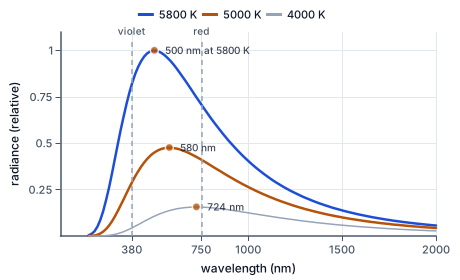
Checks. The Sun's surface, near $5800$ K, peaks near $500$ nm, in the visible; a person, near $310$ K, peaks near $9$ μm, in the infrared; the cosmic background, at $2.7$ K, peaks near $1$ mm, in the microwaves. Doubling the temperature must halve the peak wavelength and multiply the power by sixteen. A planet's equilibrium temperature does not depend on its size, since the radius cancels, but it does depend on the fourth root of the flux, so a planet at twice the distance is colder by a factor $\sqrt{2}$.
By 1900 the spectrum of cavity radiation had been measured precisely in Berlin, and classical physics could not explain it. The classical Rayleigh-Jeans law, which gives every mode $kT$, fitted the measurements at long wavelengths and failed completely at short ones, predicting energy that grew without limit toward the ultraviolet.
Planck found a formula that fitted the data everywhere, and then looked for a reason. He could derive it only by assuming that the walls exchanged energy with each mode in discrete amounts, $hf$, an idea he at first regarded as a mathematical trick. Einstein took it seriously in 1905, proposing that light itself comes in quanta, and used the same idea in 1907 for the heat capacity of solids — the Einstein solid of this course. Bose and Einstein later showed in 1924 that Planck's law follows from counting indistinguishable photons, the Bose-Einstein statistics of the previous lessons.
So the three strands of this course's last unit — the frozen modes of a solid, the occupancy of a boson state, and the spectrum of light — are one idea, and that idea is where quantum mechanics came from.
The most perfect blackbody spectrum ever measured is not in a laboratory. It fills the whole universe. About $380\,000$ years after the Big Bang, when the universe cooled to about $3000$ K, hydrogen atoms formed and the universe became transparent; the thermal radiation of that moment has traveled freely ever since, stretched by the expansion of space to $1100$ times its original wavelength.
Its temperature today is $2.725$ K, so by Wien's law it peaks at $2.898 \times 10^{-3}/2.725 = 1.06$ mm, in the microwave band. Penzias and Wilson found it by accident in 1965 with a horn antenna at Bell Labs in New Jersey, and NASA's COBE satellite measured its spectrum in 1990 to agree with Planck's formula to better than one part in ten thousand. The photon number density that follows from Planck's law, about $411$ photons in every cubic centimeter, outnumbers the atoms of the universe by more than a billion to one.
The Sun's spectrum peaks near $500$ nm, in the green, but sunlight looks white, not green. Wien's law locates the peak of a broad curve: at $5800$ K the Planck spectrum is strong across the whole visible range, from violet at $400$ nm to red at $700$ nm, and the eye blends that mixture into white. Our vision evolved under this light, so white is, in a sense, whatever the Sun's spectrum looks like. A star at $3500$ K, such as Betelgeuse, peaks in the infrared and has much more red than blue in its visible light, so it looks orange-red; one at $12\,000$ K, such as Rigel, has more blue and looks blue-white.
Firefighters, building inspectors and the thermal sights on police helicopters all use cameras that see infrared radiation, and Wien's law says which wavelengths they need. A person's skin at about $305$ K radiates with a peak at $2.898 \times 10^{-3}/305 = 9.5$ μm; a wall at room temperature, around $10$ μm. Everyday thermal cameras therefore detect the long-wave infrared band from $8$ to $14$ μm, which also happens to be a window through which the atmosphere is nearly transparent.
The Stefan-Boltzmann law sets how much signal there is. Skin at $305$ K emits $5.67 \times 10^{-8} \times 305^4 = 490$ W/m², and a surface one degree warmer emits about $4 \times 490/305 = 6.4$ W/m² more — a $1.3$ percent difference that modern sensors resolve easily, showing temperature differences of a few hundredths of a kelvin. A building inspector uses exactly this to find a missing patch of insulation: on a winter night the outside of a wall over the gap is a degree or two warmer than its surroundings, and glows brighter in the image.
Hotter objects need shorter wavelengths: lava near $1400$ K peaks at $2$ μm, and the filament of an incandescent bulb, at $2800$ K, at about $1$ μm — which is why such a bulb puts roughly ninety percent of its power into invisible infrared and only a few percent into visible light, and why it was replaced by LEDs.
Without an atmosphere, Earth would settle at the temperature where it radiates as much as it absorbs: $255$ K, or $-18$ °C. Its actual average surface temperature is about $288$ K. The $33$ kelvin difference is the greenhouse effect, and the blackbody laws explain it.
Sunlight, from a $5800$ K source, arrives mostly as visible and near-infrared light that passes through the air. Earth's surface, near $288$ K, radiates back with a peak near $10$ μm, in the thermal infrared — where water vapor and carbon dioxide absorb strongly. The atmosphere absorbs much of that outgoing radiation and re-emits it in all directions, half of it back down, so the surface must warm until the planet as a whole, seen from space, again radiates $240$ W/m², the flux of a $255$ K blackbody.
Satellites confirm the picture: seen from orbit, Earth's infrared spectrum has a deep notch near $15$ μm, where carbon dioxide absorbs, the radiation there coming from the cold upper atmosphere rather than the warm ground. Adding carbon dioxide widens that notch, so the surface and lower atmosphere must warm further to restore the balance — the physics behind modern climate change, resting on Planck's spectrum.
Wien's law gives the wavelength where a blackbody's spectrum peaks, and it is tempting to take that as the color the body appears. The Sun's spectrum peaks in the green, yet no one has seen a green Sun: its spectrum is broad, strong across the whole visible range, and the eye sees the mixture as white. A body's apparent color depends on the shape of the spectrum across the visible band, not on where its peak happens to fall — which for a stove element or a person lies in the infrared, invisible altogether.
A second trap is to use the Stefan-Boltzmann law with the wrong exponent or the wrong scale. Radiated power goes as $T^4$ in kelvin: a stove element going from $500$ K to $1000$ K radiates sixteen times as much, not twice as much, and plugging in Celsius values makes a hot object seem to radiate less than a cold one. The fourth power is why radiation dominates heat transfer at high temperature and is negligible for a cup of coffee.
The Sun's surface temperature is $5778$ K. Write Wien's law.
$\lambda_{\max} = \dfrac{2.898 \times 10^{-3}\ \text{m K}}{T}$
The peak of Planck's spectrum in wavelength.
Substitute the values.
$\lambda_{\max} = \dfrac{2.898 \times 10^{-3}}{5778}$
Temperature in kelvin.
Evaluate the result.
$\lambda_{\max} = 5.016 \times 10^{-7}\ \text{m}$
Half a micrometer.
Convert to nanometers.
$\lambda_{\max} = 501.6\ \text{nm}$
Green light, near the middle of the visible range.
Find the peak photon energy for comparison.
$\epsilon_{\text{peak}} = 2.82kT = 2.82 \times 8.617 \times 10^{-5} \times 5778 = 1.40\ \text{eV}$
In energy the spectrum peaks at $886$ nm, in the infrared: the two peaks differ because the spectra are measured per unit wavelength and per unit energy.
Find the power the Sun's surface emits per square meter.
$\sigma T^4 = 5.67 \times 10^{-8} \times 5778^4$
The Stefan-Boltzmann law.
Evaluate the fourth power.
$5778^4 = 1.115 \times 10^{15}\ \text{K}^4$
Square twice.
Multiply the factors.
$\sigma T^4 = 6.32 \times 10^{7}\ \text{W/m}^2$
Sixty-three megawatts from every square meter.
Find the Sun's surface area.
$A = 4\pi R^2 = 4\pi(6.96 \times 10^{8})^2 = 6.09 \times 10^{18}\ \text{m}^2$
The solar radius is $696\,000$ km.
Multiply for the total power.
$L = 6.32 \times 10^{7} \times 6.09 \times 10^{18} = 3.85 \times 10^{26}\ \text{W}$
The Sun's luminosity.
Find the flux at Earth's distance.
$S = \dfrac{L}{4\pi d^2} = \dfrac{3.85 \times 10^{26}}{4\pi(1.496 \times 10^{11})^2} = 1370\ \text{W/m}^2$
The solar constant, measured by satellites as $1361$ W/m².
Earth receives $S = 1361$ W/m² and reflects a fraction $a = 0.30$. Write the power it absorbs.
$P_{\text{in}} = (1 - a)S\pi R^2$
Sunlight falls on Earth's cross-section, a disk.
Write the power it emits.
$P_{\text{out}} = 4\pi R^2\sigma T^4$
Earth radiates from its whole spherical surface.
Set them equal.
$(1 - a)S\pi R^2 = 4\pi R^2\sigma T^4$
In equilibrium the energy in equals the energy out.
Cancel and solve for $T^4$.
$T^4 = \dfrac{(1 - a)S}{4\sigma} = \dfrac{0.70 \times 1361}{4 \times 5.67 \times 10^{-8}}$
$\pi R^2$ cancels on both sides.
Evaluate the result.
$T^4 = \dfrac{952.7}{2.268 \times 10^{-7}} = 4.20 \times 10^{9}\ \text{K}^4$
Numerator and denominator separately.
Take the fourth root.
$T = (4.20 \times 10^{9})^{1/4} = 254.6\ \text{K}$
Square root twice.
Compare with the measured surface temperature.
$T_{\text{surface}} \approx 288\ \text{K}$
Earth's actual average is $33$ K warmer.
Say what the difference means.
$288 - 255 = 33\ \text{K}$
The greenhouse effect: water vapor and carbon dioxide absorb Earth's infrared emission, near $10$ μm by Wien's law, and return part of it to the surface.
Write Wien's law.
$\lambda_{\max} = \dfrac{2.898 \times 10^{-3}}{T}$
In meters, with $T$ in kelvin.
Substitute the values.
$\lambda_{\max} = \dfrac{2.898 \times 10^{-3}}{2.725}$
A very cold blackbody.
Evaluate the result.
A blackbody at $9000$ K is heated to $18000$ K. By what factor does the power it radiates from each square meter increase?
Complete the worked solution: a blackbody surface of $7$ m² is at $400$ K. How much power does it radiate? Use $\sigma = 5.67 \times 10^{-8}$ W/(m² K⁴).
Raise the temperature to the fourth power.
$T^4 = (4 \times 100)^4 =$ f $\times 10^{8}$ K⁴
$100^4 = 10^8$.
Multiply by the Stefan-Boltzmann constant.
$\sigma T^4 = 5.67 \times 10^{-8} \times T^4 =$ q W/m²
The powers of ten cancel.
Multiply by the area.
$P = 7 \times \sigma T^4 =$ p W
Power per square meter times square meters.
For radiation in equilibrium at $8000$ K, match each result to its formula.
| $1/(e^{hf/kT} - 1)$ | $2.898\ \text{mm K}/T$ | $\sigma T^4$ | $0$ | |
|---|---|---|---|---|
| photons per mode | ||||
| peak wavelength | ||||
| power per square meter | ||||
| photon chemical potential |
Sirius A has a surface temperature of $9940$ K. Treating it as a blackbody, fill in its peak wavelength in nm and its power per square meter in MW/m².
| peak wavelength (nm) | power per area (MW/m²) | |
|---|---|---|
| this star |
At what photon energy, in eV, does the spectrum of blackbody radiation at $1000$ K peak, when plotted against energy?
Answer: eV
Venus receives $2601$ W/m² of sunlight and reflects a fraction $0.76$ of it. Treating it as a uniform blackbody emitter, what is its equilibrium temperature, in kelvin? Use $\sigma = 5.67 \times 10^{-8}$ W/(m² K⁴).
Answer: K
A thermal camera is chosen to see the filament of an incandescent bulb at about $2800$ K. At what wavelength, in micrometers, does its radiation peak?
Answer: μm
Lesson test: one question per skill, one attempt each, no hints. Your answers are checked when you submit.
the Sun has a surface temperature of $5778$ K. Treating it as a blackbody, fill in its peak wavelength in nm and its power per square meter in MW/m².
| peak wavelength (nm) | power per area (MW/m²) | |
|---|---|---|
| this star |
You can use the laws of thermal radiation for stars, planets and everyday objects. Explain to someone why the Sun's spectrum peaks in the green but sunlight looks white.
15. Your turn: at what wavelength does the cosmic microwave background, at $2.725$ K, peak?, step 3
$\lambda_{\max} = 1.06 \times 10^{-3}\ \text{m} = 1.06\ \text{mm}$
Microwaves, which is why it is called the microwave background.