Back to the on-screen lesson ·
The distribution of molecular speeds from the Boltzmann factor and the sphere of velocities, the most probable, mean and rms speeds, fractions in speed windows, and separating isotopes by effusion.
Paper packet. Every task here also exists on screen, where it is checked automatically; answers written on paper are not assessed by Nydus. When you are back at a device, enter your answers there.
By the end of this lesson you will be able to derive the Maxwell speed distribution, find a gas's most probable, mean and rms speeds, find the fraction of molecules in a range of speeds, and apply the dependence of speed on mass to isotope separation.
You know the Boltzmann factor, that the average translational kinetic energy of a gas molecule is $\tfrac{3}{2}kT$, and the rms speed $\sqrt{3kT/m}$ from Physics 2. From calculus you know how to find the peak of a function and how to integrate with a change of variable. This lesson finds not just the average speed of a gas's molecules but the whole distribution of their speeds.
| Term | What it means |
|---|---|
| Speed distribution | $D(v)$, defined so that the fraction of molecules with speeds between $v$ and $v + dv$ is $D(v)\,dv$. |
| Maxwell distribution | $D(v) = 4\pi\left(\frac{m}{2\pi kT}\right)^{3/2}v^2e^{-mv^2/2kT}$. |
| Most probable speed | $v_{\text{mp}} = \sqrt{2kT/m}$, the peak of $D(v)$. |
| Mean speed | $\bar{v} = \sqrt{8kT/\pi m}$, the average of $v$. |
| Root-mean-square speed | $v_{\text{rms}} = \sqrt{3kT/m}$, the square root of the average of $v^2$. |
| Velocity space | The three-dimensional space of the velocity components $v_x$, $v_y$, $v_z$. |
| Effusion | Gas escaping through a hole smaller than the distance between collisions, at a rate proportional to the mean speed. |
A molecule's kinetic energy is $\tfrac{1}{2}mv^2$, so by the Boltzmann factor the probability of any one velocity vector is proportional to $e^{-mv^2/2kT}$. That factor is largest at zero velocity. But a speed $v$ can be reached by any velocity whose tip lies on a sphere of radius $v$ in velocity space, and the number of such velocities, the area of the sphere, grows as $4\pi v^2$. The distribution of speeds is the product:
$$D(v) = 4\pi\left(\frac{m}{2\pi kT}\right)^{3/2}v^2e^{-mv^2/2kT}.$$
The prefactor makes $\int_0^\infty D(v)\,dv = 1$. The $v^2$ pulls the curve up from zero; the exponential pulls it down at high speed; the result is a skewed hump with a long tail toward high speeds.
Three speeds summarize it, all proportional to $\sqrt{kT/m}$:
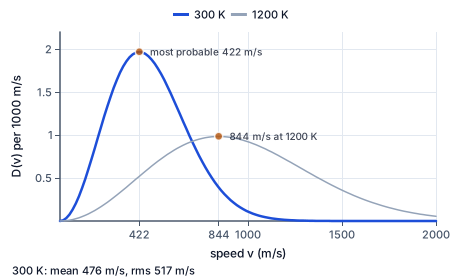
For nitrogen at $300$ K they are $422$, $476$ and $517$ m/s. Written with $v_p = v_{\text{mp}}$, the distribution takes a form that shows its universal shape:
$$D(v) = \frac{4}{\sqrt{\pi}}\frac{v^2}{v_p^3}e^{-(v/v_p)^2}.$$
The chart draws that form for nitrogen at $300$ K and at $1200$ K. Find the peak of the $300$ K curve at $422$ m/s; the mean, $476$ m/s, and the rms speed, $517$ m/s, noted on the chart, lie just to its right, because the long tail drags both averages past the peak. Quadrupling the temperature doubles every speed, so the $1200$ K peak sits at $844$ m/s, and halves the height, because each curve still encloses an area of one.
Another way: picture
Picture every molecule's velocity as a dot in velocity space. The dots crowd densely near the origin, thinning out as a Gaussian cloud. Now count the dots in thin spherical shells around the origin: the innermost shells are dense but tiny, the outer shells are large but sparse, and somewhere in between is the shell holding the most dots. Its radius is the most probable speed.
Another way: steps
The peak is where the derivative vanishes. Dropping the constant prefactor,
$$\frac{d}{dv}\left(v^2e^{-mv^2/2kT}\right) = 2ve^{-mv^2/2kT} - v^2\cdot\frac{mv}{kT}e^{-mv^2/2kT} = 0.$$
Dividing by $ve^{-mv^2/2kT}$, which is not zero for $v > 0$, leaves $2 - mv^2/kT = 0$, so $v_{\text{mp}} = \sqrt{2kT/m}$. The mean and rms speeds need the integrals
$$\int_0^\infty v^3e^{-av^2}\,dv = \frac{1}{2a^2}, \qquad \int_0^\infty v^4e^{-av^2}\,dv = \frac{3}{8a^2}\sqrt{\frac{\pi}{a}},$$
with $a = m/2kT$, which give $\bar{v} = \sqrt{8kT/\pi m}$ and $\overline{v^2} = 3kT/m$. The last is the equipartition result $\tfrac{1}{2}m\overline{v^2} = \tfrac{3}{2}kT$, recovered from the distribution — a useful check that the prefactor is right.
Checks. The three speeds are always in the order most probable, mean, rms, with ratios $1 : 1.128 : 1.225$. Doubling the absolute temperature multiplies every speed by $\sqrt{2}$; a gas four times heavier moves half as fast. The speeds of common gases at room temperature are a few hundred meters per second, comparable with the speed of sound, which is carried by exactly these molecules.
The Maxwell distribution was derived in 1860 but measured directly only in the twentieth century. In the classic experiment, a beam of atoms escapes an oven through a slit and meets a pair of slotted disks spinning on one axle, the second slot offset from the first by a small angle. Only atoms whose travel time between the disks matches the time the disks take to turn through that angle get through. Changing the rotation speed selects different atomic speeds, and counting the atoms that arrive traces the distribution.
Miller and Kusch's 1955 measurements with potassium and thallium beams at Columbia University matched the Maxwell curve to within their accuracy — with one wrinkle worth noticing. Atoms escaping a hole are weighted by their speed, since fast atoms reach the hole more often, so a beam's distribution is $v^3e^{-mv^2/2kT}$, not $v^2e^{-mv^2/2kT}$. The same speed weighting is why effusion separates isotopes: the lighter molecules, moving faster, hit the pores more often.
Behind the speed distribution sits a simpler one. Each velocity component, say $v_x$, has kinetic energy $\tfrac{1}{2}mv_x^2$, so by the Boltzmann factor its distribution is a Gaussian centered on zero:
$$D(v_x) = \sqrt{\frac{m}{2\pi kT}}\,e^{-mv_x^2/2kT}.$$
Its spread is $\sigma = \sqrt{kT/m}$, and positive and negative values are equally likely, so the average $v_x$ is zero: molecules move left as often as right. The three components are independent, and the probability of a whole velocity vector is the product of three such Gaussians, $e^{-m(v_x^2 + v_y^2 + v_z^2)/2kT} = e^{-mv^2/2kT}$. Gathering all the vectors with the same speed onto a spherical shell of area $4\pi v^2$ turns that product into the Maxwell speed distribution.
The one-component distribution is what a spectrometer sees. Atoms moving toward it emit light slightly blue-shifted by the Doppler effect, those moving away slightly red-shifted, in proportion to $v_x$. A spectral line from a hot gas is therefore broadened into a Gaussian whose width measures $\sqrt{kT/m}$, and astronomers read the temperatures of stellar atmospheres and interstellar gas from the Doppler widths of their lines. For hydrogen in the Sun's atmosphere at about $6000$ K, the spread of line-of-sight speeds is about $7$ km/s, broadening each line by roughly a part in forty thousand.
Written in terms of $v/v_p$, the Maxwell distribution has exactly the same shape for every gas at every temperature: only the scale of the speed axis changes, stretching as $\sqrt{T/m}$. A graph of helium at $1000$ K and one of xenon at $100$ K are the same curve with different numbers under the axis. That universality is why a single table of the fraction of molecules faster than a given multiple of $v_p$ serves every gas, and why the fast tail that drives evaporation, reactions and planetary escape can be computed once and used everywhere. It also shows what the distribution does not depend on: not the pressure, not the density, not how often the molecules collide, only on the temperature and the molecular mass.
Natural uranium is only $0.72$ percent uranium-235, the isotope that sustains a chain reaction; power reactors need about $3$ to $5$ percent. Chemically the two isotopes are identical, so they are separated by the one thing that differs, their mass, as the gas uranium hexafluoride.
The Maxwell distribution sets the size of the effect. At one temperature, speeds go as $1/\sqrt{m}$. The two hexafluorides have molar masses of $349.03$ and $352.04$ g/mol, so the lighter moves faster by $\sqrt{352.04/349.03} = 1.0043$. Pushing the gas through a porous barrier, the lighter molecules pass slightly more often, and each stage enriches the gas by at most that factor.
A factor of $1.0043$ per stage is tiny. Raising $0.72$ percent to $4$ percent needed on the order of a thousand stages in series, which is why the gaseous diffusion plants at Oak Ridge, Tennessee, and Paducah, Kentucky, were among the largest industrial buildings ever built, and among the largest consumers of electricity in the country. They have since been replaced by gas centrifuges, which exploit the same mass difference far more efficiently.
A water molecule escapes from a puddle only if it reaches the surface with enough energy to break free of its neighbors, about $0.44$ eV at room temperature. The average kinetic energy is only about $0.04$ eV, so only the fast tail of the distribution can escape, and the fraction in that tail goes roughly as a Boltzmann factor, $e^{-0.44\ \text{eV}/kT}$.
That makes evaporation extremely sensitive to temperature. Going from $20$ °C ($293$ K) to $35$ °C ($308$ K) changes the factor by $e^{(0.44/8.617 \times 10^{-5})(1/293 - 1/308)} = e^{0.85} \approx 2.3$. The vapor pressure of water, which measures the same effect, rises from $2.3$ kPa to $5.6$ kPa over that range, a factor of $2.4$. On a hot summer afternoon a puddle evaporates more than twice as fast as on a mild day, before wind or sunshine are even considered.
Because the fastest molecules leave, the ones left behind have less energy on average, and the water cools. That is evaporative cooling, the same physics as sweating, and it is the Maxwell tail doing the work.
The Boltzmann factor $e^{-mv^2/2kT}$ is largest at zero speed, so it seems natural that a molecule is most likely to be at rest. The factor is the probability of one particular velocity. There is exactly one velocity with zero speed, but a whole sphere of velocities — every direction — with speed $v$, and the number grows as $v^2$. The competition between the growing sphere and the falling exponential puts the peak at $\sqrt{2kT/m}$, not at zero. In one dimension, with no sphere to grow, the most probable velocity component really is zero.
A second confusion is to treat the rms speed as the typical speed of every molecule. The distribution is broad: at room temperature a good fraction of nitrogen molecules move slower than $300$ m/s and a good fraction faster than $700$ m/s, and its long tail reaches several times the peak. Many phenomena, from evaporation to reaction rates, depend on that tail rather than on any average.
Find the most probable speed of nitrogen at $300$ K.
$v_{\text{mp}} = \sqrt{\dfrac{2RT}{M}} = \sqrt{\dfrac{2 \times 8.31 \times 300}{0.028}}$
Molar form, with $M$ in kg/mol.
Evaluate the expression.
$v_{\text{mp}} = \sqrt{1.781 \times 10^{5}} = 422\ \text{m/s}$
The peak of the distribution.
Find the mean speed.
$\bar{v} = 1.1284 \times 422 = 476\ \text{m/s}$
$2/\sqrt{\pi} = 1.1284$.
Find the rms speed.
$v_{\text{rms}} = 1.2247 \times 422 = 517\ \text{m/s}$
$\sqrt{3/2} = 1.2247$.
Check the rms speed from equipartition.
$\sqrt{\dfrac{3RT}{M}} = \sqrt{\dfrac{3 \times 8.31 \times 300}{0.028}} = 517\ \text{m/s}$
The distribution reproduces $\tfrac{3}{2}kT$ of kinetic energy on average.
Write the part of $D(v)$ that depends on $v$.
$f(v) = v^2e^{-mv^2/2kT}$
The constant prefactor does not move the peak.
Differentiate with the product rule.
$f'(v) = 2ve^{-mv^2/2kT} + v^2 \cdot \left(-\dfrac{mv}{kT}\right)e^{-mv^2/2kT}$
The derivative of the exponent $-mv^2/2kT$ is $-mv/kT$.
Factor out the common terms.
$f'(v) = ve^{-mv^2/2kT}\left(2 - \dfrac{mv^2}{kT}\right)$
Both terms share $ve^{-mv^2/2kT}$.
Set the derivative to zero.
$2 - \dfrac{mv^2}{kT} = 0$
The first factor is positive for $v > 0$.
Solve for the speed.
$v_{\text{mp}} = \sqrt{\dfrac{2kT}{m}}$
Multiply by $kT/m$ and take the root.
Confirm it is a maximum.
$v < v_{\text{mp}}: f' > 0; \qquad v > v_{\text{mp}}: f' < 0$
The bracket changes from positive to negative, so the curve rises then falls.
Write the distribution in terms of the most probable speed.
$D(v) = \dfrac{4}{\sqrt{\pi}}\dfrac{v^2}{v_p^3}e^{-(v/v_p)^2}$
Substituting $m/2kT = 1/v_p^2$.
Find the ratio for $v = 400$ m/s with $v_p = 422$ m/s.
$\dfrac{v}{v_p} = \dfrac{400}{422} = 0.948$
The shape depends only on this ratio.
Square the ratio.
$\left(\dfrac{v}{v_p}\right)^2 = 0.8985$
Needed both in front and in the exponent.
Evaluate the exponential.
$e^{-0.8985} = 0.4072$
The Boltzmann factor for this speed.
Assemble the density.
$D = \dfrac{4}{\sqrt{\pi}} \times \dfrac{0.8985}{422} \times 0.4072 = 2.257 \times 2.129 \times 10^{-3} \times 0.4072 = 1.96 \times 10^{-3}\ \text{per m/s}$
The units of $D$ are inverse speed.
Multiply by a $10$ m/s window.
$\text{fraction} \approx 1.96 \times 10^{-3} \times 10 = 0.0196$
About two percent of the molecules move between $395$ and $405$ m/s.
Compare with a window around $800$ m/s.
$\dfrac{v}{v_p} = 1.896: \quad D\,\Delta v = 2.257 \times \dfrac{3.594}{422} \times e^{-3.594} \times 10 = 0.0053$
Nearly four times fewer, though $800$ m/s is less than twice the peak.
Say why the tail matters.
$\text{a few percent faster than } 2v_p$
Those fast molecules drive evaporation, chemical reactions with high barriers and the escape of gases from planets.
Write the formula in molar form.
$v_{\text{mp}} = \sqrt{\dfrac{2RT}{M}}$
With $M = 0.004$ kg/mol.
Substitute the values.
$v_{\text{mp}} = \sqrt{\dfrac{2 \times 8.31 \times 300}{0.004}} = \sqrt{1.2465 \times 10^{6}}$
Joules per kilogram.
Take the root.
For a gas at $600$ K, how do the most probable speed, the mean speed and the rms speed compare?
Complete the worked solution: a gas of molar mass $0.04$ kg/mol is at $300$ K. Find the squares of its most probable and rms speeds. Use $R = 8.31$ J/(mol K).
Multiply $2R$ by the temperature.
$2RT = 2 \times 8.31 \times 300 =$ a J/mol
Twice the gas constant times the absolute temperature.
Divide by the molar mass.
$v_{\text{mp}}^2 = \dfrac{2RT}{M} =$ b m²/s²
The square of the most probable speed.
Multiply by three halves for the rms speed.
$v_{\text{rms}}^2 = \tfrac{3}{2}v_{\text{mp}}^2 =$ c m²/s²
$3kT/m$ is three halves of $2kT/m$.
For a gas of molecules of mass $m$ at $389$ K, match each quantity to its expression.
| $\sqrt{2kT/m}$ | $\sqrt{8kT/\pi m}$ | $\sqrt{3kT/m}$ | doubles it | |
|---|---|---|---|---|
| the most probable speed | ||||
| the mean speed | ||||
| the rms speed | ||||
| what quadrupling $T$ does to every speed |
At $1200$ K the most probable speeds are given. Fill in each gas's mean and rms speeds in m/s, to the nearest $0.1$ m/s.
| most probable (m/s) | mean (m/s) | rms (m/s) | |
|---|---|---|---|
| nitrogen | 844 | ||
| oxygen | 789.5 | ||
| helium | 2232.9 |
What is the most probable speed of nitrogen molecules (molar mass $28$ g/mol) at $1200$ K, in m/s? Use $R = 8.31$ J/(mol K).
Answer: m/s
In nitrogen at $300$ K the most probable speed is $422$ m/s. What fraction of the molecules have speeds within a window of $10$ m/s around $400$ m/s?
Answer:
Isotopes can be separated because lighter molecules move faster and leak through tiny pores more often. At one temperature, by what factor is the mean speed of helium-3 (molar mass $3.016$ g/mol) larger than that of helium-4 ($4.0026$ g/mol)? Give it to four decimal places.
Answer:
Lesson test: one question per skill, one attempt each, no hints. Your answers are checked when you submit.
At $1200$ K the most probable speeds are given. Fill in each gas's mean and rms speeds in m/s, to the nearest $0.1$ m/s.
| most probable (m/s) | mean (m/s) | rms (m/s) | |
|---|---|---|---|
| nitrogen | 844 | ||
| oxygen | 789.5 | ||
| helium | 2232.9 |
You can describe and use the distribution of molecular speeds in a gas. Explain to someone why the most probable speed is not zero even though the Boltzmann factor is largest there.
16. Your turn: find the most probable speed of helium atoms at $300$ K., step 3
$v_{\text{mp}} \approx 1117\ \text{m/s}$
Seven times lighter than nitrogen, $\sqrt{7}$ times faster.