Back to the on-screen lesson ·
The exclusion principle gives degeneracy pressure, independent of temperature, which holds up Earth-sized white dwarfs with R ~ M^(-1/3) up to the Chandrasekhar mass of about 1.44 suns; beyond it, neutron degeneracy holds up 12-km neutron stars.
Paper packet. Every task here also exists on screen, where it is checked automatically; answers written on paper are not assessed by Nydus. When you are back at a device, enter your answers there.
By the end of this lesson you will be able to use electron and neutron degeneracy pressure to explain white dwarfs, the Chandrasekhar limit and neutron stars.
You know that a Sun-like star leaves a white dwarf of about half a solar mass, that the most massive stars build iron cores, and that a polytrope of index 1.5 or 3 links pressure to density. From physics you know the Pauli exclusion principle and that a particle's momentum and position cannot both be pinned down. This lesson uses that quantum physics to explain the dead remnants of stars and the largest mass a white dwarf can have.
| Term | What it means |
|---|---|
| Exclusion principle | No two electrons, or two neutrons, can occupy the same quantum state. |
| Degeneracy pressure | Pressure from particles forced into high-momentum states by the exclusion principle, independent of temperature. |
| White dwarf | The degenerate carbon-oxygen core of a low-mass star, about the size of Earth. |
| Chandrasekhar mass | The largest mass electron degeneracy can support, about 1.44 suns for carbon and oxygen. |
| Neutron star | A collapsed stellar core about 12 km across, made mostly of neutrons at nuclear density. |
| Gravitational redshift | The stretching of light as it climbs out of a strong gravitational field. |
Squeeze electrons into a small volume and the exclusion principle forces most of them into high-momentum states. Their motion exerts degeneracy pressure, which for slow electrons is
$$P \propto \left(\frac{\rho}{\mu_e}\right)^{5/3},$$
independent of temperature. A white dwarf supported this way has $R \propto M^{-1/3}$: about Earth's size at $0.6$ suns. When the electrons become relativistic, $P \propto \rho^{4/3}$, and no white dwarf can exceed the Chandrasekhar mass,
$$M_{\text{Ch}} = \frac{5.83}{\mu_e^2}\,M_\odot \approx 1.44\,M_\odot.$$
Heavier cores collapse to neutron stars about $12$ km across.
Another way: picture
Picture a parking garage where every space can take only one car and every car must park. Shrink the garage and the low, convenient levels fill at once; the rest of the cars are forced up to the high levels, however much fuel it costs. Electrons in a white dwarf are the cars and momentum is the height: squeezing them forces them into high-momentum states, and that motion is a pressure nothing can relieve by cooling.
Another way: steps
A star supports itself with the pressure of hot gas, and it stays hot by fusion. A dead core has no fusion. By the virial theorem it contracts and heats as it radiates, and if ordinary gas pressure were all it had, it would keep contracting forever. Something else must stop it, or the core of every star would end as a black hole.
That something was found in quantum mechanics in 1926, by Ralph Fowler, months after the exclusion principle was formulated: the electrons themselves refuse to be squeezed beyond a point.
Electrons obey the exclusion principle: no two can share a quantum state. Confining electrons to a small volume limits the states available at low momentum, because by the uncertainty principle a small space means large momenta. So in dense matter the electrons fill every state from zero momentum up to a Fermi momentum,
$$p_F = \hbar\,(3\pi^2 n_e)^{1/3},$$
which grows with the electron density $n_e$. The gas is degenerate when this momentum is much larger than the thermal momentum: then temperature hardly matters, because the electrons are already in the lowest states the exclusion principle allows.
Electrons with momenta up to $p_F$ carry momentum across any surface and so exert pressure. For electrons much slower than light the result is
$$P = \frac{(3\pi^2)^{2/3}\hbar^2}{5 m_e}\,n_e^{5/3}, \qquad n_e = \frac{\rho}{\mu_e m_H},$$
where $\mu_e$ is the number of nucleons per electron, $2$ for helium, carbon and oxygen. Two features matter. Temperature does not appear, so a white dwarf can cool without losing support. And the pressure depends on the electron mass, not the nucleon mass: electrons, being light, are the ones forced to high speeds, while the nucleons supply the weight. This is the pressure of a polytrope of index $1.5$.
Balancing degeneracy pressure against gravity with the scaling $P_c \sim GM^2/R^4$ and $\rho \sim M/R^3$ gives $M^{5/3}/R^5 \propto M^2/R^4$, so
$$R \propto M^{-1/3}.$$
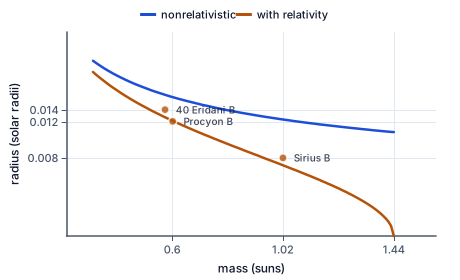
Heavier white dwarfs are smaller: adding mass squeezes the electrons harder. A typical white dwarf of $0.6$ suns has a radius of about $8{,}700$ km, a little larger than Earth, and a mean density near $4 \times 10^{8}$ kg/m$^3$: a teaspoon of it would weigh about two tonnes. Sirius B packs $1.02$ suns into $0.0084$ solar radii, about $5{,}800$ km.
As mass is added and the white dwarf shrinks, the electrons' Fermi momentum rises until they move near the speed of light. Then their pressure grows only as $n_e^{4/3}$, the stiffness of a polytrope of index $3$, which allows one mass only. In 1930, aged nineteen and on a ship from India to England, Subrahmanyan Chandrasekhar worked out the consequence: there is a maximum mass,
$$M_{\text{Ch}} = \frac{5.83}{\mu_e^2}\,M_\odot,$$
about $1.46$ suns for $\mu_e = 2$, usually quoted as $1.44$ once corrections are included. Above it, compression makes gravity grow faster than the pressure, and no white dwarf can exist. Chandrasekhar shared the 1983 Nobel Prize in Physics.
When a massive star's iron core grows past the Chandrasekhar mass, it collapses. Electrons are squeezed into protons, $p + e^- \to n + \nu_e$, and in less than a second the core falls to nuclear density, about $2 \times 10^{17}$ kg/m$^3$. Now neutrons, also obeying the exclusion principle, become degenerate, and together with the repulsive core of the nuclear force they halt the collapse: a neutron star of about $1.4$ suns and $12$ km radius.
Neutron stars too have a maximum mass, above about two suns, set by nuclear physics that is not yet fully known. The heaviest measured, PSR J0740+6620, is about $2.08$ suns, which already rules out some proposed forms of nuclear matter.
A new white dwarf is extremely hot, over $100{,}000$ K at its surface, and it has nothing to do but radiate the heat stored in its nuclei. Its degenerate interior conducts heat almost perfectly, so the whole star cools together, slowly at first through neutrinos and then by surface radiation, fading over billions of years.
As the interior cools, the carbon and oxygen nuclei lock into a crystal lattice, releasing latent heat that slows the fading. In 2019, astronomers using Gaia data found a pile-up of white dwarfs at exactly the brightness where crystallization was predicted, the first direct evidence that the cores of dead stars freeze solid. Because their cooling is well understood, the faintest white dwarfs in a population are clocks for its age.
Light leaving a compact object loses energy climbing out of its gravity, so its wavelength stretches by $z \approx GM/(Rc^2)$ when the field is weak. The shift looks like a recession velocity of $cz$. For a white dwarf it is tens of kilometers per second; for Sirius B the prediction is about $77$ km/s, and the Hubble Space Telescope measured about $80 \pm 5$ km/s. For a neutron star, $GM/Rc^2$ is about $0.2$, and the exact general-relativistic formula is needed. Gravitational redshifts test both general relativity and the mass-radius relation of degenerate stars.
The figure plots white dwarf radius against mass. The nonrelativistic curve, radius as mass to the minus one third, falls slowly and never reaches zero. The realistic curve, which allows the fastest electrons to approach light speed, bends down and reaches zero radius at $1.44$ suns, the Chandrasekhar mass. The two agree for light white dwarfs and part ways above about $0.8$ suns. Procyon B and 40 Eridani B, near $0.6$ suns, and Sirius B, at $1.02$, lie close to the realistic curve.
A white dwarf must get smaller as its mass rises, and must be roughly Earth-sized, thousands of kilometers, not hundreds or millions. Its mean density should be around $10^{8}$ to $10^{10}$ kg/m$^3$, and a neutron star's around $10^{17}$. A Chandrasekhar mass must fall as $\mu_e$ rises, and must be about $1.4$ suns for carbon and oxygen. A white dwarf's gravitational redshift should be tens of km/s; thousands means the radius was taken in kilometers where meters were needed.
In 1844 Friedrich Bessel noticed that Sirius, the brightest star in the night sky, weaves back and forth as it moves, as if orbited by an unseen companion. In 1862 Alvan Graham Clark, testing a new $18.5$-inch telescope lens at his family's workshop in Cambridgeport, Massachusetts, saw it: a faint point beside Sirius, now called Sirius B or the Pup.
Its orbit showed it has about the Sun's mass, yet it is ten thousand times fainter than Sirius. In 1915 Walter Adams at Mount Wilson found its spectrum showed a hot surface, so it had to be tiny: about the size of Earth. Its density seemed absurd until degeneracy pressure explained it in 1926. Hubble's measurement of its gravitational redshift in 2005 confirmed its mass and radius together.
The Neutron star Interior Composition Explorer, NICER, an X-ray telescope mounted on the International Space Station since 2017, times the X-rays from hot spots on rotating neutron stars to within a hundred nanoseconds. Gravity bends the light from the spots around the star, and the shape of the pulses reveals how strongly, and so the star's mass and radius together.
For the pulsar PSR J0740+6620, about $2.08$ suns, NICER analyses found a radius of about $12$ to $14$ km. That such a heavy neutron star is not smaller rules out the softest proposed equations of state for nuclear matter, the same kind of question the Chandrasekhar mass answered for electrons, now asked of neutrons at densities no laboratory can reach.
Every star we have met so far is held up by hot gas, so it is natural to expect a cooling white dwarf to shrink. But a white dwarf's support comes from the exclusion principle, which forces electrons into high-momentum states whatever the temperature. As it radiates away its heat over billions of years, it stays the same size and simply fades, from white to red and eventually, in far more time than the universe has existed, to a cold, dark black dwarf.
A second slip is thinking a heavier white dwarf is bigger, as heavier main-sequence stars are. More mass squeezes the degenerate electrons harder, so heavier white dwarfs are smaller.
Carbon-12 has 6 protons and 6 neutrons. Count the nucleons per electron.
$\mu_e = 12 \div 6 = 2$
One electron per proton.
Write the limit.
$M_{\text{Ch}} = \dfrac{5.83}{\mu_e^2}\,M_\odot$
From the index-3 polytrope.
Square the nucleons per electron.
$\mu_e^2 = 4$
Two squared.
Divide 5.83 by it.
$M_{\text{Ch}} = 5.83 \div 4 = 1.46\ M_\odot$
Before small corrections.
Compare with the heaviest known white dwarfs.
$\text{about } 1.3\ M_\odot \text{ observed}$
None exceeds the limit.
A white dwarf grows from $0.6$ to $1.2$ suns. Write the radius scaling.
$R \propto M^{-1/3}$
Nonrelativistic degeneracy.
Raise the mass ratio to the minus one third.
$2^{-1/3} = 0.794$
The radius ratio.
Multiply the old radius.
$8{,}700 \times 0.794 = 6{,}905\ \text{km}$
Smaller.
Write the density scaling.
$\rho \propto \dfrac{M}{R^3} \propto M^2$
Mass over volume.
Square the mass ratio.
$2^2 = 4$
Four times denser.
Note where the scaling fails.
$\text{relativity makes the real star smaller still}$
Near the Chandrasekhar mass the radius falls faster.
A neutron star has $1.4$ suns in a radius of $12$ km. Convert the mass.
$M = 1.4 \times 1.989 \times 10^{30} = 2.785 \times 10^{30}\ \text{kg}$
SI units.
Find its volume.
$V = \tfrac{4}{3}\pi (1.2 \times 10^{4})^3 = 7.24 \times 10^{12}\ \text{m}^3$
A sphere 24 km across.
Divide the mass by the volume.
$\bar\rho = 2.785 \times 10^{30} \div 7.24 \times 10^{12} = 3.8 \times 10^{17}\ \text{kg/m}^3$
Above nuclear density.
Find the surface gravity.
$g = \dfrac{GM}{R^2} = \dfrac{6.674 \times 10^{-11} \times 2.785 \times 10^{30}}{1.44 \times 10^{8}}$
Newtonian estimate.
Evaluate the gravity.
$g = 1.3 \times 10^{12}\ \text{m/s}^2$
A hundred billion times Earth's.
Find the escape speed.
$v = \sqrt{2GM/R} = 1.76 \times 10^{8}\ \text{m/s}$
Nearly six tenths of light speed.
Draw the conclusion.
$\text{relativity is essential}$
Newtonian gravity is only a first guide here.
Write the velocity.
$v = cz$
The redshift times light speed.
Multiply by the speed of light in km/s.
$v = 2.58 \times 10^{-4} \times 299{,}800$
Kilometers per second.
State the result.
A white dwarf has no fusion and slowly cools for billions of years. Why doesn't it shrink as it loses its heat?
Complete the worked solution: a white dwarf's interior is compressed to $64$ times its density. By what factor does its degeneracy pressure rise if its electrons are slow, with pressure going as density to the five thirds, and if they are relativistic, going as density to the four thirds?
Take the cube root of the density factor.
$\sqrt[3]{64} = 4$
Both powers have thirds.
Raise the cube root to the fifth power.
$\text{slow electrons: pressure} \times$ a
Five thirds.
Raise the cube root to the fourth power.
$\text{relativistic electrons: pressure} \times$ b
Four thirds.
Compare the two in words.
$\text{relativistic pressure stiffens less under compression}$
The root of the Chandrasekhar limit.
Match each object to what holds it up against gravity.
| the pressure of hot gas | electron degeneracy pressure | neutron degeneracy pressure and nuclear forces | nothing; no pressure can stop its collapse | |
|---|---|---|---|---|
| the Sun | ||||
| a white dwarf | ||||
| a neutron star | ||||
| a black hole |
For nonrelativistic white dwarfs, $R = 8{,}700\ \text{km} \times (M/0.6)^{-1/3}$ with $M$ in suns. For a white dwarf of $0.3$ suns, fill in its radius in kilometers and its mean density in kg/m$^3$, taking the Sun's mass as $1.989 \times 10^{30}$ kg.
| value | |
|---|---|
| radius (km) | |
| mean density (kg/m^3) |
For nonrelativistic white dwarfs, radius goes as mass to the minus one third. A white dwarf of $0.6$ suns has a radius of $1.4$ Earth radii. Write a white dwarf's volume, in Earth volumes, as a function of its mass $M$ in suns.
Answer:
The Chandrasekhar mass is $M_{\text{Ch}} = 5.83/\mu_e^2$ suns, where $\mu_e$ is the number of nucleons per electron. Find it for a composition with $\mu_e = 1$.
Answer: solar masses
a newly found white dwarf has about $0.80$ solar masses and $0.0105$ solar radii. Light climbing out of its gravity is redshifted by $z \approx GM/(Rc^2)$, which looks like a recession velocity of $cz$. What velocity, in km/s, does its gravitational redshift mimic? Use $G = 6.674 \times 10^{-11}$, $M_\odot = 1.989 \times 10^{30}$ kg, $R_\odot = 6.957 \times 10^{8}$ m and $c = 2.998 \times 10^{8}$ m/s.
Answer: km/s
Lesson test: one question per skill, one attempt each, no hints. Your answers are checked when you submit.
For nonrelativistic white dwarfs, radius goes as mass to the minus one third. A white dwarf of $0.5$ suns has a radius of $1.5$ Earth radii. Write a white dwarf's volume, in Earth volumes, as a function of its mass $M$ in suns.
Answer:
You can explain dead stars. Find the Chandrasekhar mass for carbon and oxygen, and the radius of a 1.2-solar-mass white dwarf if a 0.6-solar-mass one is 8,700 km.
21. Your turn: find the velocity Sirius B's gravitational redshift mimics, with $GM/(Rc^2) = 2.58 \times 10^{-4}$., step 3
$v = 77\ \text{km/s}$
Close to the measured 80.