Back to the on-screen lesson ·
A cloud collapses when its mass exceeds the Jeans mass, about 5 suns at 10 K and 10^4 particles per cubic centimeter, rising as T^(3/2) and falling as n^(-1/2); it falls in about a free-fall time and fragments into stars wrapped in planet-forming disks.
Paper packet. Every task here also exists on screen, where it is checked automatically; answers written on paper are not assessed by Nydus. When you are back at a device, enter your answers there.
By the end of this lesson you will be able to apply the Jeans criterion to decide whether a cloud can collapse, estimate how fast it collapses, and connect collapse to the formation of stars and planets.
You know from the last lesson that molecular clouds are the coldest, densest gas in the galaxy, and from lesson 7 that the virial theorem compares a body's thermal energy with its gravitational energy. You know the ideal gas law and the free-fall time from the Astronomy course. This lesson finds the exact condition for a cloud to collapse, how long collapse takes, and why stars are born in clusters rather than one at a time.
| Term | What it means |
|---|---|
| Jeans mass | The least mass a cloud of given temperature and density needs for gravity to overcome its pressure. |
| Jeans criterion | A cloud collapses if its mass exceeds its Jeans mass. |
| Free-fall time | The time a cloud would take to collapse with no pressure, the square root of 3 pi over 32 G rho. |
| Fragmentation | The breakup of a collapsing cloud into smaller pieces as its Jeans mass falls. |
| Protostar | A young star still gathering mass from its collapsing cloud, before fusion begins. |
| Protoplanetary disk | The rotating disk of gas and dust around a young star, where planets form. |
A cloud collapses if its gravitational energy outweighs its thermal energy. That happens above the Jeans mass,
$$M_J = \left(\frac{5kT}{G\mu m_H}\right)^{3/2}\left(\frac{3}{4\pi\rho}\right)^{1/2} \approx 5\,M_\odot\left(\frac{T}{10\ \text{K}}\right)^{3/2}\left(\frac{n}{10^4\ \text{cm}^{-3}}\right)^{-1/2}.$$
Cold, dense gas collapses most easily. Collapse takes about a free-fall time,
$$t_{\text{ff}} = \sqrt{\frac{3\pi}{32G\rho}},$$
and as the cloud densifies while staying cold, its Jeans mass drops and it fragments, which is why stars form in groups.
Another way: picture
Picture a crowd of people milling around a plaza, each wandering in random directions, with a faint pull toward the center. If the crowd is small and lively, the wandering wins and the crowd stays spread out. If it is large, calm and packed close, the pull wins and everyone drifts together. Temperature is the liveliness, density the packing, and the Jeans mass is the crowd size at which the pull wins.
Another way: steps
A cloud of gas has two competing energies. Gravity, with energy about $-\tfrac{3}{5}GM^2/R$ for a uniform sphere, pulls it together. Thermal motion, with energy $\tfrac{3}{2}NkT$ for $N = M/\mu m_H$ particles, pushes it apart. The virial theorem says a cloud in balance has twice its thermal energy equal to the size of its gravitational energy. If gravity is stronger than that, the cloud cannot stay in balance and must collapse.
Setting $3NkT < \tfrac{3}{5}GM^2/R$ and writing $R$ in terms of the density, $R = (3M/4\pi\rho)^{1/3}$, gives the condition on the mass: the cloud collapses if $M > M_J$.
James Jeans first derived this threshold in 1902, for the formation of stars and nebulae from a uniform gas. In its common form,
$$M_J = \left(\frac{5kT}{G\mu m_H}\right)^{3/2}\left(\frac{3}{4\pi\rho}\right)^{1/2}.$$
For molecular gas, with $\mu = 2.33$ for hydrogen molecules plus helium, at $10$ K and $10{,}000$ particles per cubic centimeter, it comes to about $5$ suns. It scales as $T^{3/2}$, because hotter gas pushes harder, and as $n^{-1/2}$, because denser gas binds more strongly. A diffuse cloud at $80$ K and $50$ per cubic centimeter needs about $1{,}600$ suns to collapse; most such clouds are far lighter and remain stable.
Once pressure loses, the cloud falls in on itself. With no pressure at all, a uniform sphere collapses to a point in the free-fall time,
$$t_{\text{ff}} = \sqrt{\frac{3\pi}{32G\rho}},$$
which depends only on density. A dense core at $10{,}000$ particles per cubic centimeter falls in about $340{,}000$ years; a giant molecular cloud at $100$ per cubic centimeter would take about $3.4$ million years. Real clouds take longer, because magnetic fields and turbulence slow them, and only a few percent of a cloud's gas becomes stars in each free-fall time.
A collapsing cloud radiates its heat away through dust and molecules and stays near $10$ K while its density climbs. At fixed temperature the Jeans mass falls as $n^{-1/2}$, so as the cloud densifies, smaller and smaller pieces become unstable and collapse on their own. A cloud of thousands of suns breaks into many star-sized fragments.
Fragmentation stops when the collapsing gas becomes so dense that it can no longer radiate its heat freely and begins to warm, raising the Jeans mass again. That limit falls near a hundredth of a solar mass, roughly the smallest objects that form like stars. It explains why most stars are born in clusters and associations, and why many have companions.
Fragmentation does not make stars of one size. Counting the masses of newborn stars in clusters gives the initial mass function: in 1955 Edwin Salpeter found that, above about half a solar mass, the number of stars per unit mass falls as about $M^{-2.35}$, so for every star of ten suns there are hundreds of stars like the Sun. Below half a solar mass the function flattens, and it peaks near a few tenths of a sun. Most stars are red dwarfs, but most of the light of a young cluster comes from its few massive stars. Why the function has this shape, and whether it is the same everywhere, remains one of the open questions of star formation.
At the center of a collapsing core, the densest gas eventually becomes opaque, traps its heat, and stops collapsing, forming a hot, dense protostar. Gas keeps raining onto it, and the infall, not fusion, powers its glow. Over a few hundred thousand years the protostar grows; its luminosity comes from the gravitational energy of infall and its own slow contraction, as the virial theorem predicts.
When the core temperature reaches about $10$ million kelvins, hydrogen fusion begins and the star settles onto the main sequence. A Sun-like star takes tens of millions of years to get there; a massive star only tens of thousands.
Every cloud rotates a little, and as it collapses, conserving angular momentum, it spins faster and flattens. Gas that cannot fall straight onto the protostar settles into a rotating protoplanetary disk, often a hundred astronomical units or more across. Dust grains in the disk stick together into pebbles, then planetesimals, then planets, within a few million years, before the young star's radiation clears the remaining gas.
The same angular momentum that makes the disk also drives jets: magnetic fields launch gas along the protostar's poles at hundreds of kilometers per second, carrying angular momentum away so the star can keep growing.
The Jeans mass treats a cloud as a uniform, still, nonmagnetic ball of gas. Real clouds are filamentary, turbulent and threaded by magnetic fields. Turbulence can both support a cloud on large scales and compress gas into dense knots on small ones; magnetic fields resist collapse across their field lines. External pressure, from surrounding hot gas or a nearby supernova, can push a stable cloud over the edge. The Jeans criterion is the first estimate, and the place every more complete theory starts.
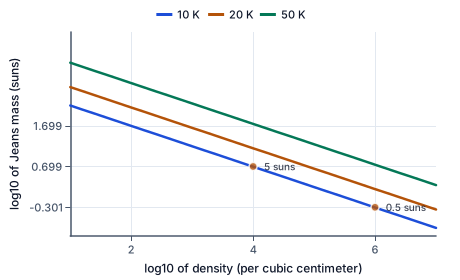
The figure plots the logarithm of the Jeans mass against the logarithm of density for gas at $10$, $20$ and $50$ kelvins. Each line falls by half a power of ten for each power of ten in density, the $n^{-1/2}$ law. At $10$ K, gas at $10{,}000$ particles per cubic centimeter has a Jeans mass of about $5$ suns, and at a million per cubic centimeter about half a sun. Each warmer line sits higher: at $50$ K every Jeans mass is $5^{3/2} \approx 11$ times larger. Star formation lives in the lower right: cold, dense gas.
A Jeans mass must rise with temperature and fall with density; if a denser cloud came out needing more mass, a power has the wrong sign. For cold molecular gas, Jeans masses of a fraction of a sun to tens of suns are typical, while warm diffuse gas needs thousands. A free-fall time should be hundreds of thousands to a few million years for molecular clouds. And a cloud lighter than its Jeans mass cannot collapse on its own, however long you wait, unless something compresses or cools it.
The Orion Nebula, about $1{,}350$ light-years away and visible to the naked eye in Orion's sword, is the nearest large region of massive star formation. It sits at the edge of a giant molecular cloud of about $100{,}000$ suns. Radio maps of the cloud show dense cores with Jeans masses of a few suns, many of them collapsing, and infrared images reveal thousands of young stars in the Orion Nebula Cluster, most less than a few million years old.
The Hubble Space Telescope also found more than a hundred protoplanetary disks there, silhouetted against the bright nebula or glowing as they are evaporated by the hot central stars: the disks of this lesson's last stage, caught in the act, about a hundred to a thousand astronomical units across.
In 2014 the Atacama Large Millimeter Array in Chile, operated with the National Radio Astronomy Observatory in Charlottesville, Virginia, as a partner, imaged the disk around the young star HL Tauri, about $450$ light-years away and less than a million years old. The image showed bright rings separated by dark gaps, most likely carved by planets forming in the disk, sooner than many expected.
Since then ALMA has imaged dozens of such disks, many with rings and spirals. Combined with the Jeans criterion for how cores collapse and the conservation of angular momentum that flattens them into disks, they complete the story of how a cold cloud becomes a star with planets.
Gravity is always attractive, so it seems any cloud should eventually pull itself together. But a cloud below its Jeans mass has more than enough thermal motion to resist: it simply sits in balance, or drifts apart, forever. Most of the gas in the galaxy is far too warm and thin to collapse; only the coldest, densest regions form stars.
A second slip is picturing one cloud forming one star. Collapsing clouds fragment, so stars are born in groups, and a single giant molecular cloud can make thousands of stars.
A core is at $10$ K with $10{,}000$ particles per cubic centimeter and $\mu = 2.33$. Find the mass density.
$\rho = 10^{10} \times 2.33 \times 1.674 \times 10^{-27} = 3.90 \times 10^{-17}\ \text{kg/m}^3$
Ten billion particles per cubic meter.
Evaluate the thermal factor.
$\dfrac{5kT}{G\mu m_H} = \dfrac{5 \times 1.381 \times 10^{-23} \times 10}{6.674 \times 10^{-11} \times 2.33 \times 1.674 \times 10^{-27}} = 2.65 \times 10^{15}$
In SI units.
Raise it to the three halves.
$(2.65 \times 10^{15})^{3/2} = 1.37 \times 10^{23}$
The temperature part.
Evaluate the density factor.
$\left(\dfrac{3}{4\pi \times 3.90 \times 10^{-17}}\right)^{1/2} = 7.82 \times 10^{7}$
The density part.
Multiply and convert to suns.
$1.37 \times 10^{23} \times 7.82 \times 10^{7} \div 1.989 \times 10^{30} = 5.4\ M_\odot$
About 5 suns.
A cloud of $1{,}000$ suns at $10$ K starts at $100$ particles per cubic centimeter. Scale its Jeans mass.
$M_J = 5 \times (100 \div 10{,}000)^{-1/2} = 50\ M_\odot$
Twenty times lighter than the cloud.
Apply the Jeans criterion.
$1{,}000 > 50$
The cloud collapses.
Let it collapse to $10^{4}$ per cubic centimeter at the same temperature.
$M_J = 5\ M_\odot$
Ten times smaller.
Count the pieces that can now collapse separately.
$1{,}000 \div 5 = 200$
Up to two hundred fragments.
Continue to $10^{6}$ per cubic centimeter.
$M_J = 5 \times (100)^{-1/2} = 0.5\ M_\odot$
Star-sized pieces.
Say what stops the process.
$\text{the gas grows opaque and warms}$
The Jeans mass stops falling.
A core is at $12$ K with $20{,}000$ particles per cubic centimeter and holds $8$ suns. Write the scaling.
$M_J = 5\,(T/10)^{3/2}\,(n/10^4)^{-1/2}$
From the reference.
Raise the temperature ratio to the three halves.
$1.2^{3/2} = 1.315$
A little warmer.
Raise the density ratio to the minus one half.
$2^{-1/2} = 0.707$
Twice as dense.
Multiply the three factors together.
$M_J = 5 \times 1.315 \times 0.707 = 4.65\ M_\odot$
The Jeans mass.
Compare with the cloud's mass.
$8 > 4.65$
Gravity wins.
Find the free-fall time.
$0.34 \times 2^{-1/2} = 0.24\ \text{Myr}$
About a quarter of a million years.
Note the caveat.
$\text{a strong magnetic field could still hold it up}$
The Jeans test ignores it.
Write the scaling.
$M_J = 5 \times (10^{6} \div 10^{4})^{-1/2}$
Temperature unchanged.
Evaluate the density factor.
$M_J = 5 \times 100^{-1/2} = 5 \times 0.1$
A hundred times denser.
State the Jeans mass.
Four clouds each hold 10 solar masses. Which is most likely to collapse and form stars?
Complete the worked solution: gas at $10$ K and $10{,}000$ particles per cubic centimeter has a Jeans mass of $5$ suns. Find the Jeans mass of gas at $40$ K whose density is $100$ times as great.
Raise the temperature ratio to the three halves.
$\text{temperature factor} =$ a
Thermal support grows with temperature.
Take the square root of the density factor.
$\sqrt{100} = 10$
Gravity's share.
Multiply 5 suns by the temperature factor and divide by the root.
$M_J =$ m $M_\odot$
The new Jeans mass.
Match each change to a cloud with its effect on the mass needed to collapse.
| raises the Jeans mass through thermal pressure | lowers the Jeans mass by strengthening self-gravity | lowers the Jeans mass by making particles heavier | raises the mass needed by adding non-thermal support | |
|---|---|---|---|---|
| heating the cloud | ||||
| compressing the cloud to a higher density | ||||
| turning atomic hydrogen into molecules | ||||
| threading the cloud with magnetic fields |
Molecular gas at $10$ K and $10{,}000$ particles per cubic centimeter has a Jeans mass of $5$ suns and a free-fall time of $0.34$ million years. For gas at $40$ K and $100000$ particles per cubic centimeter, fill in the Jeans mass and the free-fall time.
| value | |
|---|---|
| Jeans mass (suns) | |
| free-fall time (million years) |
Take the Jeans mass as $M_J = 5\,(T/10)^{3/2}\,(n/10^4)^{-1/2}$ suns, with $T$ in kelvins and $n$ per cubic centimeter. A cloud holds $0.5$ suns. Write the density it must exceed to collapse as a function of its temperature $T$.
Answer:
A molecular cloud has $1000000$ particles per cubic centimeter with mean molecular weight $2.33$. Find its free-fall time $t_{\text{ff}} = \sqrt{3\pi/(32G\rho)}$ in millions of years, with $m_H = 1.674 \times 10^{-27}$ kg, $G = 6.674 \times 10^{-11}$ and a year of $3.156 \times 10^{7}$ s.
Answer: million years
A radio survey finds a massive clump in a giant molecular cloud at $20$ K with $1000$ particles per cubic centimeter and a mass of $2000$ suns. Scaling from a Jeans mass of $5$ suns at $10$ K and $10{,}000$ per cubic centimeter, give its Jeans mass and decide whether it can collapse.
| Jeans mass (suns) | verdict | |
|---|---|---|
| the cloud |
Lesson test: one question per skill, one attempt each, no hints. Your answers are checked when you submit.
Take the Jeans mass as $M_J = 5\,(T/10)^{3/2}\,(n/10^4)^{-1/2}$ suns, with $T$ in kelvins and $n$ per cubic centimeter. A cloud holds $0.5$ suns. Write the density it must exceed to collapse as a function of its temperature $T$.
Answer:
You can decide whether a cloud forms stars. Find the Jeans mass of gas at 10 K and a million particles per cubic centimeter, and whether an 8-sun core at 12 K and 20,000 per cubic centimeter collapses.
21. Your turn: gas at $10$ K has a million particles per cubic centimeter. Find its Jeans mass., step 3
$M_J = 0.5\ M_\odot$
Half a sun.